


Insights
SEO & GEO
Copy Link




Haz que tu marca sea fácil de identificar, citar y verificar para que los motores de respuesta basados en IA la recomienden en sus resultados.
Las herramientas de IA ya influyen en el descubrimiento de marcas: 43% de los consumidores estadounidenses han descubierto una nueva marca a través de la IA, y el 55% utiliza la IA para investigar productos al menos una vez a la semana. Si quiero que mi marca aparezca, debo dejar claras tres cosas: qué es mi marca, a qué consultas respondey por qué la gente debería confiar en ella.
Aquí tienes la versión corta:
Organization, LocalBusiness, Service, y PersonLa idea principal es sencilla: Los sistemas de IA no recomiendan marcas al azar. Buscan páginas y fuentes que sean claras, relevantes y respaldadas por pruebas externas. Si optimizo esas señales, le doy a mi marca más posibilidades de ser mencionada en las respuestas de la IA.
Mi conclusión: si quiero más menciones de IA, debo dejar de pensar solo en el posicionamiento y empezar a hacer que mi marca sea más fácil de identificar, verificar y citar.
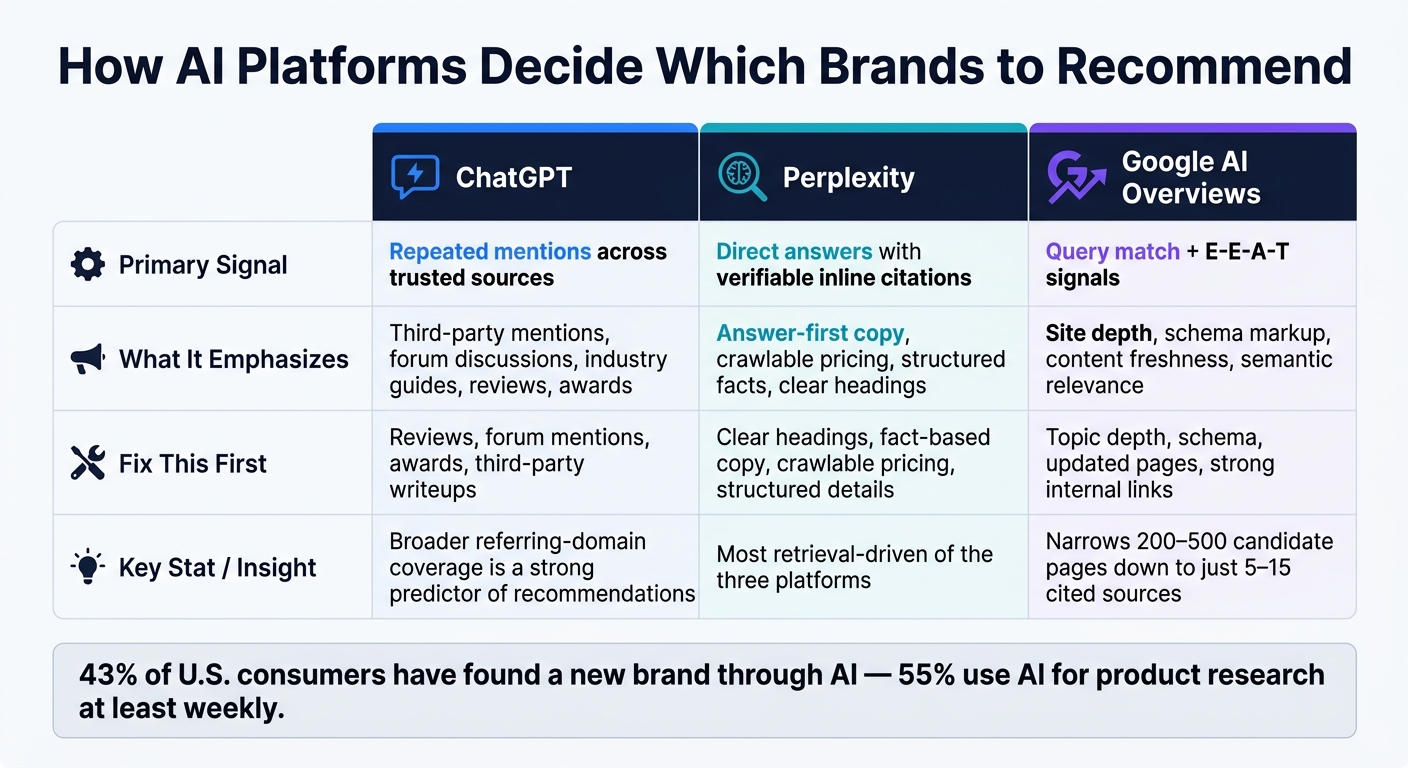
Cómo ChatGPT, Perplexity y Google AI recomiendan marcas
Each AI system pulls sources, checks relevance and trust, and then surfaces the brands it can identify and back most clearly. This section explains how to make your brand easier for AI to recognize, trust, and cite.
Relevance comes down to whether your page answers the user's prompt directly. AI systems use topic matching to find content that fits buyer-intent queries. That means service pages, comparison pages, and FAQ pages often have an edge when they answer those queries head-on, use clear headings, and state fit right away. If the answer is strong but the system can't tell which brand is behind it, visibility can still slip.
Entity clarity is about helping the system understand exactly who you are. Use one brand name across your site, make your About page plain and direct, and add Organization schema. Once that identity is clear, the next filter is outside proof.
Trust comes from proof beyond your own site. Independent mentions and reviews help back up your claims. So do expert roundups, industry mentions, and directory listings that repeat the same brand identity.
These signals don't carry the same weight on every platform.
You can use those differences to decide what to fix first on your site and across your citations. Perplexity is the most retrieval-driven of the three. Google AI Overviews can shrink a pool of 200–500 candidate pages down to just 5–15 cited sources, applying experience, expertise, authority, and trust signals while re-ranking for relevance along the way. And for ChatGPT, broader referring-domain coverage is a strong predictor of recommendations.
AI systems need clear entity signals to understand who you are and when your site fits a query. That starts with a consistent brand identity across your website.
One of the most common mistakes is using slightly different business names, descriptions, or category terms from page to page. To an AI system, that kind of mismatch adds noise.
Choose one canonical version of your business name and use it everywhere: your homepage, About page, service pages, Contact page, author bios, and metadata. Then pair it with a short business description you can repeat across key places. It should say what you do and who you help.
For example, "a Seattle-based website optimization partner for B2B companies" gives AI systems a steady mix of category, location, and audience. Use that same wording in your homepage hero, About page intro, and meta descriptions.
Your Name, Address, and Phone (NAP) details should also match exactly across your site and off-site listings like Google Business Profile and LinkedIn.
Schema markup makes your brand details easier for AI systems to read.
For most businesses, a good starting point is Organization schema. If you serve a specific area, use LocalBusiness instead. Add it to your homepage in JSON-LD format and include your name, url, logo, contactPoint, and sameAs links to verified profiles. That sameAs array helps AI systems connect your website to those profiles.
On service pages, Service schema ties each offer back to your organization entity. Include serviceType, areaServed, and an offers field with a price range in USD.
On blog posts and other content, add Person schema to author bios. Include jobTitle, worksFor, and a sameAs link to a LinkedIn profile. This shows that named experts are behind the content.
One rule matters here: keep your schema in sync with what people can see on the page.
A strong service page should make four things plain: who it's for, what problem it solves, how it works, and what proof backs it up.
For a B2B website optimization service, that means naming your target audience, spelling out the problems you solve, walking readers through your process with realistic timelines, and adding proof like case studies and testimonials with numbers.
Your About page should do some of that work too. Name your founder, explain their background and specializations, and link to off-site references like LinkedIn or conference talks. Named people, a clear focus, and proof give AI systems more reason to connect your brand with the right topic instead of treating it like a vague result.
Once your entity is clear, publish pages that answer buyer questions in a format AI can quote.
Clear entity signals help AI systems understand who you are. Pages that are easy to quote help those systems figure out when your brand makes sense to recommend.
Create one page for each intent - service, industry, use case, or process - and make sure each page answers one query in a direct way. That gives AI systems a clean answer to pull from and a clear brand name to attach to it.
Open each page by answering three core questions: ¿Para quién es esto? ¿Cuándo tiene sentido elegirlo? ¿Qué resultados debería esperar alguien? Úselos como encabezados. Los bloques de respuesta cortos y autónomos son más fáciles de citar con precisión para los sistemas de IA.
Una pequeña elección estructural puede ayudar mucho: una honesta sección de "No es adecuado si…". Si indica dónde su servicio no encaja, los lectores obtienen una imagen más clara y los sistemas de IA también obtienen un mejor contexto.
Las páginas de comparación pueden ayudar a los sistemas de IA a ubicar su marca dentro de su categoría. Pero eso solo funciona cuando la página se construye en torno a criterios de decisión, no a exageraciones.
Una buena página de comparación comienza con un veredicto breve y directo. ¿Para quién es mejor cada opción? ¿Cuál es la diferencia real? Luego, avance a través de criterios concretos como precios en rangos claros en USD, compensaciones de funciones, modelos de soporte y límites que la gente debería conocer. Por ejemplo, use precios como "$49–$199/mes para planes de nivel medio". Añada una breve nota de metodología como "Precios basados en información pública a agosto de 2026" para que la fuente de los datos sea clara.
Evite las afirmaciones vagas. Decir "líder en la industria" sin pruebas no ayuda a nadie. "La mejor opción para empresas del mercado medio en EE. UU. con ingresos anuales entre $5,000,000 y $50,000,000" le da a un sistema de IA algo que realmente puede utilizar.
Los sistemas de IA prefieren el contenido dividido en unidades pequeñas y etiquetadas. Cada unidad debe responder a una pregunta con un formato que se mantenga constante en todas las páginas. Algunos formatos que funcionan bien son:
Los enlaces internos conectan estas piezas. Si su página principal de servicios enlaza a una página de sector, que a su vez enlaza a una página de casos de uso, y esta vuelve a su página de procesos, ayudará a los sistemas de IA a entender cómo se relacionan esas respuestas con la misma marca. Utilice un texto de anclaje descriptivo como "email marketing para marcas de comercio electrónico" en lugar de textos vagos como más información. Ese nivel de detalle adicional ayuda a los sistemas de IA a relacionar sus páginas con las consultas adecuadas y refuerza su posicionamiento en torno a un tema, no solo en una página específica.
Una vez que estas páginas estén listas para responder preguntas directas, refuércelas con menciones externas, reseñas y citas.
Cuando las señales de su sitio web son claras, el siguiente nivel es obtener pruebas externas. Las menciones fuera de su sitio respaldan las señales de confianza que ya ha construido. Cuando el nombre de su marca, su categoría y sus servicios principales aparecen de forma constante en fuentes de terceros de buena reputación, los sistemas adquieren mayor confianza en que usted es un negocio real que merece ser recomendado.
Céntrese en menciones de fuentes que se ajusten a su categoría, audiencia y ubicación. Para una agencia B2B con sede en EE. UU., esto suele significar directorios del sector, publicaciones especializadas, sitios web de socios y páginas de ponentes en conferencias. Para un negocio de servicios local, significa el Perfil de Negocio de Google, sitios de reseñas de su categoría y cobertura en noticias regionales.
Las mejores menciones externas combinan datos estructurados con contexto en lenguaje sencillo. Los datos estructurados incluyen el nombre de su empresa, su ubicación y su categoría. El contexto explica qué hace, a quién ayuda y qué tipo de resultados ofrece. Un perfil de fundador que diga "Jane Smith, fundadora de Acme Analytics, una agencia de atribución de marketing con sede en EE. UU. para marcas de comercio electrónico" proporciona a un sistema de IA tanto los detalles de la entidad como el contexto necesario para asociar su nombre con las búsquedas correctas.
Algunos buenos objetivos incluyen:
Cuando termine un proyecto importante, pida al cliente que destaque su marca en un artículo sobre proveedores o en un resumen del proyecto. Esa mención debe especificar el servicio que prestó y el resultado que ayudó a conseguir. Esto proporciona a los sistemas de IA pruebas sólidas a las que recurrir cuando alguien busque un proveedor en su nicho.
Esas mismas fuentes también crean el rastro de reseñas y citas que los sistemas de IA utilizan para verificar su marca.
"Acme Analytics configuró nuestra implementación de GA4 y redujo las discrepancias en los informes entre canales, ayudando a nuestra tienda de comercio electrónico en EE. UU. a mejorar el ROAS" menciona el servicio, el problema y el resultado. Ese es el tipo de detalle que los sistemas de IA pueden utilizar al decidir qué marcas mostrar.
La actualidad también importa. Los perfiles de reseñas sin actividad reciente en los últimos 12 a 24 meses pueden indicar que el negocio está inactivo. Un flujo constante de reseñas detalladas en periodos de 30 a 90 días indica a los sistemas de IA que su negocio está activo y sigue realizando un buen trabajo. Cuando pida opiniones a sus clientes, guíelos con preguntas abiertas como: "¿Qué servicio utilizó? ¿Qué problema resolvió? ¿Qué cambió como resultado?" Eso les impulsa a dar detalles útiles sin ponerles palabras en la boca.
Mantenga el nombre, la dirección, el número de teléfono y las descripciones de los servicios de su empresa exactamente iguales en todas las plataformas. Si esos detalles varían, una entidad clara empieza a parecer varias señales débiles. Es útil mantener una hoja de datos comerciales canónicos y revisarla cada trimestre.
Con estas señales externas en su lugar, compruebe si las herramientas de IA las están mostrando realmente.
Una vez que tu sitio y tus citas estén listos, comprueba si la IA puede encontrarlos, mencionarlos y utilizarlos .
Empieza probando las recomendaciones de la IA de la misma forma que lo harían tus clientes. Crea una lista constante de 20 a 50 prompts con intención de compra basados en cómo buscan las personas en EE. UU. Esto puede incluir prompts como "mejores plataformas de email marketing B2B para pequeñas empresas en EE. UU.", "herramientas de email marketing asequibles para startups" y "cómo elegir una plataforma de email marketing para una pequeña empresa".
Una división sencilla funciona bien:
Ejecuta el conjunto completo en ChatGPT, Perplexity y Google AI una vez al mes.
Las respuestas de la IA pueden variar de una ejecución a otra, así que no te quedes con una sola prueba. Ejecuta cada prompt de 3 a 10 veces por plataforma en sesiones nuevas. Luego, realiza un seguimiento de:
Log the date, platform, whether your brand was mentioned, whether it was linked, and which URL was cited.
The cited page matters just as much as the mention itself. If a pricing-related prompt pulls up a general blog post instead of your pricing page, that's not just a visibility problem. It's a structure problem on your site, and it's worth fixing.
Use search and citation tools to tell the difference between on-site issues and off-site citation issues.
Google Search Console shows which queries and pages already appear in search. If a high-intent commercial page shows up in search but not in AI answers, look at its heading structure, internal links, and schema markup. That's often where the disconnect shows up.
Perplexity is especially useful because it shows numbered sources in every answer. Run brand-specific prompts like "[Your Brand] features" or "Is [Your Brand] good for small businesses?" Then look closely at the URLs it cites. If it keeps pulling older blog posts instead of core service pages, those pages likely need clearer topical focus and better structure.
Semrush and Ahrefs help from a different angle. They show where your topic is being covered, where your brand is missing, and where your site may be thin compared with others in your space.
Use what these tests show you to fix the pages and mentions AI skips most often. Build one clear signal set, test it every month, and fix the weakest pages first.
AI tends to reward brands it can identify, verify, and cite. The more clearly you send those signals, the more often your brand can show up in answers.
There’s no set timeline for showing up in AI recommendations. Citations and recommendations usually don’t happen overnight. In many cases, you’ll spot early signals first, then see stronger visibility build over time. Updating key pages within the past six months can help your odds.
For the best shot, publish crawlable, answer-first pages that make life easy for both systems and readers. That usually means:
It’s a simple idea: if your page gives a direct answer fast, backs it up, and stays easy to parse, it’s more likely to get picked up.
Start with pages that already rank and can serve as direct, answer-first sources.
That usually means your:
Put the answer in the first 60 to 100 words. Use question-led H2 and H3 headings, add relevant schema, and make sure facts are verifiable in crawlable HTML.
If AI points to the wrong page, your site structure may be too loose or hard to follow. Check Google Search Console to see which queries bring impressions to that URL. If the page is pulling in off-intent traffic, tighten its focus or break the topic into separate pages.
Rewrite the title, H1, and headings so they match the way people search. Your priority page should answer the target question in the first 40–60 words and use accurate schema markup.
{"@context":"https://schema.org","@type":"FAQPage","mainEntity":[{"@type":"Question","name":"How long does it take to show up in AI recommendations?","acceptedAnswer":{"@type":"Answer","text":"<p>There’s no set timeline for showing up in AI recommendations. Citations and recommendations usually <strong>don’t happen overnight</strong>. In many cases, you’ll spot early signals first, then see stronger visibility build over time. Updating key pages within the past six months can help your odds.</p> <p>For the best shot, publish <strong>crawlable, answer-first pages</strong> that make life easy for both systems and readers. That usually means:</p> <ul> <li>Question-style headings</li> <li>Short <strong>40–60 word</strong> answers</li> <li>Schema</li> <li>Clear, consistent proof signals</li> </ul> <p>It’s a simple idea: if your page gives a direct answer fast, backs it up, and stays easy to parse, it’s more likely to get picked up.</p>"}},{"@type":"Question","name":"Which pages should I optimize first for AI visibility?","acceptedAnswer":{"@type":"Answer","text":"<p>Start with pages that already rank and can serve as direct, answer-first sources.</p> <p>That usually means your:</p> <ul> <li>homepage hero</li> <li>top product or service pages</li> <li>pricing pages with plain <strong>USD</strong> amounts and visible update dates</li> <li>key guides or comparison pages tied to <strong>one specific question</strong></li> </ul> <p>Put the answer in the first <strong>60 to 100 words</strong>. Use question-led <strong>H2</strong> and <strong>H3</strong> headings, add relevant schema, and make sure facts are verifiable in crawlable HTML.</p>"}},{"@type":"Question","name":"What if AI cites the wrong page on my site?","acceptedAnswer":{"@type":"Answer","text":"<p>If AI points to the wrong page, your site structure may be too loose or hard to follow. Check Google Search Console to see which queries bring impressions to that URL. If the page is pulling in off-intent traffic, tighten its focus or break the topic into separate pages.</p> <p>Rewrite the title, H1, and headings so they match the way people search. Your priority page should answer the target question in the first <strong>40–60 words</strong> and use accurate schema markup.</p>"}}]}