



Insights
SEO & GEO
Copy Link




Make your brand easy to identify, cite, and verify so AI answer engines will recommend it in responses.
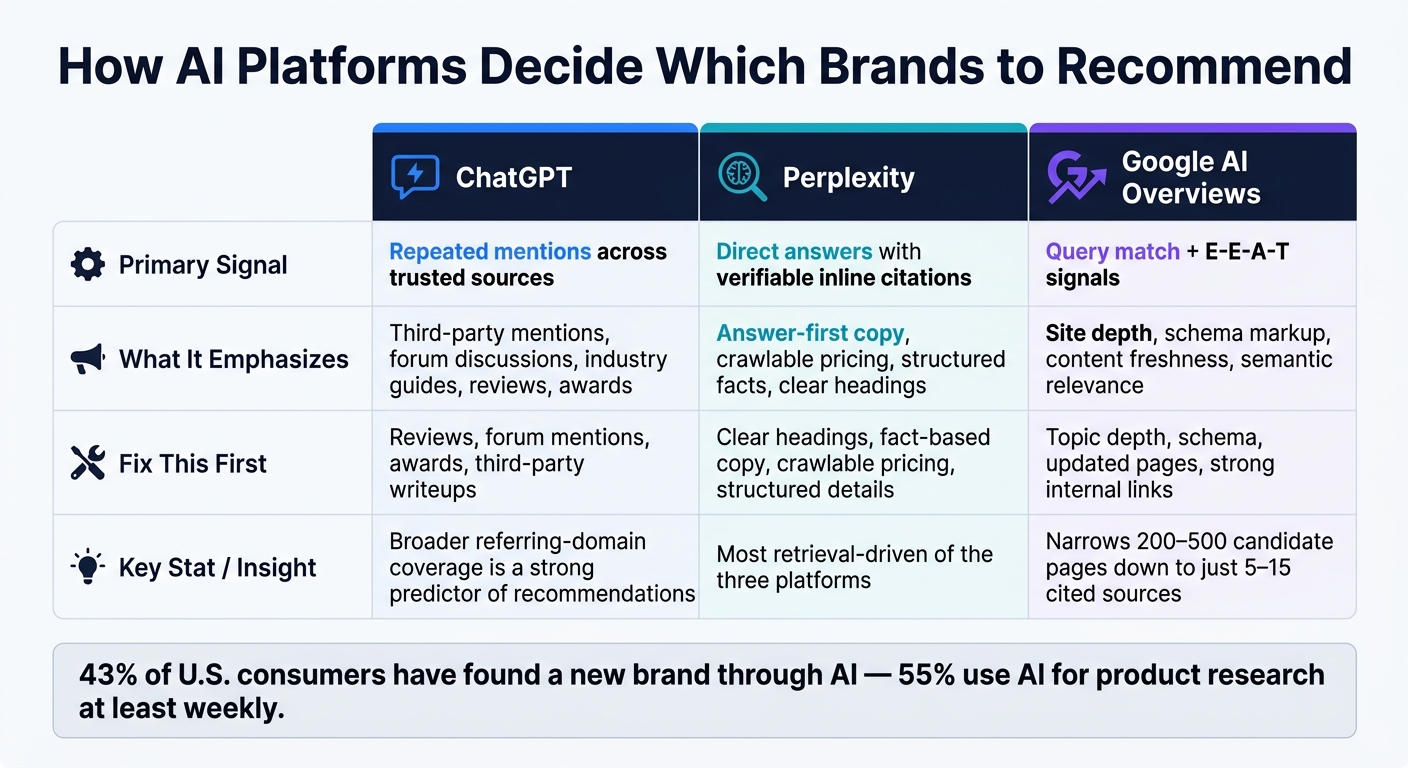
AI tools already influence brand discovery: 43% of U.S. consumers have found a new brand through AI, and 55% use AI for product research at least weekly. If I want my brand to show up, I need to make three things plain: what my brand is, which queries it fits, and why people should trust it.
Here’s the short version:
Organization, LocalBusiness, Service, and PersonThe main idea is simple: AI systems do not recommend brands at random. They look for pages and sources that are clear, relevant, and backed by outside proof. If I tighten those signals, I give my brand a better shot at being named in AI answers.
| Platform | What it tends to look for | What I should improve first |
|---|---|---|
| ChatGPT | Repeated mentions across trusted sites | Reviews, forum mentions, awards, and third-party writeups |
| Perplexity | Direct answers with cited sources | Clear headings, fact-based copy, crawlable pricing, and structured details |
| Google AI | Query match plus E-E-A-T-style signals | Topic depth, schema markup, updated pages, and strong internal links |
My takeaway: if I want more AI mentions, I should stop thinking only about rankings and start making my brand easier to identify, verify, and cite.
How ChatGPT, Perplexity & Google AI Recommend Brands
Each AI system pulls sources, checks relevance and trust, and then surfaces the brands it can identify and back most clearly. This section explains how to make your brand easier for AI to recognize, trust, and cite.
Relevance comes down to whether your page answers the user's prompt directly. AI systems use topic matching to find content that fits buyer-intent queries. That means service pages, comparison pages, and FAQ pages often have an edge when they answer those queries head-on, use clear headings, and state fit right away. If the answer is strong but the system can't tell which brand is behind it, visibility can still slip.
Entity clarity is about helping the system understand exactly who you are. Use one brand name across your site, make your About page plain and direct, and add Organization schema. Once that identity is clear, the next filter is outside proof.
Trust comes from proof beyond your own site. Independent mentions and reviews help back up your claims. So do expert roundups, industry mentions, and directory listings that repeat the same brand identity.
These signals don't carry the same weight on every platform.
| Platform | What it tends to emphasize | Site signals that matter most |
|---|---|---|
| ChatGPT | Repeated mentions across trusted sources | Third-party mentions, forum discussions, industry guides, reviews, and awards |
| Perplexity | Direct answers with verifiable, inline citations | Answer-first copy, crawlable pricing, structured facts, and clear page headings |
| Google AI Overviews | Query match, experience, expertise, authority, and trust signals | Site depth, schema markup, content freshness, and semantic relevance |
You can use those differences to decide what to fix first on your site and across your citations. Perplexity is the most retrieval-driven of the three. Google AI Overviews can shrink a pool of 200–500 candidate pages down to just 5–15 cited sources, applying experience, expertise, authority, and trust signals while re-ranking for relevance along the way. And for ChatGPT, broader referring-domain coverage is a strong predictor of recommendations.
AI systems need clear entity signals to understand who you are and when your site fits a query. That starts with a consistent brand identity across your website.
One of the most common mistakes is using slightly different business names, descriptions, or category terms from page to page. To an AI system, that kind of mismatch adds noise.
Choose one canonical version of your business name and use it everywhere: your homepage, About page, service pages, Contact page, author bios, and metadata. Then pair it with a short business description you can repeat across key places. It should say what you do and who you help.
For example, "a Seattle-based website optimization partner for B2B companies" gives AI systems a steady mix of category, location, and audience. Use that same wording in your homepage hero, About page intro, and meta descriptions.
Your Name, Address, and Phone (NAP) details should also match exactly across your site and off-site listings like Google Business Profile and LinkedIn.
Schema markup makes your brand details easier for AI systems to read.
For most businesses, a good starting point is Organization schema. If you serve a specific area, use LocalBusiness instead. Add it to your homepage in JSON-LD format and include your name, url, logo, contactPoint, and sameAs links to verified profiles. That sameAs array helps AI systems connect your website to those profiles.
On service pages, Service schema ties each offer back to your organization entity. Include serviceType, areaServed, and an offers field with a price range in USD.
On blog posts and other content, add Person schema to author bios. Include jobTitle, worksFor, and a sameAs link to a LinkedIn profile. This shows that named experts are behind the content.
One rule matters here: keep your schema in sync with what people can see on the page.
A strong service page should make four things plain: who it's for, what problem it solves, how it works, and what proof backs it up.
For a B2B website optimization service, that means naming your target audience, spelling out the problems you solve, walking readers through your process with realistic timelines, and adding proof like case studies and testimonials with numbers.
Your About page should do some of that work too. Name your founder, explain their background and specializations, and link to off-site references like LinkedIn or conference talks. Named people, a clear focus, and proof give AI systems more reason to connect your brand with the right topic instead of treating it like a vague result.
| Page Type | Key AI Signal | Recommended Schema |
|---|---|---|
| About Page | Identity - founder name, brand mission, location, core category language | Organization Schema |
| Service Pages | Topical focus - audience, problems solved, process, crawlable pricing, proof | Service Schema |
| Author/Team | Expertise - credentials, published work, topical specialization | Author / Person Markup |
| Contact Page | Local proof - consistent NAP, business hours, map references | LocalBusiness Schema |
Once your entity is clear, publish pages that answer buyer questions in a format AI can quote.
Clear entity signals help AI systems understand who you are. Pages that are easy to quote help those systems figure out when your brand makes sense to recommend.
Create one page for each intent - service, industry, use case, or process - and make sure each page answers one query in a direct way. That gives AI systems a clean answer to pull from and a clear brand name to attach to it.
Open each page by answering three core questions: Who is this for? When does it make sense to choose this? What outcomes should someone expect? Use those as headings. Short, self-contained answer blocks are easier for AI systems to quote with accuracy.
One small structural choice can help a lot: an honest "Not a fit if…" section. If you say where your service does not belong, readers get a clearer picture, and AI systems get better context too.
Comparison pages can help AI systems place your brand within its category. But that only works when the page is built around decision criteria, not hype.
A good comparison page starts with a short, plain verdict. Who is each option best for? What is the actual difference? Then move through concrete criteria like pricing in clear USD ranges, feature trade-offs, support models, and limits people should know about. For example, use pricing like "$49–$199/month for mid-tier plans". Add a brief methodology note such as "Pricing based on public information as of Aug. 2026" so the source of the data is clear.
Skip fuzzy claims. "Industry-leading" without proof doesn't help anyone. "Best fit for mid-market US companies with annual revenue between $5,000,000 and $50,000,000" gives an AI system something it can actually use.
AI systems tend to prefer content split into small, labeled units. Each unit should answer one question in a format that stays consistent from page to page. A few formats work well:
Internal links connect these pieces. If your main service page links to an industry page, which links to a use-case page, which links back to your process page, you help AI systems see how those answers relate to the same brand. Use descriptive anchor text like "email marketing for eCommerce brands" instead of vague text like "learn more." That extra detail helps AI systems match your pages to the right queries and strengthens your position across a topic, not just on one page.
Once these pages are ready to answer direct questions, support them with off-site mentions, reviews, and citations.
Once your site signals are clear, the next layer is proof from outside your site. Off-site mentions back up the trust signals you've already built. When your brand name, category, and main services show up in a steady way across reputable third-party sources, those systems gain more confidence that you're a real business worth recommending.
Focus on mentions from sources that fit your category, audience, and location. For a U.S.-based B2B agency, that usually means industry directories, trade publications, partner websites, and conference speaker pages. For a local service business, it means Google Business Profile, review sites in your category, and regional news coverage.
The best off-site mentions pair structured facts with plain-language context. Structured facts include your business name, location, and category. Context explains what you do, who you help, and what kind of results you deliver. A founder profile that reads "Jane Smith, founder of Acme Analytics, a U.S.-based marketing attribution agency for eCommerce brands" gives an AI system both the entity details and the context it needs to match your name to the right searches.
Good targets include:
When you finish a strong project, ask the client to feature your brand in a vendor spotlight or project recap. That mention should name the service you delivered and the result you helped achieve. This gives AI systems solid proof they can point to when someone asks for a provider in your niche.
Those same sources also build the review and citation trail AI systems use to check your brand.
"Acme Analytics set up our GA4 implementation and reduced reporting discrepancies across channels, helping our U.S. eCommerce store improve ROAS" names the service, the problem, and the outcome. That's the kind of detail AI systems can use when deciding which brands to surface.
Recency matters too. Review profiles with no new activity in the last 12 to 24 months can hint that the business is inactive. A steady flow of detailed reviews across rolling 30- to 90-day windows tells AI systems your business is active and still doing good work. When you ask customers for feedback, guide them with open questions like: "What service did you use? What problem did it solve? What changed as a result?" That pushes them toward useful detail without putting words in their mouth.
Keep your business name, address, phone number, and service descriptions exactly the same across every platform. If those details vary, one clear entity starts to look like several weak signals. It helps to keep one canonical business-details sheet and review it every quarter.
With these external signals in place, test whether AI tools are actually surfacing them.
Once your site and citations are in place, check whether AI can find, mention, and use them.
Start by testing AI recommendations the same way your customers would. Build a steady list of 20 to 50 buyer-intent prompts based on how people in the U.S. search. That can include prompts like "best B2B email marketing platforms for small businesses in the US", "affordable email marketing tools for startups", and "how to choose an email marketing platform for a small business."
A simple split works well:
Run the full set in ChatGPT, Perplexity, and Google AI once a month.
AI answers can shift from one run to the next, so don't stop at a single test. Run each prompt 3 to 10 times per platform in fresh sessions. Then track:
Log the date, platform, whether your brand was mentioned, whether it was linked, and which URL was cited.
The cited page matters just as much as the mention itself. If a pricing-related prompt pulls up a general blog post instead of your pricing page, that's not just a visibility problem. It's a structure problem on your site, and it's worth fixing.
Use search and citation tools to tell the difference between on-site issues and off-site citation issues.
Google Search Console shows which queries and pages already appear in search. If a high-intent commercial page shows up in search but not in AI answers, look at its heading structure, internal links, and schema markup. That's often where the disconnect shows up.
Perplexity is especially useful because it shows numbered sources in every answer. Run brand-specific prompts like "[Your Brand] features" or "Is [Your Brand] good for small businesses?" Then look closely at the URLs it cites. If it keeps pulling older blog posts instead of core service pages, those pages likely need clearer topical focus and better structure.
Semrush and Ahrefs help from a different angle. They show where your topic is being covered, where your brand is missing, and where your site may be thin compared with others in your space.
| Tool | Best Use Case | Gap It Helps Identify |
|---|---|---|
| Google Search Console | Query and page-level visibility | High-intent pages that search engines see but AI systems may not cite |
| Perplexity | Citation and source analysis | Which URLs and third-party sources AI uses to describe your brand |
| Semrush | Topic gap and authority signal analysis | Missing content topics and weak editorial presence in your category |
| Ahrefs | Brand mention and backlink tracking | Review sites and publications that mention your topic but not your brand |
Use what these tests show you to fix the pages and mentions AI skips most often. Build one clear signal set, test it every month, and fix the weakest pages first.
AI tends to reward brands it can identify, verify, and cite. The more clearly you send those signals, the more often your brand can show up in answers.
There’s no set timeline for showing up in AI recommendations. Citations and recommendations usually don’t happen overnight. In many cases, you’ll spot early signals first, then see stronger visibility build over time. Updating key pages within the past six months can help your odds.
For the best shot, publish crawlable, answer-first pages that make life easy for both systems and readers. That usually means:
It’s a simple idea: if your page gives a direct answer fast, backs it up, and stays easy to parse, it’s more likely to get picked up.
Start with pages that already rank and can serve as direct, answer-first sources.
That usually means your:
Put the answer in the first 60 to 100 words. Use question-led H2 and H3 headings, add relevant schema, and make sure facts are verifiable in crawlable HTML.
If AI points to the wrong page, your site structure may be too loose or hard to follow. Check Google Search Console to see which queries bring impressions to that URL. If the page is pulling in off-intent traffic, tighten its focus or break the topic into separate pages.
Rewrite the title, H1, and headings so they match the way people search. Your priority page should answer the target question in the first 40–60 words and use accurate schema markup.