



Insights
SEO & GEO
Copy Link




Why AI favors competitors: make pages quoteable, unify brand signals, add schema, and build third-party proof to get cited.
If AI tools skip your brand, the problem usually comes down to 3 things: your pages are hard to quote, your brand description shifts across the web, or other sites don’t back up your claims.
Here’s the short version: ranking in Google and getting named in AI answers are not the same thing. AI tools tend to favor brands they can read fast, define fast, and check fast. That means your site needs clear answers near the top, your homepage/About/profile language needs to match, and your brand needs support from places like G2, Capterra, Clutch, LinkedIn, or industry write-ups.
If I had to boil the article down to a simple checklist, it would be this:
Organization, WebSite, and Person markup to help AI connect the dotsA plain way to think about it:
| Area | What AI wants | What goes wrong |
|---|---|---|
| Pages | Short, direct answers | Vague copy, hidden text, thin pages |
| Brand | One steady description | Mixed messaging across pages and profiles |
| Proof | Other sources that confirm you | Little presence outside your own site |
So the core idea is simple: AI is more likely to mention brands that are easy to extract, easy to classify, and easy to verify. The rest of the article explains how to fix those 3 gaps on your site and across the web.
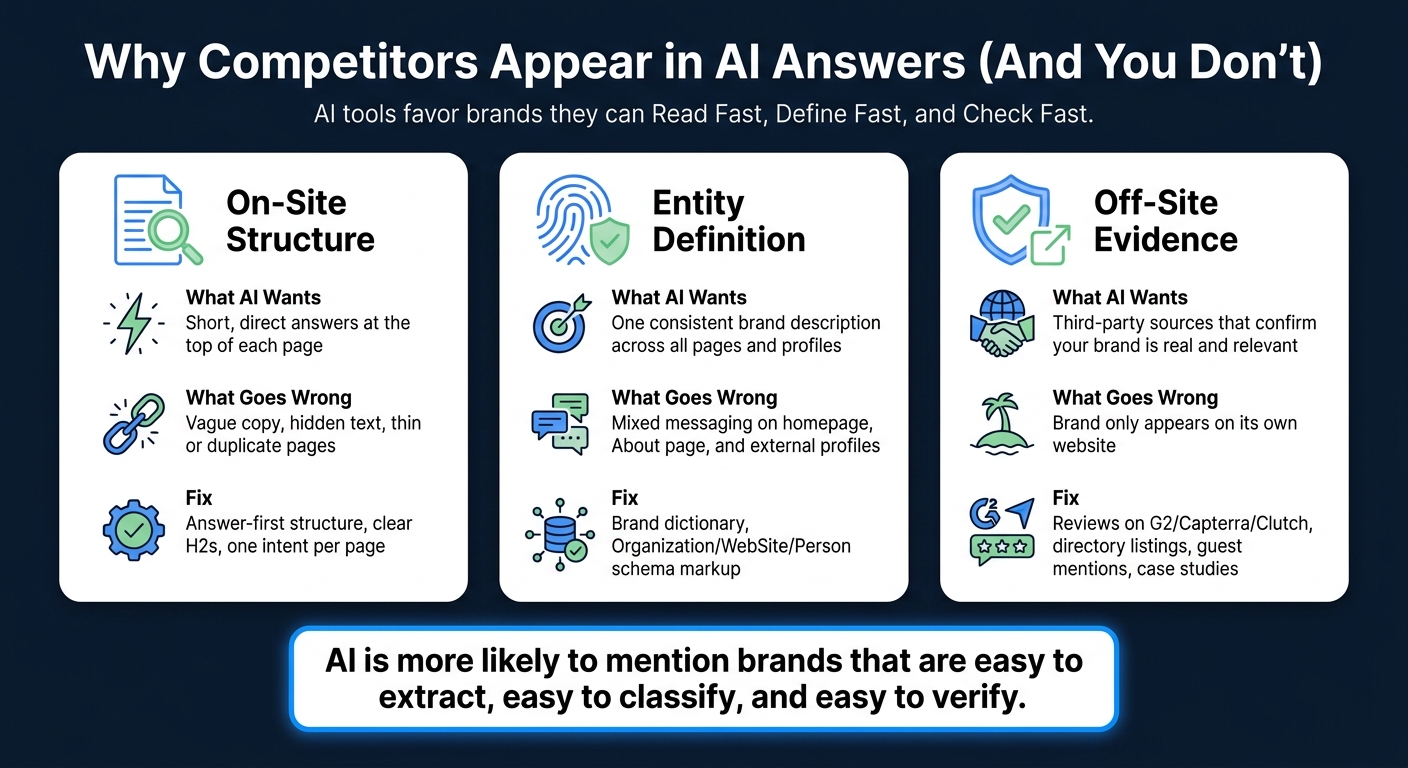
Why Competitors Appear in AI Answers: The 3 Visibility Gaps
Start with these three layers, in this order: site structure, brand definition, then outside proof.
AI tends to favor pages that are easy to crawl and easy to quote. Thin pages or duplicate pages weaken that signal. Brands that show up in AI answers usually make key details simple to find and simple to pull out.
Take a hard look at your main pages. Do they explain what you do in a direct, plainspoken way? If a person has to dig around to figure out what your business does, AI will likely struggle too. And if a page is tough to quote, it’s less likely to become a citation source.
Diagnostic prompt: Can AI extract a useful answer from this page in one scan?
If a page is hard to quote, there’s a good chance your brand message is just as muddy in other places.
Your entity is the brand signal AI uses to identify you. If your name, description, and positioning shift from page to page, you’re sending mixed signals.
Check your homepage, About page, service pages, and external profiles. Do they all describe your brand the same way? The clearer and more consistent that definition is, the easier it is for AI systems to match your brand correctly.
Diagnostic prompt: Do your homepage, About page, and profiles describe the brand the same way?
Once your on-site message lines up, the next step is to see whether outside sources back it up.
AI looks beyond your own site for proof that your brand is real and relevant. Review your off-site presence for mentions, links, reviews, and expert references that point back to your business.
If your company only appears on its own website, that leaves a hole in the proof. Independent mentions give AI more reason to trust your brand and cite it.
Diagnostic prompt: Can outside sources confirm what your site claims?
Take the gaps you just found and use them to tighten the pages AI is most likely to pull from. Competitors show up more often because their pages are simpler to extract, group, and trust. Start with the pages AI is most likely to quote: service pages, landing pages, and core articles.
Put the answer near the top of each key page, then back it up with short sections and clear headings. Lead with the answer first, then add the supporting details.
A simple structure works best here:
When the page structure is clear, organize related content in your CMS so the same topic shows up the same way across the site.
A clear Webflow CMS helps keep related pages grouped around the same topics. Use Collections to organize services, case studies, and use cases under one topic map.
That makes your site easier to understand at a glance. It also helps AI systems connect pages that belong together instead of treating them like scattered pieces.
After the content structure is set, strip out design choices that block crawling or make the page harder to read.
Remove anything that hides text from crawlers: heavy animation, collapsed content, image-only sections, and duplicate or thin pages. Keep the layout clean, but make sure the copy stays visible.
If a crawler has to work hard to find the main point, that's a problem. Your design can still look sharp, but the meaning of the page should sit out in the open.
Once your site is easy to read, the next gap is entity clarity. You want one brand identity that AI can match across your pages and profiles. Start with the pages that define you most clearly: your homepage and About page.
Your homepage and About page should work together as one source of truth for your brand. Say, early and plainly, who you are, who you help, what you offer, and why people should believe you. If those pages say slightly different things, AI can get the wrong idea or lump you into the wrong category.
A homepage hero like "The Hoop Studio is a Webflow design and growth partner for B2B SaaS companies in the United States." gives AI a clear starting point. Then your About page should back that up with your origin story, your named leadership team, and the kinds of clients you serve, such as B2B SaaS companies.
To keep that language steady across your site and outside profiles, keep an internal brand dictionary. This can be a simple doc that locks in:
Use that doc as the source for every page and profile.
Schema markup turns your brand facts into a format AI can read directly. For a services brand, the main schema types are Organization, WebSite, and Person for named team members.
In Webflow, add Organization and WebSite JSON-LD in Webflow Site Settings so every page carries the same organization-level schema without extra page-by-page work. For blog posts and case studies, use CMS Collection fields to pull author names, roles, and profile URLs into page-level Article or Person schema on autopilot.
sameAs is often incomplete or messy, and that’s where many brands slip. It’s an array of URLs that tells AI your LinkedIn Company Page, Clutch profile, Crunchbase listing, and Google Business Profile all point to the same entity. For U.S.-based brands, common profiles include LinkedIn, Twitter/X, Clutch or G2, and Google Business Profile. Check your schema on a regular basis with Google’s Rich Results Test so you catch errors before they weaken your signals. Once AI can match your entity, topical depth gives it a reason to cite you.
Recognition helps AI match you. Authority helps it cite you.
AI tends to favor brands that cover a tight set of topics with depth and consistency. For The Hoop Studio, that means building content clusters around themes like Webflow CMS for B2B SaaS, conversion-focused marketing sites, and growth retainers. Each cluster should include a pillar page backed by several deeper articles, not just one or two posts.
Named authors matter here too. When the same person’s name shows up again and again on articles, case studies, and guest posts - and that byline is backed by Person schema and matching profile links - AI can tie that expertise to your brand entity more easily. Use case studies with clear outcomes and third-party mentions that support the same area of expertise. Third-party mentions strengthen that signal and help AI systems put more faith in it.
Once you fix your page, entity, and proof signals, AI has much less reason to pass over your brand. In practice, AI visibility comes down to four things: crawlable structure, answer-ready content, consistent brand identity, and outside proof. If even one of those is weak, AI systems can lose confidence and move on to a brand that has all four in place.
This works best as a system you keep up over time, not a one-and-done cleanup. These signals stack up. Your competitors usually aren't winning because of some secret trick. They're winning on structure and consistency. Keep doing that, and every new page, case study, and mention gives you a better shot at showing up in AI answers instead of getting left out.
Run brand-specific prompts 3 to 10 times per platform in fresh sessions so you can account for variation in outputs. Then track three things:
If AI keeps citing a general blog post instead of a high-intent service page, that usually points to a focus or hierarchy issue in your site structure. In plain English: the model may understand your topic, but not which page should be the main destination.
It also helps to review whether your pages use answer-first content, question-led headings, and crawlable HTML. Those small structural signals can make a big difference in which page gets picked.
There’s no fixed timeline for showing up in AI-generated answers, and you probably won’t see results overnight. In many cases, you’ll notice small signs first, then stronger visibility later as things build.
To improve your odds, make sure your content is crawlable, updated within the last six months, and written in an answer-first format. That usually means using question-style headings, short 40- to 60-word summaries, and schema markup.
AI answers tend to lean toward brands they can verify across the web. That’s why third-party trust signals matter more than anything you say about yourself.
What does that look like in practice?