




Insights
SEO & AEO
Copy Link




Align brand details, author bios, reviews, and schema so AI can verify and recommend your business.
If AI can’t verify your business fast, it may not recommend you at all.
I’d boil this down to four jobs:
The article’s main point is simple: AI tools don’t just look for pages that match a query. They try to confirm that a business is real, clear, and worth citing. That means your homepage, author pages, schema, reviews, directory listings, and topic coverage all need to line up.
A few facts stand out:
If I were acting on this today, I’d do this first:
Here’s the short version: clear identity, expert attribution, outside proof, and topic depth are the signals that help AI move from mentioning your business to recommending it.
That’s the thread running through the full article.
Before you change anything, review the signals AI can check right now. Start with the ones that can damage trust the fastest: identity, authorship, and third-party proof.
Make a list of every major profile where The Hoop Studio appears online. Then log the canonical brand name, service description, founder title, URLs, and contact details in one spreadsheet.
Put those fields side by side and look for conflicts AI has to sort out. If one profile says "elite basketball skills training" and another says "youth sports coaching", AI gets mixed signals. The same issue shows up when Harry's name or title changes from one profile to another.
A 2026 audit of 200 local businesses across 41 platforms found that 73% had citation inconsistencies in their name, address, and phone data that were hurting rankings. Up to 80% of users lose trust in a business when they run into incorrect or conflicting contact information online. Fix these first.
Once your brand facts match everywhere, check whether your site gives AI enough proof to verify them.
Make sure the site includes About, Contact, Privacy Policy, and Terms of Service pages. The About page should explain who runs the business, the brand's mission and history, and relevant credentials such as coaching certifications or NCAA experience. The Contact page should show a U.S. phone number format and an address that matches your Google Business Profile and other directories.
Every blog post, guide, FAQ, or case study that AI might cite needs a visible byline tied to a real person with proof of expertise. A byline like "By Harry Smith, Head Coach at The Hoop Studio" should link to a detailed bio page that explains his background. Anonymous content tends to carry less authority.
Use a schema validator to check that Organization or LocalBusiness, Person, and Article or Service markup appear on the right pages and match the visible content. If your schema says one thing and the page says another, that mismatch can hurt more than it helps.
List your off-site signals in one place, such as:
For each source, note the review count, average rating, most recent review date, and how complete the profile is.
That gap review helps you see where your proof is thin and which sources or pages need attention first.
Then run AI search queries for The Hoop Studio and track what shows up. Is the brand only mentioned, or is it cited as a source? That difference matters. A mention is passive. A citation means AI is treating the brand as evidence. Wherever citations are missing, that's the next place to work on.
Once you know where the gaps are, the next step is to make your site easier for AI systems to read, trust, and cite. The goal isn't a full rebuild. It's a cleaner identity, clearer attribution, and proof that's easy to parse.
Start by turning the audit into a sharper on-site identity. Your homepage or About page should act as the main brand summary for The Hoop Studio: who you are, what you do, and where you work.
Include:
Use one master brand description across your site and profiles. That consistency matters. When the same wording shows up in multiple places, AI systems are more likely to confirm that they're looking at the same business.
Once that brand summary is in place, add proof to each page.
Every article, guide, or case study that AI might cite should have a named byline. Put the byline at the top and link it to a detailed author bio. That bio should mention specific outcomes, such as the number of sites launched or measurable gains after migrations. Specifics make the expertise easier to trust.
Case studies can do a lot of heavy lifting, but only if they include hard details. Use clear metrics, a clear challenge, and a clear outcome. A simple structure works well:
That format helps AI pull out the evidence without making assumptions.
Service pages should follow the same pattern. Add a short 2- to 4-sentence summary block, an FAQ block, and a comparison table across your packages that covers scope, timeline, and starting price.
After the copy is cleaned up, connect everything with schema.
Start small and focus on the schema types that will have the most impact. Add Organization schema across the site with a JSON-LD embed in your project settings. Include name, url, logo, founder, address, and sameAs links to your verified external profiles.
Then add Person schema for Harry on his bio page. Include jobTitle, worksFor pointing back to The Hoop Studio, and sameAs links to his LinkedIn.
For each package page, use Service schema with name, description, provider, and offers that match the starting price shown on the page. For blog posts and guides, use BlogPosting or Article schema, and make sure the author property links to Harry's Person entity.
Keep your page copy and schema aligned whenever service descriptions or prices change. If the page says one thing and the markup says another, that sends mixed signals.
Use Webflow CMS collections for blog posts and case studies so fields like author, publish date, and topic can populate schema dynamically. It's a simple way to keep the build tidy and cut down on manual upkeep.
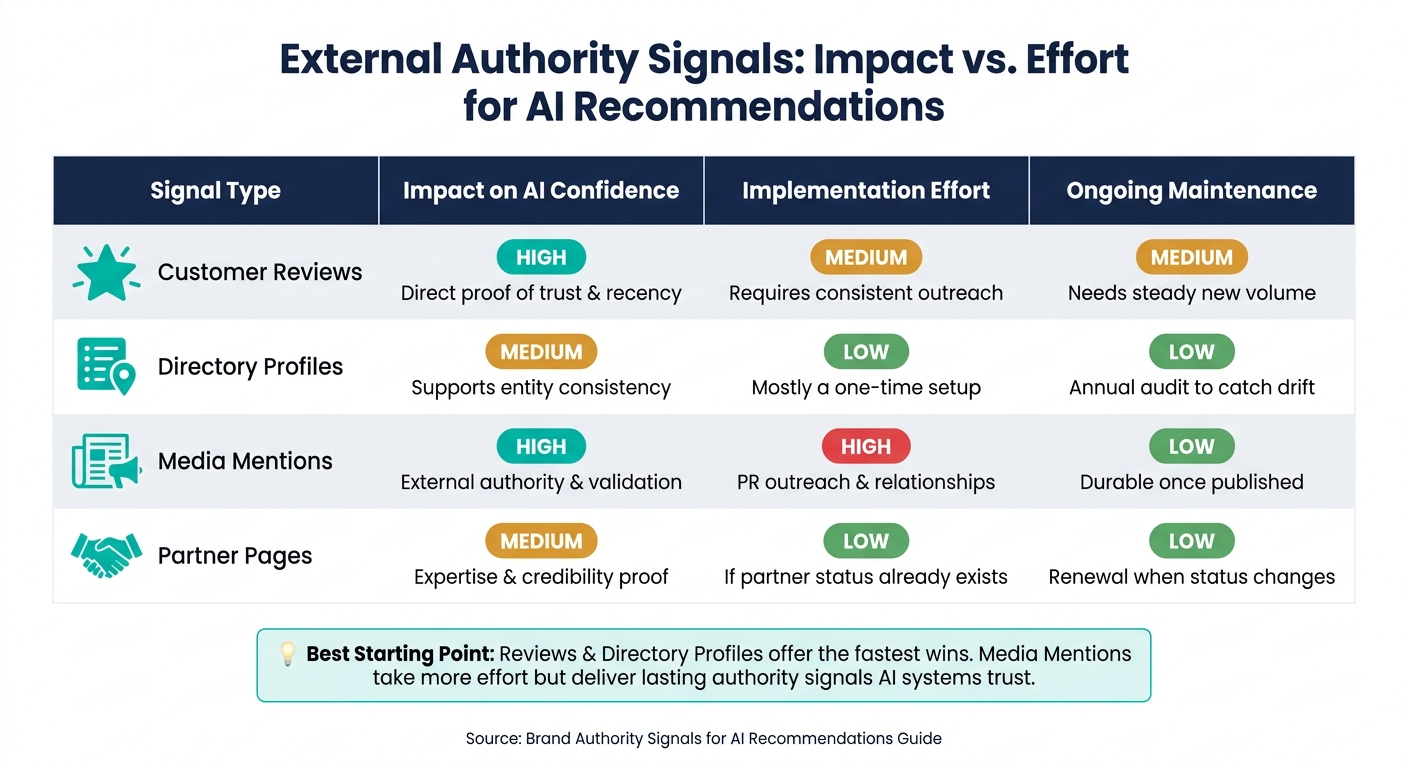
External Authority Signals: Impact vs. Effort for AI Recommendations
Once your on-site proof is in place, the next step is outside proof. In plain English: your website says who you are, and the rest of the web backs that up. Reviews, directory listings, and editorial mentions help AI systems confirm that The Hoop Studio is active, real, and known beyond its own site.
Generic praise doesn’t do much. What helps is a review that points to a clear result, like a Webflow migration finished in a few weeks or a conversion lift you can measure. That kind of detail gives AI more than a pat on the back. It gives context.
83% of consumers say recency is essential for trust, and 73% only trust reviews from the last 30 days.
So if most of your reviews came in two years ago, that trust signal fades. A steady stream of recent, specific reviews is far more useful, especially on platforms AI already checks.
For The Hoop Studio, the best reviews mention actual project outcomes:
The best time to ask is at project handoff, when the result is still top of mind and the client is most likely to respond. Spread those reviews across Google Business Profile and any niche directories tied to Webflow or digital growth work. When the same story shows up in more than one place, it helps reinforce the same business identity.
Start with the profiles most likely to be crawled and compared: Google Business Profile, LinkedIn company page, Clutch, relevant Webflow partner listings, and niche directories tied to your service categories. Each profile should match your website exactly. Even small mismatches can weaken the entity signal AI systems are trying to piece together.
Then go a step further and get mentioned in places that carry outside editorial judgment. A podcast interview on a Webflow-focused show, a guest contribution to a GEO or AI search publication, or a spot in an expert roundup tends to matter more than a directory listing. Why? Because someone else chose to feature you.
One strong mention in a trusted industry publication that names The Hoop Studio, explains your approach, and links back to your site can do more than ten weak directory entries.
Use this table to decide where to start. Reviews and directory profiles are often the fastest plays. Media mentions usually take more work, but they can keep paying off long after they go live.
| Signal Type | Impact on AI Confidence | Implementation Effort | Ongoing Maintenance |
|---|---|---|---|
| Customer Reviews | High - direct proof of trust and recency | Medium - requires consistent outreach | Medium - needs steady new volume |
| Directory Profiles | Medium - supports entity consistency | Low - mostly a one-time setup | Low - annual audit to catch drift |
| Media Mentions | High - external authority and validation | High - PR outreach and relationships | Low - durable once published |
| Partner Pages | Medium - expertise and credibility proof | Low - if partner status already exists | Low - renewal when status changes |
Once this outside proof is steady, the next move is to build topic clusters and original insights around the subjects you want AI to connect with The Hoop Studio.
Once your site is in good shape and outside proof is showing up, the next job is building depth around the topics you want The Hoop Studio to be known for.
Random blog posts won't do much here. What moves the needle is deep, connected coverage across a small set of topics you know well. For The Hoop Studio, that means focusing on three areas tied straight to its services:
For each topic, map the subtopics prospects ask about right before they buy or narrow down a shortlist. Then sort those ideas by business value, search demand, competition, and where you can add the most original value. A simple topic matrix works well: one column for the topic, one for business value, one for query demand, and one for your point of view.
Start each cluster with a pillar page, which acts as the main hub for that topic. Then build supporting articles around narrower questions. For Webflow, that could mean B2B site redesigns and CRO-focused marketing pages. For GEO, it might mean B2B demand generation playbooks and funnel diagnostics. For AI-powered CRM systems, it could cover AI lead scoring and workflow automation for sales teams.
That setup helps AI connect The Hoop Studio with specific subjects instead of treating it as just another company with a decent site.
Comparison pages and short FAQ sections can also strengthen each cluster. They answer common decision-stage questions in plain U.S. English, with clear subheads and short comparison blocks that are easy to cite. Internal linking matters too. Pillar pages should point to supporting articles, supporting articles should link back, and related pages in the same cluster should reference one another using consistent anchor text.
Once the cluster map is done, the next step is to publish pages that show how the work actually happens.
AI systems are filtering out generic summary content more often. They're more likely to cite material that adds something new: a specific process, a real result, or even a decision that went sideways before it got fixed.
Original process detail turns topic coverage into proof AI can trust.
For The Hoop Studio, that means publishing the kind of detail that only comes from doing the work. That could be a Webflow migration broken down from the first audit to DNS cutover, a launch checklist with U.S.-specific ADA accessibility checks, or an AI CRM build log that shows how lead scoring fields were set up, how training data was prepared, and what changed in the sales team's behavior afterward.
Each piece should include a named author and a bio tied to that subject area, such as years of experience, U.S.-based sites launched, and related certifications. That repeated connection between person, brand, and topic gives AI systems a pattern they can pick up and repeat.
Project retrospectives should be part of the process, not an afterthought. After each launch, document the constraints, the decisions made, what changed the plan, and what the numbers looked like. The strongest retrospectives can then become public case studies and implementation guides.
Use case studies and retrospectives to turn topic coverage into evidence.
Each step in this guide builds on the one before it. Auditing your signals shows where entity clarity and off-site proof are weak. Tightening up your website gives you a dependable home base with clear brand details, expert bios, case studies, and structured data. Third-party validation adds outside confirmation through reviews, directory listings, and media mentions. Then topical depth turns all of that into a system where The Hoop Studio is tied again and again to the subjects it wants to own.
Track coverage, topic share, rankings, and AI citations every quarter, then update content as results shift and platform behavior changes.
There’s no fixed timeline. AI systems usually don’t cite or recommend brands overnight, so you may notice early signals before stronger, more consistent visibility builds over time.
You can improve your chances by making your content easy to crawl, answer-first, and backed by schema markup and consistent proof. Updating key pages within the last six months can also help AI systems see your brand as current and trusted.
Start with brand entity consistency. Your brand name, description, and core services should match across your website, Google Business Profile, and third-party directories.
Then clean up your on-site structure and lead with answer-first content. Add direct 40- to 60-word answers near the top of your homepage and core service pages under question-based headings. This helps people get the point fast and gives search engines clearer context.
After that, add schema markup such as Organization, Service, and FAQPage.
Update review content on a steady cadence and keep it recent. Aim to publish several new, detailed reviews each quarter. AI systems tend to lean toward activity from the last 12–24 months, and the signal often gets stronger in rolling 30–90-day windows.
Treat schema and author pages as a baseline, not a one-and-done task. Check them often and keep them current. Update key pages within six months, review schema for errors on a regular schedule, and make changes right away if pricing, features, regulations, or author details shift.