




Insights
SEO & AEO
Copy Link




AEO forces marketers to write answer-first pages—question headings, 40–60-word answers, and schema—so AI can cite your site.
AEO means writing and structuring pages so AI tools can pull your answer and cite your site. If 69% of searches end without a click and AI Overviews can cut clicks to the top result by up to 64%, then ranking alone is no longer enough.
I see the article making one clear point: you now need two things at once - show up in search results and show up inside AI answers. That means using question-led headings, 40–60 word answer blocks, semantic HTML, schema markup, and clear opening copy near the top of the page.
Here’s the short version:
A quick side-by-side helps show the shift:
| Focus | SEO | AEO |
|---|---|---|
| Main goal | Rank in search results | Get quoted in AI answers |
| Best content format | Full pages | Short answer sections |
| Query style | Keywords | Questions and natural phrasing |
| Key signals | Crawlability, speed, links | Structure, schema, extractable copy |
| Main metric | Rankings, clicks, sessions | Citations, mentions, answer visibility |
For me, the main takeaway is simple: AEO does not replace SEO. It changes how I write priority pages so answer engines can read, lift, and cite them fast.
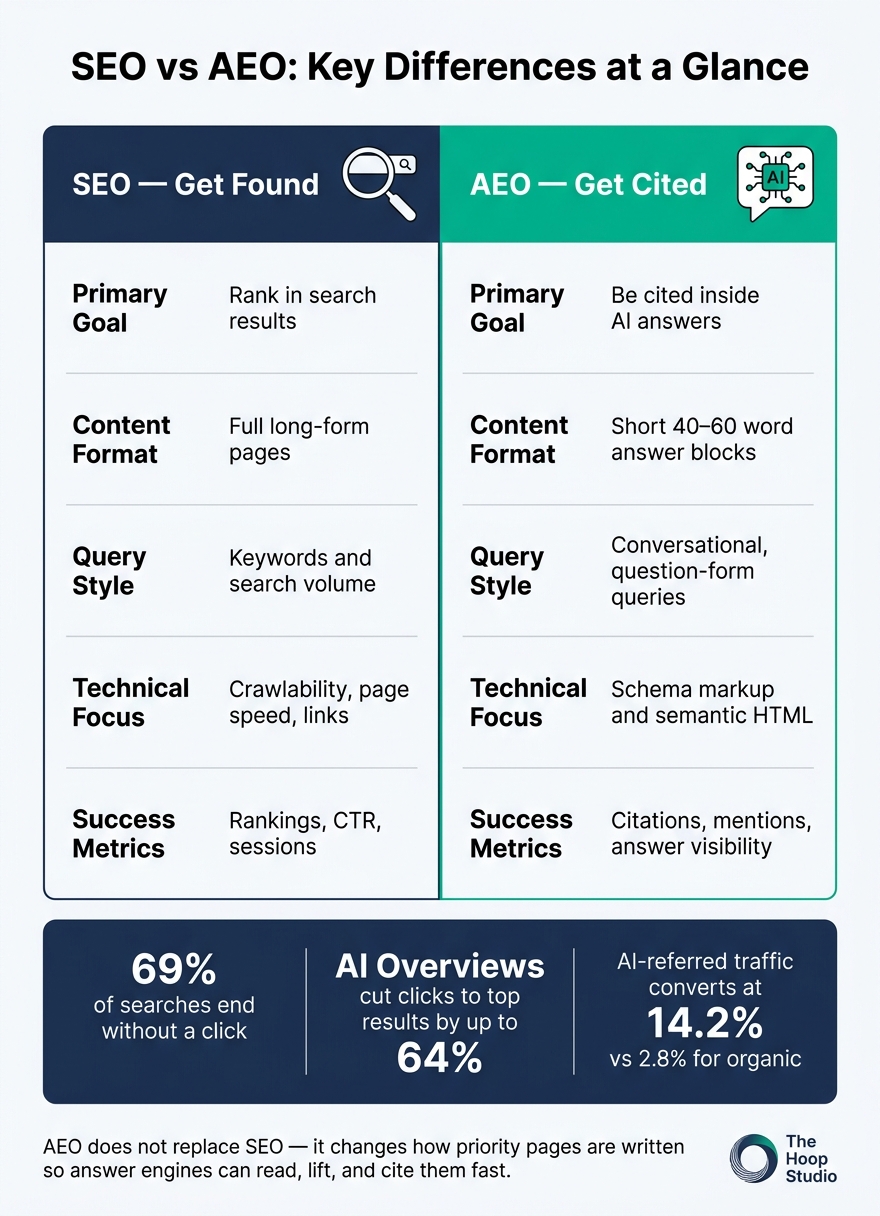
SEO vs AEO: Key Differences at a Glance
Answer Engine Optimisation (AEO) is the practice of structuring your content, brand entities, and technical signals so answer engines - Google AI Overviews, ChatGPT, Perplexity, Gemini, and voice assistants - can identify and cite accurate answers from your website.
Put simply, the goal is to get cited inside the answer itself. SEO still matters. But AEO puts the focus on citation inside AI-generated responses. For marketing websites, that means service pages, landing pages, and FAQs need to be written for extraction, not just readability. That shift changes how pages should be written, structured, and marked up.
Answer engines don’t use whole pages. They cite fragments.
They scan the HTML for concise answer blocks and pull the clearest one into the response. Roughly 44% of ChatGPT citations come from the first 30% of a page’s text. So if your main point shows up halfway down the page, you’re making life harder for the engine - and for yourself.
So what makes a fragment extractable? It needs to stand on its own. In plain English, it should answer one clear question without leaning on the sentences around it. A practical rule is to place a 40–60 word answer block right under a question-led heading.
Semantic HTML matters too. Engines rely on actual <h2>, <table>, and <ul> tags to understand structure. Use real semantic tags. Visual styling by itself does nothing for extraction.
"A page can rank well and still be a poor AEO candidate if it lacks concise answers, source proximity, entity clarity, or visible evidence." - Awais Khalid
That’s why the opening section of a page carries extra weight, especially on service pages, landing pages, and FAQs.
AEO and SEO overlap a lot. They share roughly 70–80% of the same technical base - crawlability, page speed, mobile-friendliness, and topical authority all matter in both.
Where they split is the target.
| Dimension | Traditional SEO | AEO |
|---|---|---|
| Primary goal | Rank in results | Be cited in answers |
| Content structure | Long-form pages | Short answer blocks |
| Keyword strategy | Search volume and keyword difficulty | Conversational, question-form queries |
| Technical focus | Site architecture and crawlability | Schema markup and semantic HTML |
| Success metrics | Rankings, CTR, sessions | Citations, visibility, mentions |
| User outcome | Visit the website | Read the answer in-situ |
For marketing websites, this changes the game a bit. Visibility now depends on being cited, not only ranked. And that gap matters more now that AI Overviews show up for 64.7% of question-form queries.
AEO now shapes how marketing websites get seen and win leads. That change makes it tougher for service pages and landing page layouts to keep attention. For marketing teams, the old playbook isn't enough anymore.
When AI Overviews show up above organic results, even pages with top rankings can lose clicks. A page may rank well and still not make it into the answer box. 60% of sources cited by AI engines aren't even in Google's top 10 organic results.
That changes the goal. Ranking still matters, but it isn't the whole game. Relevance to the answer matters just as much, and in some cases more.
AEO is about earning citations that send qualified traffic. Why? Because AI often filters and sums up the query before the user ever clicks. By the time someone lands on your site, they're often further along in the decision process.
The numbers make that clear. AI-referred traffic converts at 14.2%, compared to 2.8% for traditional Google organic traffic. In plain English, AI is doing part of the qualification work before the visit reaches your site.
For marketing websites that sell services with longer consideration cycles, that matters a lot. You may get less traffic overall, but each visit can carry stronger intent.
That points straight to the page structures that help answer engines pull from your content.
That shift starts with page structure. Once AEO becomes the goal, page structure often decides whether your content gets cited at all. AI systems tend to pull short passages, so structure matters just as much as the topic itself.
Start each section with a 40–60 word answer, then follow it with added detail. Put the answer first so engines can lift it without needing the rest of the page for context. The first 150 words of a page are cited in about 61% of AI answers when that page is referenced.
The wording of your headings matters too. A heading like "How long does a Webflow migration take?" is much more likely to line up with a real search than "Project Timelines." The same idea works for service explanations, pricing context, and outcome descriptions. Write them the way a person would ask them.
Treat each page like a set of self-contained blocks, not one long wall of text. A service page that starts with a tight two-sentence summary and then moves through scope, timeline, and outcomes in short sections is easier for an engine to parse. It also has a better shot at earning a citation that sends qualified traffic.
Short paragraphs help. Specific claims help. Narrow topic blocks help too. For example, "The Hoop Studio builds Webflow websites" says far more than "We provide website services."
Schema markup makes your content easier for machines to parse. Here are common schema combinations and page elements that fit each page type on a marketing site:
| Page Type | Recommended Schema | Key Structural Element |
|---|---|---|
| Service Page | Service, Product, FAQPage |
Concise summary + outcome bullet lists |
| Landing Page | Organization, FAQPage |
Direct-answer value prop + comparison tables |
| Blog/Guide | Article, Person |
Question-led H2s + 40–60 word answer blocks |
| FAQ Section | FAQPage |
Natural language Q&A pairs |
| Case Study | Article, Review |
Sourced statistics + authoritative quotations |
These page patterns make priority content easier to extract. But schema isn't the whole story. Use real semantic HTML - actual <h2>, <ul>, and <table> tags instead of styled <div> elements. AI extractors use those tags to find likely answer snippets.
On Webflow sites, keep answer blocks in the initial HTML, not behind client-side JavaScript, or extractors may miss them.
Use these structures first on the pages that matter most.
Once the structure is set, the next job is building it cleanly in Webflow. On Webflow, implementation shapes whether answer blocks and schema show up in the initial HTML. Webflow's server-rendered pages expose answer blocks and schema in the initial HTML, which makes them easier for answer engines to read.
The process starts with an audit of high-value pages like Home, Services, Pricing, and core blog posts. Each page is mapped to 30–50 priority search questions based on intent, not just keywords.
From there, the first 150 words of each page are rewritten to put the most extractable information first. That matters because the opening section is cited in roughly 61% of AI-generated answers when the page is referenced.
H2s and H3s are then rewritten as real questions that match how people search. Schema is added in JSON-LD using FAQPage, HowTo, Service, and Organization types based on the page. An llms.txt file is placed at the root to list priority pages for AI crawlers. Internal links are also tightened up with descriptive anchor text so the site's topic signals stay clear across pages.
AEO isn't a separate service added at the end. It's part of how sites are structured from the start. The scope then expands by project tier.
| Project Tier | AEO Scope |
|---|---|
| Growth | AEO-ready foundations: semantic HTML, Organization schema, question-led H2s |
| Signature | Full AEO: llms.txt, entity-clear writing, FAQPage/HowTo schema, answer-first restructuring |
| Scale / Scale+ | Ongoing iteration: citation tracking, query-led updates, monthly freshness audits |
Ongoing retainers keep priority pages current, track citation share, and refresh content as search behavior shifts.
Search is now split between clicks and AI-generated answers. More than 65% of Google searches end without a click, and AI search visits keep going up. So if a marketing site is set up only to rank, it covers only part of the visibility picture.
That changes the goal. It’s no longer just about ranking. It’s about getting cited. AEO helps you earn a place inside the answer itself, not just as a blue link on the results page. The page patterns above help make that happen.
Why does that matter? Because cited answers can still bring in the most qualified visits. In many cases, that traffic is more qualified because the engine has already filtered the query.
The main idea is simple: AEO sharpens the pages you already have.
You don’t need to start from scratch. AEO builds on SEO basics and makes priority answers easier for answer engines to pull out. Visibility now depends on being usable by answer engines, not just discoverable in search results.
Use the cover test: hide everything below the first two sentences under each H2. If the text that’s left still gives a complete, self-contained answer to the heading’s question, the page is set up well for machine extraction.
AEO-ready content puts the answer first, ideally in a 40 to 60-word summary under question-based headings. Specs and comparisons should also appear in tables or lists, and FAQ or HowTo schema markup should be in place.
Prioritize pages that already rank in the top 10 search results. AI answer engines tend to pull from pages that already perform well in search, so those URLs are often your best place to start if you want more citations.
Make those pages easier to pull from. Add a clear 40- to 60-word answer near the top of the page. Use question-led H2 and H3 headings so the page is easy to scan. Then turn technical details and side-by-side comparisons into clean tables and lists.
It helps to think of it this way: if a machine has to work hard to find the answer, it may skip your page and grab a cleaner one instead.
There’s no separate or instant timeline for AEO results.
AEO still leans on the same core SEO ideas. That means your pages need to be crawled, indexed, and checked by search engines and AI models against the questions people are asking.
You can check AI tools by hand to see if your content is getting cited. But there isn’t a set schedule or standard timeframe for when that happens.
What helps most is pretty simple: publish clear, answer-first content and use schema markup in a consistent way. Over time, that can help your visibility improve.