



Insights
SEO & GEO
Copy Link




La IA favorece a las marcas con páginas rastreables que priorizan las respuestas, datos coherentes, pruebas de terceros, reseñas y esquemas para una verificación rápida.
Si la IA no puede leer, relacionar y verificar tu marca rápidamente, es probable que te pase por alto.
Resumiría todo el artículo en esto: las herramientas de búsqueda por IA tienden a mencionar a las marcas que superan tres pruebas:
Esto significa que aparecer citado no es solo cuestión de posicionar una página. Se trata de hacer que tu marca sea fácil de identificar como una entidad única, fácil de asociar a una consulta y fácil de confirmar a través de otras fuentes. Los insumos más sólidos son páginas de servicios claras, datos de marca coherentes, volumen y actualidad de las reseñas, menciones de terceros, y marcado de esquema. El artículo también señala un aumento del 44% en citas de IA provenientes de bloques de preguntas frecuentes en páginas diseñadas en torno a las dudas de los compradores.
Si tuviera que actuar al respecto hoy mismo, me centraría en:
Organization, Servicio, y FAQPage esquemaLa idea es sencilla: La IA recomienda las marcas que puede verificar fácilmente. El resto del artículo muestra dónde fallan las marcas en esa prueba y qué corregir primero.
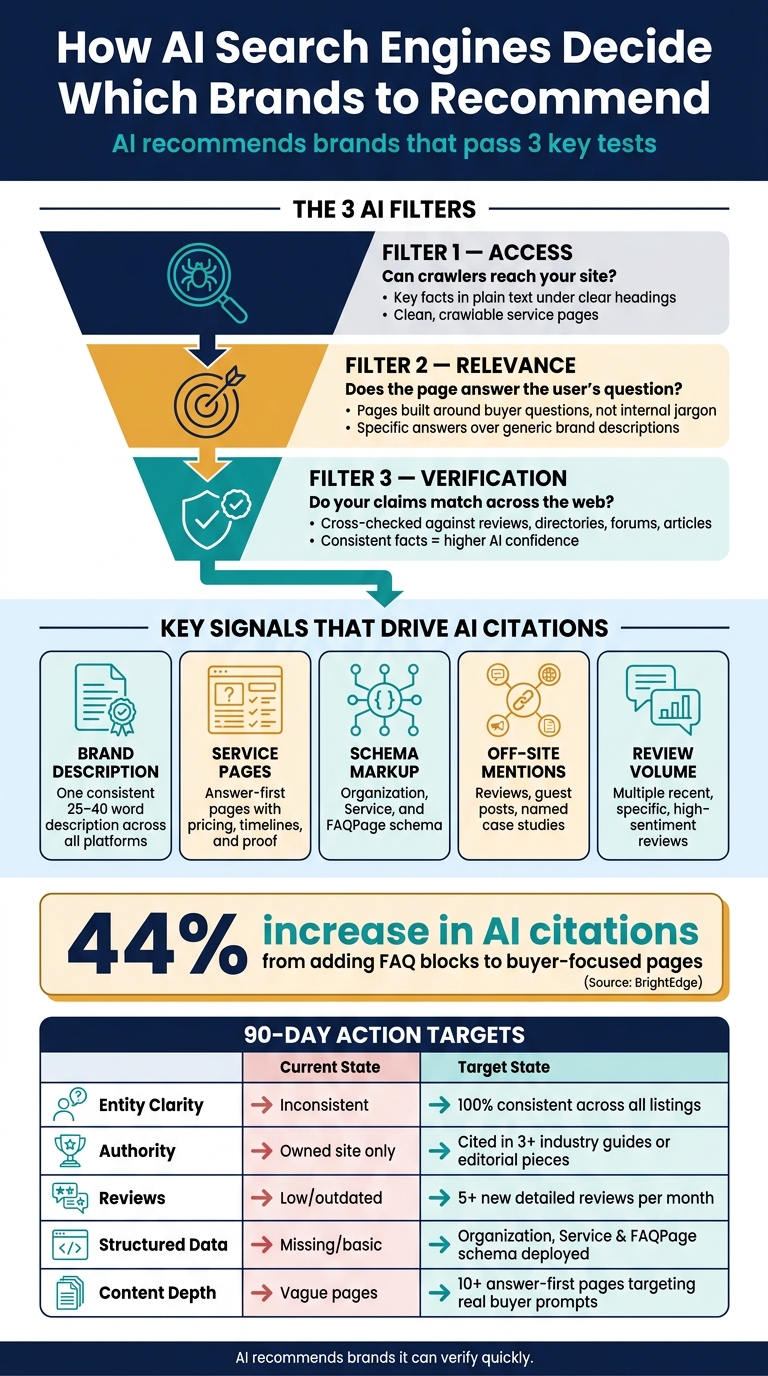
Cómo deciden los motores de búsqueda con IA qué marcas recomendar
Los sistemas de IA someten a las marcas a tres comprobaciones antes de mencionarlas: acceso, relevancia y verificación. Puedes identificar estos controles en tres áreas: capacidad de rastreo, relevancia y validación entre fuentes.
La primera comprobación es técnica. ¿Puede el rastreador llegar a tu sitio y extraer datos útiles de él?
Esto significa que tus detalles clave deben estar en texto plano, bajo encabezados claros y en páginas de servicio rastreables. Si esas páginas son pobres, difíciles de encontrar o están enterradas en lo profundo del sitio, el motor de búsqueda a menudo seguirá adelante.
Ser rastreado es solo el primer obstáculo. A continuación, el motor analiza la adecuación: ¿responde la página a lo que el usuario está preguntando?
Los sistemas de IA tienden a favorecer las páginas que responden a una pregunta específica sobre aquellas que hablan de una empresa en términos amplios y genéricos. Por lo tanto, en lugar de redactar páginas de servicio basadas en jerga interna, diséñalas en torno a las preguntas de los compradores. Una vez que la página se alinea con la consulta, el motor comienza a buscar pruebas en otras fuentes.
La última comprobación es la verificación. Incluso si tu sitio es accesible y tu página coincide con la consulta, el motor aún busca una confirmación externa antes de mencionar tu marca.
Compara tu sitio web con plataformas de reseñas, cobertura editorial y comparativas, y foros comunitarios. Si los datos no coinciden —direcciones, servicios o precios diferentes—, la confianza cae rápidamente.
Puedes ver el patrón con bastante claridad cuando comparas marcas que son fáciles de verificar con marcas que no lo son:
El patrón es bastante sencillo: las marcas que son recomendadas facilitan que un motor de búsqueda las encuentre, las comprenda y las contraste con otras fuentes. Las marcas que rara vez son citadas suelen fallar en uno de esos tres pasos.
Después del acceso y la relevancia, el siguiente filtro es la prueba. La IA analiza tres señales principales: autoridad, reputación y estructura.
La autoridad proviene principalmente de lo que otras personas dicen sobre tu marca, no solo de lo que tú dices de ti mismo. Cuando publicaciones respetadas, blogs del sector o expertos mencionan tu marca por su nombre, los sistemas de IA pueden tratar esas menciones como señales de confianza, incluso cuando no hay un enlace adjunto.
Los casos de estudio también ayudan, pero solo cuando son específicos. Un caso de estudio que incluye el nombre del cliente, el punto de partida, el resultado y el plazo es mucho más fácil de verificar que una historia de éxito vaga. Lo mismo ocurre con la autoría. Cuando el contenido está vinculado a una persona real con una biografía de experto, cargo y trayectoria, le da a la IA más información con la que trabajar.
La IA tiende a favorecer las reseñas que son recientes, específicas y escritas por usuarios verificados. Una reseña que menciona un resultado medible vale más que una que simplemente dice que la experiencia fue genial.
El volumen también importa. Una marca con decenas de reseñas en sus plataformas principales parece mucho más consolidada que una con solo unas pocas dispersas por la web. Por eso ayuda mantener un flujo constante de reseñas. Un objetivo razonable es conseguir varias reseñas nuevas cada trimestre.
Los datos estructurados facilitan la lectura de los datos de tu marca para la IA. El marcado de esquema como Organization, Servicio, FAQPagey Reseña ayudan a los sistemas de IA a identificar quién eres y qué ofreces sin tener que adivinar a partir de texto plano.
Las menciones editoriales, la autoría de expertos, el texto de las reseñas, el esquema y los datos coherentes en distintas fuentes ofrecen a la IA una forma adicional de verificar tu marca. Si esas señales son escasas o no coinciden, la IA tiene menos motivos para mencionar tu marca.
Las mismas señales que ayudan a que una marca sea recomendada también pueden fallar de formas bastante predecibles. Las marcas quedan fuera de las respuestas de la IA cuando su posicionamiento es confuso, sus pruebas solo existen en su propio sitio o sus páginas son difíciles de procesar.
La IA necesita una descripción clara y repetida de lo que es y hace una empresa. Cuando tu sitio envía mensajes contradictorios, la confianza disminuye. Y cuando la confianza disminuye, la IA puede pasar a otra marca con una historia más clara.
Una página de inicio que dice "agencia de marketing" mientras que la página "Sobre nosotros" dice "empresa de software" genera confusión. Lo mismo ocurre con los títulos vagos, las meta descripciones llenas de eslóganes y los textos principales que omiten el servicio, la ubicación o el sector al que se presta servicio.
Revisa tu página de inicio, tu página "Sobre nosotros", tus páginas de servicios, tus títulos, tus meta descripciones y tus listados. En las dos primeras frases de cada uno, indica a quién sirves, qué ofreces y por qué la gente debería confiar en ti. Luego, utiliza la misma descripción breve en tu página de inicio, en tu Perfil de Negocio de Google y en LinkedIn.
Los motores de respuesta de IA verifican las afirmaciones más rápido cuando otras fuentes las respaldan. Si todas las pruebas provienen de tu propio sitio, al sistema le resulta más difícil distinguir entre la profundidad de la materia y la simple promoción.
Por eso las pruebas externas son importantes. Unos sencillos pasos pueden ayudar:
Incluso si tu posicionamiento es claro y otros sitios te mencionan, una estructura de página desordenada puede ser un obstáculo. Los encabezados planos, los párrafos largos, la falta de marcado de esquema, los testimonios que son solo imágenes y los resultados de casos en PDF dificultan la citación de datos clave.
La siguiente tabla muestra cómo se traduce esto en la práctica:
Reestructura tus páginas clave en torno a un H1 descriptivo, H2 lógicos, párrafos HTML cortos, precios visibles y el esquema pertinente. Agrupa testimonios, logotipos, certificaciones, menciones en medios y resultados de casos en una sección de pruebas claramente etiquetada.
Soluciona esos tres problemas y el plan de acción que aparece a continuación será mucho más fácil de llevar a cabo.
Empiece por la coherencia de la entidad. Luego, pase a un contenido que responda directamente a las preguntas.
La victoria más rápida es corregir la falta de coherencia de la marca. Si el nombre de su marca, su descripción breve, su categoría principal, las ubicaciones que atiende y sus servicios principales dicen cosas diferentes en su sitio web, Google Business Profile, LinkedIn y directorios del sector, a la IA le resultará más difícil tratar a su marca como una entidad clara.
Utilice una descripción de marca canónica de entre 25 y 40 palabras en su sitio web, Google Business Profile, LinkedIn y los principales directorios. Por ejemplo: "Acme Roofing & Solar es un contratista de techado residencial y comercial con sede en Denver, CO, especializado en reemplazo de techos, reparaciones e instalaciones de paneles solares en azoteas." Mantenga también el mismo formato de URL de su página de inicio en todos los listados. Eso facilita que los sistemas de IA verifiquen su marca rápidamente.
Una vez que los datos de su marca estén alineados, publique páginas que respondan a las preguntas que los compradores ya están haciendo.
A continuación, cree páginas que respondan a las preguntas de los compradores con un lenguaje sencillo. Cada página de servicio debe centrarse en una pregunta del comprador, una oferta y un punto de prueba.
Cada servicio principal necesita su propia página. No un párrafo corto enterrado dentro de una página general de "Servicios". Especifique a quién va dirigido el servicio, las ubicaciones que atiende, qué obtiene el comprador, los rangos de precios típicos y los plazos probables. Por ejemplo, podría decir: "Los honorarios mensuales suelen oscilar entre $3,000 y $7,500." Utilice encabezados que suenen como la forma en que los compradores piensan y buscan, tales como:
Las páginas creadas de esta manera, junto con el esquema FAQPage, tienen más probabilidades de aparecer en las respuestas de la IA. Y añadir bloques de preguntas frecuentes puede generar un Aumento del 44% en las citas de IA, según datos de BrightEdge .
También ayuda añadir pruebas externas con el tiempo. Piensa en artículos como invitado, reseñas de hitos, casos de estudio creados en colaboración y comentarios recurrentes de expertos.
La IA recomienda marcas que puede verificar rápidamente a través de fuentes independientes. La claridad de la entidad, la relevancia temática, las menciones de terceros de confianza, el sentimiento de las reseñas, los datos estructurados y la coherencia de los hechos en toda la web facilitan que un sistema conecte tu marca con una recomendación fiable.
Usa los próximos 90 días para convertir esas señales en objetivos que puedas medir:
Empieza con la alineación de la entidad. Luego añade contenido estructurado y pruebas externas. Un paso facilita el siguiente.
No existe un plazo establecido para que una herramienta de búsqueda con IA comience a citar a una marca. Estos patrones de citación suelen aparecer pronto y, una vez que lo hacen, tienden a consolidarse con el tiempo.
Las marcas que construyen autoridad y envían señales constantes a través de la web desde el principio tienen más probabilidades de convertirse en recomendaciones predeterminadas. Un contenido claro y conciso, definiciones de entidad sólidas y datos estructurados facilitan que los sistemas de IA reconozcan una marca y la muestren con mayor frecuencia.
Empieza por la claridad de la entidad y el contenido que responde directamente. Revisa tus páginas principales para que cada encabezado basado en preguntas vaya seguido de una respuesta directa de 40 a 60 palabras.
Luego, añade marcado de esquema descriptivo. Asegúrate también de que tu contenido sea claro y coherente en fuentes externas, como foros comunitarios y guías del sector.
Sí. Una pequeña empresa puede ser recomendada incluso sin una gran cantidad de reseñas si demuestra autoridad y relevancia.
¿Cómo se traduce esto en la práctica? Por lo general, se reduce a un contenido claro, coherente y estructurado que facilite la comprensión de la empresa. Priorizar la respuesta Las páginas que van directo al grano también ayudan, porque son más rápidas. Si añades un marcado de esquema descriptivo, los sistemas de IA tendrán más señales con las que trabajar.
Las menciones en debates relevantes del sector o en foros comunitarios también pueden ser útiles. Esas referencias aportan un contexto adicional sobre lo que hace la empresa y dónde encaja su experiencia, lo que facilita que los sistemas de IA reconozcan dicha experiencia y la citen.
{"@context":"https://schema.org","@type":"FAQPage","mainEntity":[{"@type":"Question","name":"¿Cuánto tiempo tardan las herramientas de búsqueda por IA en empezar a citar a una marca?","acceptedAnswer":{"@type":"Answer","text":"<p>No existe un plazo establecido para que una herramienta de búsqueda por IA empiece a citar a una marca. Estos patrones de citación suelen aparecer pronto y, una vez que lo hacen, tienden a consolidarse con el tiempo.</p> <p>Las marcas que construyen autoridad y envían señales constantes a través de la web desde el principio tienen más posibilidades de convertirse en recomendaciones predeterminadas. Un contenido claro y conciso, definiciones de entidad sólidas y datos estructurados facilitan que los sistemas de IA reconozcan una marca y la muestren con mayor frecuencia.</p>"}},{"@type":"Question","name":"¿Qué correcciones debo priorizar primero si mi marca apenas se menciona?","acceptedAnswer":{"@type":"Answer","text":"<p>Empieza por la <strong>claridad de la entidad</strong> y el <strong>contenido que prioriza la respuesta</strong>. Revisa tus páginas principales para que cada encabezado basado en preguntas vaya seguido de una <strong>respuesta directa de 40 a 60 palabras</strong>.</p> <p>A continuación, añade un marcado de esquema descriptivo. Asegúrate también de que tu contenido sea claro y coherente en fuentes externas, como foros comunitarios y guías del sector.</p>"}},{"@type":"Question","name":"¿Puede una pequeña empresa ser recomendada sin un gran volumen de reseñas?","acceptedAnswer":{"@type":"Answer","text":"<p>Sí. Una pequeña empresa puede ser recomendada incluso sin un gran número de reseñas si demuestra <strong>autoridad</strong> y <strong>relevancia</strong>.</p> <p>¿Cómo se traduce esto en la práctica? Por lo general, se reduce a un contenido claro, coherente y estructurado que haga que la empresa sea fácil de entender. Las páginas que <em>priorizan la respuesta</em> también ayudan, porque van directo al grano. Añade un marcado de esquema descriptivo y los sistemas de IA tendrán más señales con las que trabajar.</p> <p>Las menciones en debates relevantes del sector o en foros comunitarios también pueden ser útiles. Esas referencias aportan un contexto adicional sobre lo que hace la empresa y dónde encaja su experiencia, lo que facilita que los sistemas de IA reconozcan dicha experiencia y la citen.</p>"}}]}