





Insights
SEO & AEO
Copy Link




AI favors brands with crawlable, answer-first pages, consistent facts, third-party proof, reviews, and schema for quick verification.
If AI can’t read, match, and check your brand fast, it will likely skip you.
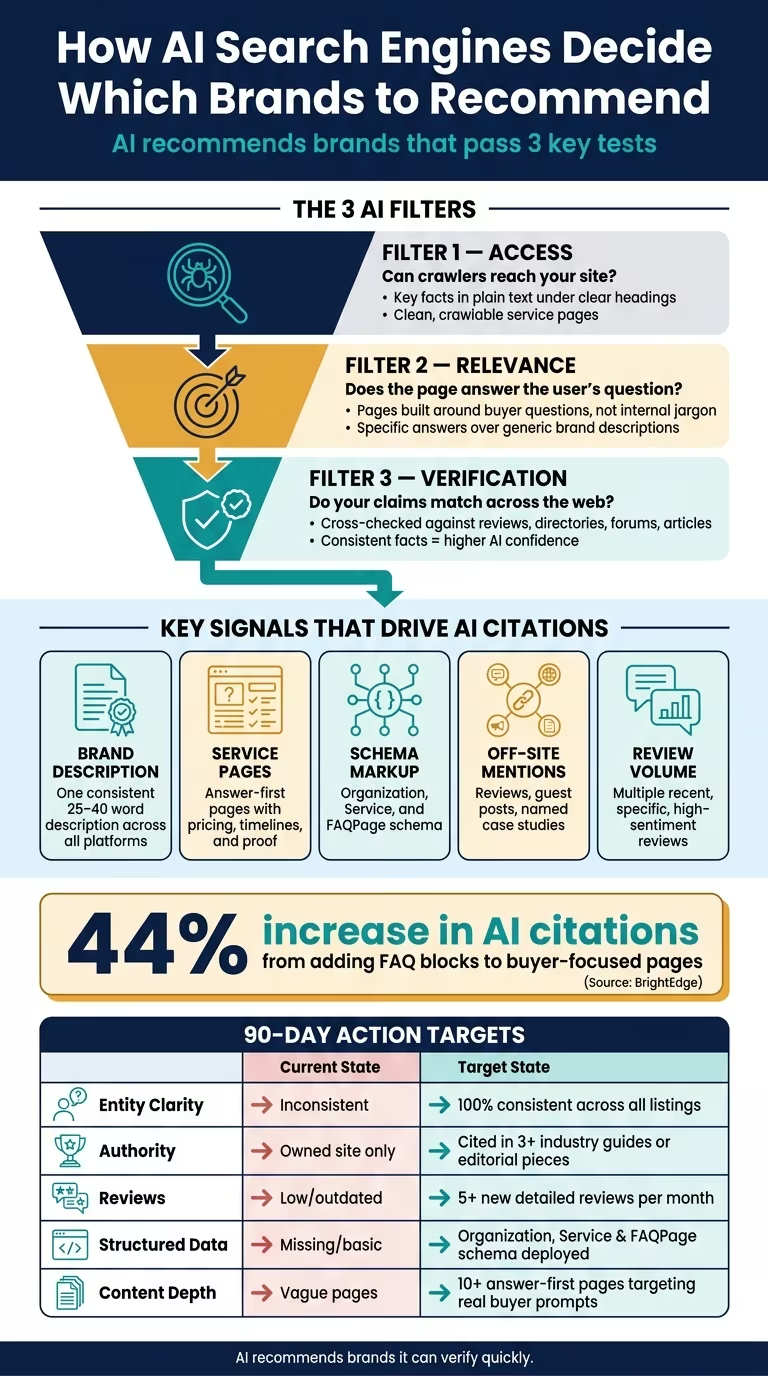
I’d boil the whole article down to this: AI search tools tend to mention brands that pass three tests:
That means getting cited is not just about ranking a page. It’s about making your brand easy to identify as one entity, easy to match to a prompt, and easy to confirm from other sources. The strongest inputs are clear service pages, consistent brand facts, review volume and recency, third-party mentions, and schema markup. The article also points to a 44% lift in AI citations from FAQ blocks on pages built around buyer questions.
If I were acting on this today, I’d focus on:
Organization, Service, and FAQPage schemaHere’s the simple idea: AI recommends brands it can check with low friction. The rest of the article shows where brands fail that test and what to fix first.
How AI Search Engines Decide Which Brands to Recommend
AI systems put brands through three checks before they mention them: access, relevance, and verification. You can spot those checks in three areas: crawlability, relevance, and cross-source proof.
The first check is technical. Can the crawler reach your site and pull useful facts from it?
That means your key details need to live in plain text, under clear headings, on crawlable service pages. If those pages are thin, hard to find, or buried deep in the site, the engine will often move on.
Getting crawled is only the first hurdle. Next, the engine looks at fit: does the page answer what the user is asking?
AI systems tend to favor pages that answer a specific question over pages that talk about a company in broad, generic terms. So instead of writing service pages around internal jargon, build them around buyer questions. Once the page lines up with the query, the engine starts looking for proof from other sources.
The last check is verification. Even if your site is accessible and your page matches the query, the engine still wants outside confirmation before it mentions your brand.
It checks your website against review platforms, editorial and comparison coverage, and community forums. If the facts don't line up - different addresses, services, or pricing - confidence drops fast.
You can see the pattern pretty clearly when you compare brands that are easy to verify with brands that aren't:
| Signal | Brands AI frequently cites | Brands AI rarely cites |
|---|---|---|
| Crawlability | Clean, accessible pages with structured data | Blocked content, thin copy, or vague service descriptions |
| Third-party mentions | Cited in editorial guides, articles, and forums | Mentioned only on their own website |
| Review sentiment | High volume of recent, positive reviews across multiple platforms | Stale reviews or low sentiment scores |
| Structured data | Schema markup that defines brand facts clearly | No structured data; facts buried in unformatted text |
| Consistency across the web | Identical facts across all web profiles | Conflicting info such as different addresses or service lists |
The pattern is pretty simple: brands that get recommended make it easy for an engine to find them, understand them, and check them against other sources. Brands that rarely get cited usually break down at one of those three steps.
After access and relevance, the next filter is proof. AI looks at three main signals: authority, reputation, and structure.
Authority mostly comes from what other people say about your brand, not just what you say about yourself. When respected publications, industry blogs, or experts mention your brand by name, AI systems can treat those mentions like trust signals, even when there’s no link attached.
Case studies help too, but only when they’re specific. A case study that includes a client name, starting point, result, and timeframe is much easier to check than a vague success story. The same goes for authorship. When content is tied to a real person with an expert bio, job title, and track record, it gives AI more to work with.
AI tends to favor reviews that are recent, specific, and written by verified users. A review that mentions a measurable outcome means more than one that just says the experience was great.
Volume matters too. A brand with dozens of reviews across its main platforms looks far more established than one with only a few scattered around the web. That’s why it helps to keep reviews coming in on a steady basis. Several new reviews per quarter is a reasonable target.
Structured data makes your brand facts easier for AI to read. Schema markup such as Organization, Service, FAQPage, and Review helps AI systems identify who you are and what you offer without having to guess from plain text.
Editorial mentions, expert authorship, review text, schema, and steady facts across sources each give AI another way to verify your brand. If those signals are thin or don’t line up, AI has less reason to name your brand.
The same signals that help a brand get recommended can also break down in pretty predictable ways. Brands get left out of AI answers when their positioning is muddy, their proof lives only on their own site, or their pages are tough to pull from.
AI needs one clear, repeated description of what a company is and does. When your site sends mixed messages, confidence drops. And when confidence drops, AI may move on to a brand with a clearer story.
A homepage that says "marketing agency" while the About page says "software company" creates confusion. The same thing happens with vague titles, slogan-heavy meta descriptions, and hero copy that leaves out the service, location, or industry served.
Review your homepage, About page, service pages, titles, meta descriptions, and listings. In the first two sentences of each, say who you serve, what you offer, and why people should trust you. Then use the same short description across your homepage, Google Business Profile, and LinkedIn.
AI answer engines check claims faster when other sources back them up. If all the proof comes from your own site, it's harder for the system to tell the difference between subject-matter depth and plain promotion.
That’s why off-site proof matters. A few simple moves can help:
Even if your positioning is clear and other sites mention you, messy page structure can still get in the way. Flat headings, long paragraphs, missing schema, image-only testimonials, and PDF-only case results all make key facts harder to cite.
The table below shows what that looks like in practice:
| Aspect | Unstructured pages | Structured pages |
|---|---|---|
| Crawlability | Content buried in scripts or complex layouts; crawlers may miss key sections | Clean HTML with a clear H1–H3 hierarchy; key sections are accessible |
| Fact extraction | Pricing, locations, and services hidden in long paragraphs or images | Facts in labeled sections, short sentences, and structured data |
| Quoting potential | Long, multi-topic sentences that are risky to lift into a concise answer | Self-contained statements that are easy to paraphrase |
Rework key pages around one descriptive H1, logical H2s, short HTML paragraphs, visible pricing, and relevant schema. Put testimonials, logos, certifications, media mentions, and case results into one clearly labeled proof section.
Fix those three issues, and the action plan below becomes a lot easier to carry out.
Start with entity consistency. Then move to answer-first content.
The fastest win is fixing brand inconsistency. If your brand name, short description, primary category, locations served, and core services say different things across your website, Google Business Profile, LinkedIn, and industry directories, AI has a harder time treating your brand as one clear entity.
Use one canonical 25–40-word brand description across your website, Google Business Profile, LinkedIn, and major directories. For example: "Acme Roofing & Solar is a residential and commercial roofing contractor based in Denver, CO, specializing in roof replacement, repair, and rooftop solar installations." Keep your homepage URL format the same across every listing too. That makes it easier for AI systems to verify your brand fast.
Once those brand facts line up, publish pages that match the questions buyers are already asking.
Next, build pages that answer buyer questions in plain language. Each service page should focus on one buyer question, one offer, and one proof point.
Every core service needs its own page. Not a short paragraph buried inside a broad "Services" page. Spell out who the service is for, the locations you serve, what the buyer gets, typical price ranges, and likely timelines. For example, you might say: "Monthly retainers typically range from $3,000–$7,500." Use headings that sound like the way buyers think and search, such as:
Pages built this way, paired with FAQPage schema, are more likely to show up in AI answers. And adding FAQ blocks can drive a 44% increase in AI citations, according to BrightEdge data.
It also helps to add off-site proof over time. Think guest articles, milestone reviews, co-created case studies, and recurring expert commentary.
AI recommends brands it can verify quickly across independent sources. Entity clarity, topical relevance, trusted third-party mentions, review sentiment, structured data, and consistent facts across the web all make it easier for a system to connect your brand to a confident recommendation.
Use the next 90 days to turn those signals into targets you can track:
| Signal | Current signal strength | Target signal strength (90-day goal) |
|---|---|---|
| Entity clarity | Inconsistent brand facts across listings | 100% consistency across site, listings, and social profiles |
| Authority | Mentioned only on owned website | Cited in 3+ industry guides, editorial pieces, or forums |
| Reviews | Low volume or outdated sentiment | 5+ new, detailed, high-sentiment reviews per month |
| Structured data | Basic or missing schema | Organization, Service, and FAQPage schema deployed |
| Content depth | Vague service descriptions | 10+ answer-first pages targeting real buyer prompts |
Start with entity alignment. Then add structured content and off-site proof. One step makes the next one easier.
There’s no set timeline for when an AI search tool will start citing a brand. These citation patterns tend to show up early, and once they do, they often build on themselves over time.
Brands that build authority and send steady signals across the web early on have a better shot at becoming default recommendations. Clear, concise content, strong entity definitions, and structured data make it easier for AI systems to recognize a brand and surface it more often.
Start with entity clarity and answer-first content. Review your main pages so each question-based heading is followed by a direct 40- to 60-word answer.
Then add descriptive schema markup. Also make sure your content is clear and consistent across outside sources like community forums and industry guides.
Yes. A small business can still be recommended even without a huge number of reviews if it shows authority and relevance.
What does that look like in practice? It usually comes down to clear, consistent, structured content that makes the business easy to understand. Answer-first pages help too, because they get to the point fast. Add descriptive schema markup, and AI systems have more signals to work with.
Mentions in relevant industry discussions or community forums can also help. Those references give extra context around what the business does and where its expertise fits, which makes it easier for AI systems to recognize that expertise and cite it.