



Insights
Webflow
Copy Link




Opte por un desarrollador Webflow independiente para sitios web sencillos y una agencia para sitios complejos orientados a la estrategia.
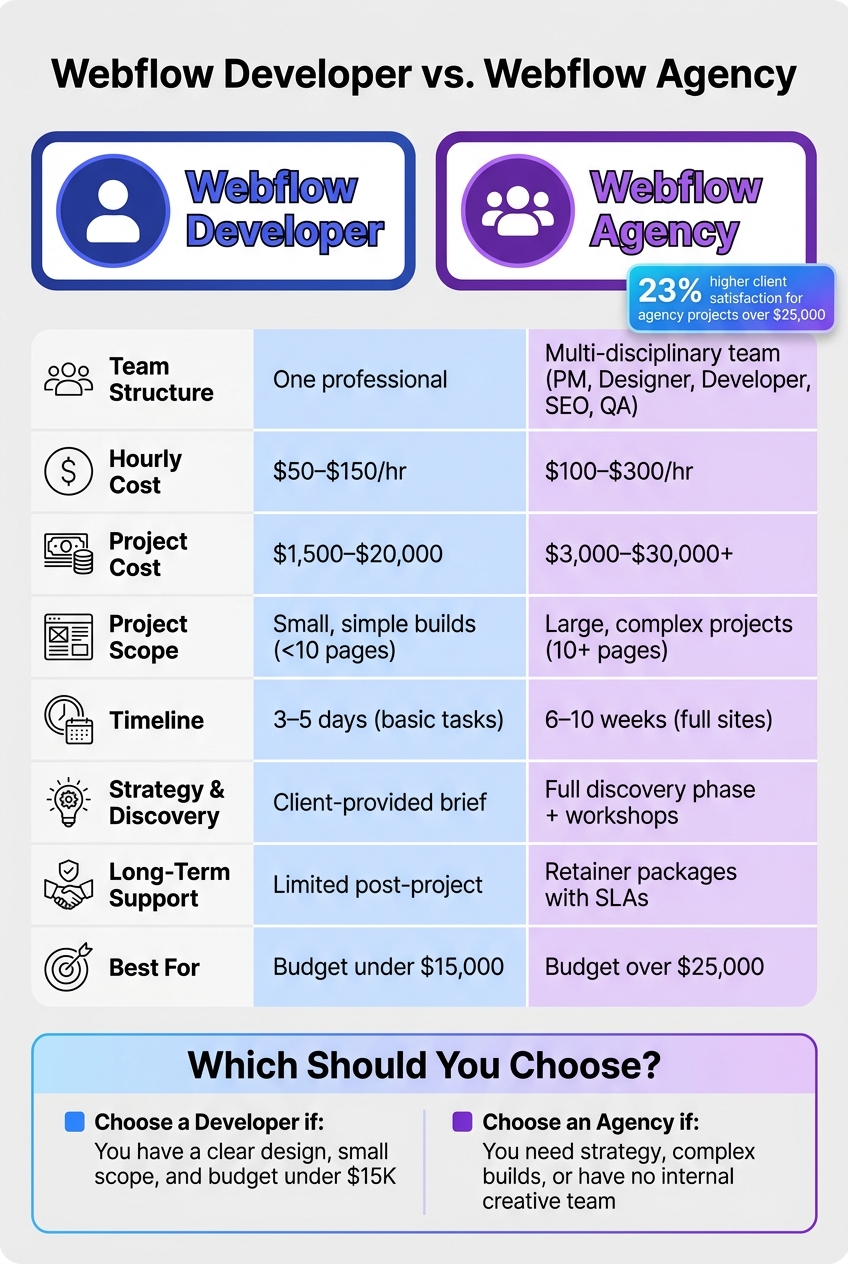
Al decidir entre un Webflow desarrollador y una Webflow agencia, la elección se reduce al alcance de tu proyecto, tu presupuesto y tus recursos internos:
Conclusión clave: Los desarrolladores son rentables para tareas sencillas. Las agencias ofrecen un enfoque basado en equipos para proyectos que requieren estrategia y funciones avanzadas.
Factor
Desarrollador Webflow
Agencia Webflow
Un profesional
Equipo multidisciplinar
50–150 $/hora
100–300 $/hora
Proyectos pequeños y sencillos
Proyectos grandes y complejos
3–5 días para tareas básicas
6–10 semanas para sitios completos
Limitado
Elige en función de la complejidad de tu proyecto, tu presupuesto y tus capacidades internas.

Un desarrollador Webflow se especializa en la creación y el mantenimiento de sitios web utilizando la plataforma Webflow. A menudo se les contrata cuando una empresa tiene una visión de diseño clara —como un archivo de Figma, directrices de marca o un informe de proyecto detallado— y necesita a alguien que la haga realidad de forma eficiente.
Los desarrolladores Webflow toman maquetas de diseño y las transforman en sitios web totalmente funcionales y adaptables. Esto incluye añadir animaciones interactivas y garantizar la compatibilidad móvil. También configuran colecciones de CMS, facilitando a los equipos la publicación de contenido como entradas de blog, estudios de caso o páginas de productos sin necesidad de tocar código.
Más allá del diseño y el desarrollo, se encargan de las integraciones técnicas y las tareas relacionadas con el SEO, como:
Estas tareas requieren un conjunto de habilidades específico, que se detalla a continuación.
Un desarrollador experto en Webflow utiliza un conjunto de tecnologías específico y sigue las mejores prácticas. Es fundamental tener experiencia en el Diseñador, el CMS y las herramientas de interacción de Webflow. Muchos desarrolladores también adoptan convenciones de nomenclatura CSS estructuradas, como Client First o Lumos, para mantener el código limpio y manejable.
Categoría de habilidad
Herramientas y experiencia clave
Figma, Webflow Designer, guías de estilo, unidades REM
Colecciones de CMS,
, atributos personalizados
Zapier, Make,
, integración con HubSpot
, schema (JSON-LD)
Slack, Notion, Loom
Una buena pregunta para hacerle a un desarrollador potencial de Webflow: ¿Utilizan unidades REM en lugar de píxeles? Esto puede indicar su atención a la accesibilidad y al diseño responsivo.
Los desarrolladores freelance de Webflow a menudo entregan proyectos como páginas de aterrizaje, pequeños sitios web de marketing, blogs con CMS o migraciones de plataforma. Estos proyectos suelen completarse en 3-5 días, mientras que las agencias pueden tardar 2-3 semanas. Esta velocidad es ideal para proyectos bien definidos y con un presupuesto ajustado.
Sin embargo, tareas como la estrategia de marca de alto nivel, la redacción profesional o el desarrollo backend complejo pueden requerir especialistas adicionales. Para proyectos de menos de $15,000, contratar a un desarrollador freelance suele ser la opción más económica, con costos que oscilan entre $1,500 y $20,000 dependiendo de la complejidad.
"Trabajar con un freelance es como enviarle un mensaje al chef. Con una agencia, normalmente hablas con el anfitrión." - Stephanie Woodley, Desarrolladora Web
Este enfoque contrasta con los servicios más amplios que suelen ofrecer las agencias, lo cual se explorará en la siguiente sección.
Una agencia Webflow ofrece servicios integrales que cubren estrategia, diseño, redacción, desarrollo y SEO. A diferencia de un desarrollador individual que simplemente sigue un encargo, una agencia colabora con los clientes para dar forma a ese encargo, asegurando un enfoque más personalizado y estratégico.
Las agencias Webflow suelen operar con un equipo multidisciplinar. Cada proyecto reúne a especialistas que se encargan de aspectos distintos del proceso. A continuación, se desglosan los roles clave y lo que aportan:
Role
Key Responsibility
Oversees timelines, budgets, and client communication
Develops messaging frameworks, positioning, and unique value propositions
Designs wireframes, builds design systems, and creates high-fidelity mockups in Figma
Constructs responsive layouts, configures CMS structures, and integrates APIs
Handles technical SEO, including
, sitemaps, and redirects
Writes compelling headlines and page-specific messaging
For more intricate projects, teams may also include motion designers and additional strategists. Thanks to parallel workflows, agencies can often deliver complete websites within 6–10 weeks. Most agencies employ between 8 and 15 people and juggle 20 to 40 projects annually. This collaborative structure ensures a seamless process from concept to completion.
Webflow agencies manage every stage of a web project. It all begins with discovery and strategy, where the team defines the site’s goals, architecture, and messaging. From there, the project moves through wireframing, creating a design system, developing the Webflow build, setting up CMS architecture, integrating tools like CRMs or analytics platforms, and conducting a rigorous QA process. This QA phase includes cross-browser testing and code reviews to ensure everything works perfectly.
Beyond the initial project, agencies often provide ongoing support through retainer packages. These retainers cover continuous design updates, development tweaks, and strategic improvements, keeping the website fresh and functional over time.
Agencies deliver far more than just a functioning website. Clients receive a polished, multi-page marketing site, a well-documented CMS structure, and a reusable design system that supports future growth.
Statistics show that websites built by agencies result in a 23% higher client satisfaction rate for projects over $25,000. Additionally, sites created by cross-functional teams achieve 3.5 times more conversions compared to those built by a single individual. This success comes from the built-in safeguards agencies provide - design critiques, code reviews, and thorough QA processes - that are difficult for solo developers to replicate. For businesses lacking internal design or strategy teams, an agency doesn’t just act as a vendor; it becomes an essential partner in achieving their goals.
The easiest way to understand the difference between a solo Webflow developer and an agency is to compare what each delivers on key project factors.
Factor
Webflow Developer (Solo)
Webflow Agency
One professional (design or development focused)
Team of specialists (PM, Designer, Developer, SEO, QA)
Builds based on provided files
Offers full UX/UI design, brand strategy, and design systems
Standard builds with limited scripting
Handles advanced CMS, migrations, and app-like functionality
Basic tools (e.g., Zapier, standard forms)
Advanced setups (e.g., Make, custom APIs, CRM integration)
Self-conducted review
Multi-stage peer reviews
Quick for small tasks (3–5 days)
Structured timelines for full projects (6–10 weeks)
$50–$150/hr
$100–$300/hr
Limited availability post-project
Ongoing support with defined SLAs through retainers
Let’s break down these differences further.
One of the biggest distinctions lies in how each approaches project strategy. A solo developer typically works based on what you provide - hand them a Figma file and a project brief, and they’ll build exactly what’s outlined. This approach works well if you already have a clear vision. But if your messaging, site structure, or product positioning still needs refinement, a solo developer won’t address those gaps.
Agencies, on the other hand, prioritize a discovery phase before any design or development begins. This process includes strategy workshops, stakeholder interviews, and a detailed review of your business goals. The aim? To ensure the website doesn’t just look good but also addresses the right problems. This upfront clarity often leads to better results. In fact, agency-built sites frequently outperform others when it comes to driving conversions.
The technical side of a project is another area where agencies often shine. For simpler builds, a skilled solo developer can deliver solid results. But when projects involve more complexity, such as multi-language functionality or custom integrations, agencies have the edge.
For example, creating a multi-language site requires careful planning. You might choose Webflow's Native Localization for better SEO and design control or a tool like Weglot for faster deployment. Making the wrong decision early on can lead to expensive fixes later.
Similarly, advanced CRM integrations, intricate CMS setups, or custom components (like React elements via DevLink) demand expertise across multiple layers. Agencies bring in specialists for each aspect, ensuring fewer mistakes and cleaner code. As Ansif, a Webflow Designer at VictorFlow, explains:
"A visually impressive website that loads in 4 seconds and has poor heading structure will lose to a simpler site that loads in 1.5 seconds and ranks on page one."
This kind of attention to performance, accessibility, and SEO comes standard in an agency’s workflow, directly impacting the success of the final product. This often involves implementing specific Webflow SEO strategies to ensure the site captures qualified leads effectively. With a solo developer, it all depends on their individual skills and approach.
If your project involves creating a simple landing page or a website with fewer than 10 pages and basic features, a freelance Webflow developer is often the way to go. However, for larger, more complex projects - think over 10 pages, structured CMS setups, or custom integrations - a Webflow agency is better equipped to handle the workload. Budget matters, too. For projects under $15,000, a freelancer is usually a better fit, while projects exceeding $25,000 often benefit from an agency's streamlined processes and built-in quality checks. Misjudging this decision can lead to budget overruns of up to 40%, making careful planning essential.
Your current team’s capabilities also play a big role in this decision. If you already have an in-house designer and copywriter, a skilled developer can take your Figma designs and turn them into a functioning site without adding extra costs. This approach works well for straightforward projects where your team can handle the creative and strategic elements.
On the other hand, if your team lacks design, strategy, or copywriting expertise, an agency might be the better choice. Agencies typically provide a complete package, including a project manager, designer, developer, and sometimes even a copywriter. This bundled service is especially helpful for founders or marketing leads who don’t want the hassle of managing multiple freelancers.
Your budget should also reflect your comfort level with risk. Freelance developers are often more affordable upfront, but they come with a downside: they’re a single point of contact. If your developer becomes unavailable due to illness, overbooking, or other reasons, your project timeline could be severely impacted.
Agencies, while more expensive, offer greater reliability. With a team in place, they provide continuity, structured contracts, and service level agreements. This is particularly important for high-stakes projects like rebrands, migrations, or flagship site launches. In fact, websites built by agencies report a 23% higher satisfaction rate for projects over $25,000. If you’re unsure about committing to a freelancer for a large project, consider starting with a smaller task - something in the $500–$1,000 range - to test their quality and communication before moving forward with a full-scale build.
Choosing between a Webflow developer and an agency comes down to your project's specific needs. A developer focuses on building, while an agency offers a full-service approach that includes strategy, design, development, and quality assurance. There's no one-size-fits-all answer - your decision depends on the complexity and scope of your project.
Webflow co-founder Vlad Magdalin emphasized how architectural thinking can lead to faster campaign launches. This is one reason agencies often come with higher price tags. However, for smaller, clearly defined projects, a skilled developer may deliver quicker results at a lower cost.
Working long-term with The Hoop Studio can enhance continuity and deepen understanding of your brand. These benefits play a big role in determining the right partner for your unique requirements.
Here’s a quick guide to help align your needs with the right service option:
Your Situation
Best Fit
Budget under $15,000, simple site or landing page
Webflow Developer
Strong in-house design and copy team
Webflow Developer
Budget over $25,000, 10+ pages
Webflow Agency
Rebrand, migration, or complex CMS build
Webflow Agency
No internal creative resources
Webflow Agency
Need structured SLAs and project continuity
Webflow Agency
Ongoing small updates and maintenance
Webflow Developer
Selecting the right partner is essential to keeping your project on budget and on schedule. A mismatch between your project’s scope and the chosen delivery model could lead to a 40% budget overrun on average. Careful planning upfront can help you avoid this costly mistake.
Yes, it's possible to move from working as a Webflow developer to running an agency. Often, businesses begin by hiring a developer for smaller tasks or upkeep. As their needs expand - like preparing for bigger launches that demand design expertise, strategic planning, or project management - they might decide to partner with an agency. If you're anticipating this kind of growth, it's smart to plan the transition early. This ensures that the site's structure, CMS, and components are handed off seamlessly as the project scales.
To kick things off without a hitch, make sure to provide detailed project specifications y todos los activos de diseño necesarios. Si ya tienes un diseño listo, comparte tus archivos de Figma para ayudar al desarrollador a crear una implementación perfecta al píxel. Además, describe tu estrategia de contenido y especifica cualquier necesidad de CMS, como la funcionalidad de blog o diseños de página filtrables.
Para proyectos en curso, dale al desarrollador acceso a tus activos existentes o incluso a tu sitio en vivo. Esto les permite revisar tu configuración actual y asegurar que puedan mantener la coherencia en el código base.
Si tu proyecto exige experiencia en varios campos - como diseño, SEO, redacción de contenidos y gestión de proyectos - podría ser más de lo que un desarrollador individual puede manejar. Para sitios web con más de 10 páginas, configuraciones complejas de CMS, integraciones de API personalizadas o un cambio de marca completo, trabajar con una agencia podría ser la mejor opción. Las agencias también son ideales para proyectos de alto riesgo donde la escalabilidad, una rigurosa garantía de calidad o un tiempo de actividad constante son críticos. Su estructura basada en equipos ayuda a minimizar los riesgos que conlleva depender de la disponibilidad o el conjunto de habilidades de un solo individuo.
{"@context":"https://schema.org","@type":"FAQPage","mainEntity":[{"@type":"Question","name":"¿Puedo empezar con un desarrollador y luego cambiar a una agencia?","acceptedAnswer":{"@type":"Answer","text":"<p>Sí, es posible pasar de trabajar con un desarrollador de Webflow a dirigir una agencia. A menudo, las empresas comienzan contratando a un desarrollador para tareas más pequeñas o mantenimiento. A medida que sus necesidades se expanden, como la preparación de lanzamientos más grandes que exigen experiencia en diseño, planificación estratégica o gestión de proyectos, pueden decidir asociarse con una agencia. Si anticipas este tipo de crecimiento, es inteligente planificar la transición con antelación. Esto asegura que la estructura del sitio, el CMS y los componentes se transfieran sin problemas a medida que el proyecto escala.</p>"}},{"@type":"Question","name":"¿Qué debo proporcionar a un desarrollador de Webflow antes de que empiece?","acceptedAnswer":{"@type":"Answer","text":"<p>Para empezar sin problemas, asegúrate de proporcionar <strong>especificaciones detalladas del proyecto</strong> y todos los activos de diseño necesarios. Si ya tienes un diseño listo, comparte tus <strong>archivos de Figma</strong> para ayudar al desarrollador a crear una implementación perfecta al píxel. Además, describe tu <strong>estrategia de contenido</strong> y especifica cualquier necesidad de CMS, como la funcionalidad de blog o diseños de página filtrables.</p> <p>Para proyectos en curso, dale al desarrollador acceso a tus activos existentes o incluso a tu sitio en vivo. Esto les permite revisar tu configuración actual y asegurar que puedan mantener la coherencia en el código base.</p>"}},{"@type":"Question","name":"¿Cómo sé si mi proyecto es demasiado complejo para un desarrollador individual?","acceptedAnswer":{"@type":"Answer","text":"<p>Si tu proyecto exige experiencia en varios campos - como diseño, SEO, redacción de contenidos y gestión de proyectos - podría ser más de lo que un desarrollador individual puede manejar. Para sitios web con más de 10 páginas, configuraciones complejas de CMS, integraciones de API personalizadas o un cambio de marca completo, trabajar con una agencia podría ser la mejor opción. Las agencias también son ideales para proyectos de alto riesgo donde la escalabilidad, una rigurosa garantía de calidad o un tiempo de actividad constante son críticos. Su estructura basada en equipos ayuda a minimizar los riesgos que conlleva depender de la disponibilidad o el conjunto de habilidades de un solo individuo.</p>"}}]}