



Insights
Webflow
Copy Link




Webflow retainers provide marketing teams fast, predictable website support—landing pages, A/B tests, and updates delivered in days with fixed monthly pricing.
Marketing teams are under pressure to launch campaigns faster, but outdated workflows often slow things down. Webflow retainers solve this by giving teams direct access to experts who handle website updates, landing pages, and A/B tests in just days instead of weeks. This approach eliminates delays caused by engineering backlogs and allows marketers to focus on driving results.
Companies like Dropbox Sign and Oyster have used Webflow retainers to speed up website updates, launch campaigns quickly, and improve conversion rates. This model empowers marketing teams to act faster and achieve their goals without relying heavily on developers.
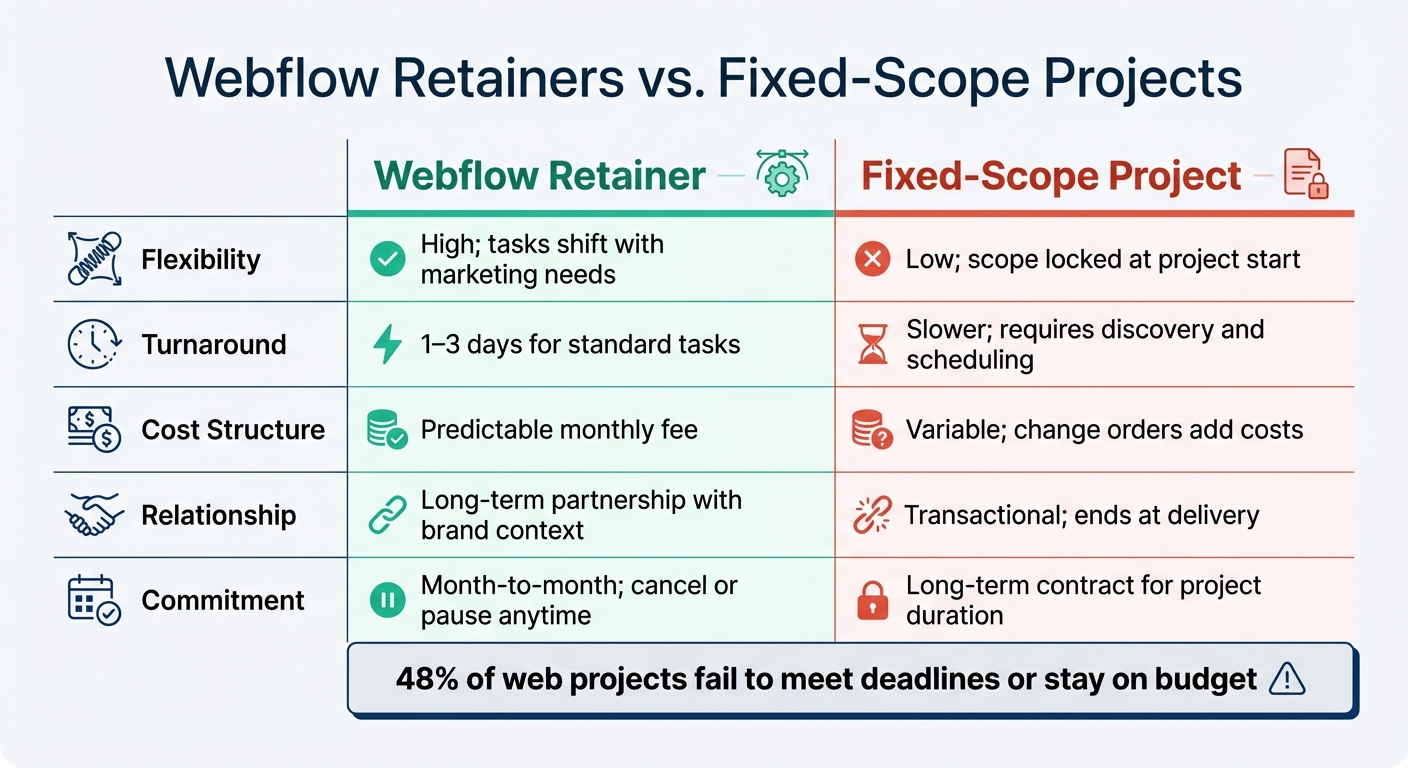
Webflow Retainers vs Traditional Fixed-Scope Projects Comparison
With the growing demand for quicker marketing workflows, it's worth exploring what a Webflow retainer actually involves.
A Webflow retainer provides ongoing access to a team of skilled designers, developers, and project managers for a set monthly fee. This setup eliminates the hassle of hiring individual experts or relying on internal teams that may already be stretched thin.
Through a centralized portal or Slack channel, you can submit requests for tasks like bug fixes, landing page creation, or A/B testing. These tasks are typically completed within 1–3 days. Unlike traditional workflows, this approach avoids starting from scratch each time. The team quickly becomes familiar with your brand and needs, leading to faster outcomes and fewer revisions.
This model directly addresses common bottlenecks by providing consistent and rapid support. For marketing teams, it means true independence. Campaigns and site updates can be launched in days rather than weeks, bypassing delays caused by engineering backlogs. The retainer model allows non-technical teams to move at the pace today’s marketing landscape demands.
Webflow retainers are designed to meet a wide range of marketing website needs. They typically include priority access to services like landing page creation, CMS management, SEO improvements, A/B test setups, and integrations with tools such as HubSpot, Zapier, and Google Tag Manager. Technical upkeep is often part of the package too, covering bug fixes, mobile responsiveness adjustments, and page speed optimizations that can improve conversion rates by as much as 20%.
Design services are another key feature. Agencies often handle UI/UX updates in Figma, develop custom animations, and refine interaction designs to keep your website engaging. Some retainers even include regular analytics reviews to identify what’s working and what needs tweaking.
Pricing is usually tiered to match different needs, offering predictable costs while ensuring fast execution:
"One of the key benefits to our SaaS company is that they give us an external team dedicated to building and updating our marketing websites - so we can quickly get new ideas and content in front of our audience." – Anthony Xiques, Product Manager, Deadline Funnel
To understand the flexibility of a retainer, it helps to compare it with fixed-scope projects.
The key difference lies in adaptability and speed. Fixed-scope projects are tied to a predefined deliverable. If marketing priorities shift mid-project - as they often do - you’ll need to renegotiate terms, wait for updated quotes, and possibly face extra fees. No wonder 48% of web projects fail to meet deadlines or stay on budget.
Retainers, on the other hand, allow for flexibility. Your monthly scope can adjust based on your campaign needs. If priorities change, you can pivot immediately without renegotiating a contract. The team is already familiar with your brand and can start working as soon as you submit a request.
The nature of the relationship also differs. Fixed-scope projects are transactional - they end once the deliverable is handed over. Retainers foster a long-term partnership. Over time, the agency gains a deeper understanding of your business goals, audience, and marketing tools. This knowledge leads to better alignment, fewer misunderstandings, and work that supports your broader strategy.
| Feature | Webflow Retainer | Fixed-Scope Project |
|---|---|---|
| Flexibility | High; tasks shift with marketing needs | Low; scope locked at project start |
| Turnaround | 1–3 days for standard tasks | Slower; requires discovery and scheduling |
| Cost Structure | Predictable monthly fee | Variable; change orders add costs |
| Relationship | Long-term partnership with brand context | Transactional; ends at delivery |
| Commitment | Month-to-month; cancel or pause anytime | Long-term contract for project duration |
For marketing teams that need to stay agile, retainers eliminate the administrative burden of traditional project work. They provide the flexibility to respond to market changes quickly, without compromising quality or putting additional strain on your internal team.
When marketing teams need to act quickly, Webflow retainers become a game-changer. Instead of waiting weeks for development queues to clear, you gain direct access to experts who can execute immediately.
In many organizations, even simple tasks like copy edits can take over two weeks - this happens in about 33% of companies. A retainer eliminates that bottleneck by providing dedicated resources working directly within Webflow's visual development environment, skipping the engineering queue altogether.
Take Dropbox Sign (formerly HelloSign), for example. In 2023, they adopted this model and saw a 67% drop in web development tickets assigned to engineers. Their content team also doubled its output by independently building landing pages. Justin Johnson, a Web Developer at Dropbox Sign, shared:
"With visual development tools, the designers and marketing team can make any changes they need to functionality on the fly. They can build a new landing page in a couple of days instead of the next sprint in a couple of weeks".
Retainers also minimize collaboration delays. With a dedicated resource working on a unified platform, teams can provide real-time feedback and enjoy faster execution. Oyster, a global employment platform, sped up its time-to-market by six times using Webflow workflows. Similarly, Fivetran launched 130 new web pages in under a year, achieving a 26% improvement in conversion rates. GrubHub managed to roll out a marketing campaign that reached over 1.3 million visitors in just seven weeks - a timeline that traditional development couldn’t have matched.
This efficiency lays the foundation for rapid landing page creation and agile design updates.
Launching campaigns fast requires landing pages to go live in just a few days. Retainers make this possible by blending speed with consistency. Instead of starting from scratch each time, teams use pre-built, brand-approved components, ensuring quick assembly without compromising on design or quality. This approach eliminates concerns about design inconsistencies or accumulating technical debt.
Most landing pages are completed within 1–3 days. The process involves converting designs from tools like Figma or Adobe XD into pixel-perfect Webflow pages, integrating CMS solutions if needed, connecting forms to CRMs, and ensuring mobile responsiveness.
The payoff can be huge. In October 2025, Katie Giori, Growth Marketing Leader at Retool, reported a 70% increase in demo requests after streamlining forms and removing unnecessary fields using Webflow. She explained:
"With Webflow Optimize, we gained the autonomy to quickly design, launch, and measure experiments".
Mobile optimization plays a critical role since mobile traffic often accounts for 70% or more of site visits. For example, the marketing team at Waste Connections boosted conversions by up to 81% through mobile experience improvements, such as shortening descriptions and repositioning CTAs.
Websites need constant updates to stay relevant, whether it’s based on user feedback, performance metrics, or shifting marketing goals. A retainer ensures your site remains fresh and effective without the hassle of scoping out new projects every time.
Because the retainer team works with you consistently, they develop a deep understanding of your brand, audience, and tools. This familiarity leads to fewer revisions and better alignment with your overall strategy.
Typical updates include UI/UX refinements, CMS management, mobile optimization, and technical maintenance like bug fixes and performance enhancements. Retainers also encourage experimentation. Sarah Scharf, VP of Product and Corporate Marketing at Vanta, highlighted this benefit:
"As Vanta moves upmarket, Webflow gives our marketing team more freedom to quickly test new messaging and create personalized experiences for the different audiences and personas we serve".
Beyond regular updates, testing remains a cornerstone of continuous improvement.
A/B testing is crucial for optimization, but the technical setup can be a hurdle. Retainers take care of these details, allowing your team to focus on strategy and analysis.
The retainer team handles everything from setting up A/B tests for headlines, CTA buttons, and forms to configuring analytics and tracking goals. They even use AI-powered tools to create on-brand text variations instantly, saving time on writing multiple drafts.
Quick iterations lead to measurable results. For instance, in October 2025, the marketing team at Aspect doubled their website conversion rates in just a few months by testing multiple CTA variations. They discovered that "Get a Tour" performed better than "Contact Sales" as user preferences evolved. Josh Jacobs, Staff Brand Designer at Jasper, also noted:
"Our new homepage has become much more performant because we're able to test and iterate quickly while collaborating with our SEO experts".
The Hoop Studio's Webflow retainer model is designed to tackle the common hurdles of fast-paced marketing. Forget waiting around for engineering teams or dealing with unexpected project costs - this approach offers a dependable way to work with Webflow experts who understand your brand and goals. Let’s break down how this model streamlines marketing efforts.
The difference between traditional development workflows and the retainer model is night and day. Here’s a quick comparison:
| Benefit | Traditional Workflow | Retainer Workflow |
|---|---|---|
| Time to Launch Updates | Weeks via dev tickets | Hours or days |
| Team Dependencies | Heavy reliance on developers | Marketer-led with expert support |
| Cost Structure | Unpredictable project fees | Starts at $500/month |
| Scalability | Bottlenecks from solo devs | Parallel workstreams |
On average, companies spend $1.6 million per year on teams and tools to manage their websites. The Hoop Studio’s retainer model simplifies this by bundling design, development, and optimization into one flexible service, cutting down on unnecessary overhead.
Efficiency isn’t the only win here - collaboration gets a major boost too. Traditional workflows often separate designers, developers, and marketers, with each working in their own silo. Designers might use Figma, developers work independently, and marketers are stuck submitting tickets through tools like Jira. Unsurprisingly, this disjointed process causes 48% of web projects to miss deadlines or go over budget.
The Hoop Studio flips this script by embedding Webflow experts directly into your marketing team. Instead of a ticketing system, you get a collaborative pod where developers have the context they need to take ownership of their work. Justin Johnson, a Web Developer at Dropbox Sign, shared his perspective:
"Being part of the marketing pod gives me more context than I'm used to for the work I'm doing. Once you have context for something, you have more agency and ownership over it."
This approach also addresses the issue of fragile websites - a headache for 55% of marketing leaders relying on outdated tech stacks. By using scalable systems with structured class naming and reusable components, The Hoop Studio ensures your site stays solid, even during frequent updates.
Another standout advantage is the financial clarity. Traditional project-based work often comes with surprise re-scoping fees, while fixed monthly pricing under the retainer model keeps things predictable. For example, many CMS platforms charge $250–$1,000/month just for security patches and plugin updates. With Webflow’s automated maintenance, those costs are virtually eliminated, allowing your budget to focus on growth efforts like A/B testing and high-converting landing pages.
Starting at $500/month, The Hoop Studio’s retainer provides priority access to designers and developers for updates, conversion optimizations, SEO monitoring for lead generation, and analytics reviews. Enterprise teams using similar Webflow retainers have reported up to 10x annual cost savings compared to traditional custom development. Plus, the flexibility to pause or resume services during slower periods means you’re only paying for what you actually need.
Marketing teams can’t afford to wait weeks for website updates, especially in today’s fast-paced environment. That’s where Webflow retainers come in - offering direct access to experts who truly understand your brand and can implement changes in just hours. The result? Faster turnarounds and greater efficiency, giving your team the ability to launch campaigns without the bottlenecks of traditional development workflows.
The Hoop Studio’s retainer model takes this a step further. With predictable monthly costs starting at $500, priority support, and a dedicated team working side-by-side with your marketers, you eliminate unnecessary friction. This means landing pages go live sooner, A/B tests run without delays, and your site stays optimized - all without the expense of a full-time developer.
Organizations adopting Webflow-based workflows have reported up to 10x annual cost savings. This approach doesn’t just save money; it empowers your marketing team with the speed and flexibility to test ideas, respond to market trends, and drive meaningful growth. The ability to quickly iterate and optimize ensures every campaign is fine-tuned for success.
Switching to a Webflow retainer lets your team move faster and work smarter.
A Webflow retainer works perfectly for marketing teams and freelance designers who require consistent support to keep their websites running smoothly. Whether it's launching new pages, making updates, or fine-tuning for better performance, this setup ensures quicker campaign rollouts. Plus, it streamlines collaboration and boosts efficiency, especially when managing projects with tight deadlines.
To handle requests and stay updated on progress with Webflow retainers, connect with your Webflow team or developer through platforms like Slack or Teams. Keep an eye on the workflow using project updates, feedback sessions, or built-in communication tools. If you have specific requirements, schedule a call or reach out to Webflow support directly to maintain clear communication and get timely updates on your projects.
Webflow retainers usually don’t cover tasks like extensive custom coding, managing large CMS databases that go beyond Webflow’s limits, or handling platform maintenance duties that Webflow automates - such as security updates. These responsibilities are either restricted by Webflow’s capabilities or handled directly by the platform.