






Insights
SEO & GEO
Copy Link




Clear guide to semantic SEO: use entities, intent mapping, NLP insights, schema markup, and topic clusters to boost relevance and conversions.
Semantic SEO is about creating content that focuses on meaning, context, and relationships between ideas, rather than just stuffing keywords. By understanding what users want and how search engines process language, you can improve rankings, user engagement, and conversions. Here's what you need to know:
For example, a company using semantic SEO increased organic sessions by 495.97% and revenue by 415.30% in one year. By focusing on context, relationships, and intent, semantic SEO can deliver measurable results.
Want to make your content work smarter? Focus on meaning, structure, and aligning with search intent.
Search engines have evolved far beyond simply matching keywords - they now interpret the meaning behind words. Thanks to Natural Language Processing (NLP), which combines machine learning with linguistics, search engines analyze context and patterns rather than just individual words. This allows them to understand sentence structures and the relationships between words. These techniques are the backbone of how search engines handle disambiguation and semantic matching.
Take the example of searching for "aluminum bats." NLP enables the search engine to figure out whether you're asking about baseball equipment or flying mammals, based on the context of the query. Google's BERT model, launched in 2019, takes this one step further by processing every word in a sentence in relation to all the others, capturing the nuances of conversational searches.
Modern search systems also use vector embeddings - numerical representations of words and phrases - to perform more accurate semantic searches. This technology powers features like autocomplete suggestions and related searches. Google's Multitask Unified Model (MUM), which is said to be 1,000 times more powerful than BERT, takes this even further. MUM can process text, images, and video in over 75 languages simultaneously, making it a game-changer for understanding complex queries. These advancements explain why semantic search now influences over 60% of Google's rankings.
In search engine terms, an entity refers to any uniquely identifiable thing - whether it's a person, place, product, or concept. Search engines organize these entities through a Knowledge Graph, where each entity is a "node" connected to others by "edges" that define their relationships. For example, the Knowledge Graph might represent the relationship: "Apple (Subject) is a (Predicate) Company (Object)".
This structure helps search engines disambiguate terms. For instance, the word "Apple" is understood as a company when paired with terms like "iPhone" or "tech", but as a fruit when the context includes words like "nutrition" or "orchard". Search engines also use salience scoring to determine how central each entity is to a piece of content. When you search, the engine identifies entities in your query and taps into their attributes and relationships within the Knowledge Graph to better understand your intent.
Veruska Anconitano, Multilingual SEO and Localization Consultant, explains: "Entities are the atomic units of meaning in Google's ecosystem: the named people, products, and concepts that form the backbone of the Knowledge Graph."
These connections between entities are essential for semantic SEO, which focuses on improving content relevance and search rankings. A staggering 82.5% of citations in Google's AI Overview point to "deep pages" with rich semantic detail and strong entity coverage. This shift from focusing on "strings" (keywords) to "things" (entities) highlights how search engines now prioritize meaning and relationships over simple keyword matches.
Aligning content with user intent is critical for both search rankings and user experience. Search engines typically classify queries into four main categories: informational (seeking facts), navigational (looking for a specific site), transactional (ready to buy), and commercial (researching before a purchase). By identifying entities in a query, search engines can determine its intent based on the attributes and relationships mapped in the Knowledge Graph.
Machine learning models like RankBrain play a key role in deciphering ambiguous or unfamiliar search terms. They analyze patterns in existing data to approximate what the user is looking for. This is especially important since roughly 87% of searches involve long-tail keywords, which demand precise and detailed answers based on semantic understanding. For example, the system can recognize that a query about "low shedding dogs" is semantically similar to "hypoallergenic dogs", even though the keywords differ.
Interestingly, visitors arriving from AI-powered search results are over four times more likely to convert compared to those from traditional organic traffic. This higher conversion rate underscores how semantic SEO, by better matching user intent, delivers stronger results and measurable business benefits.
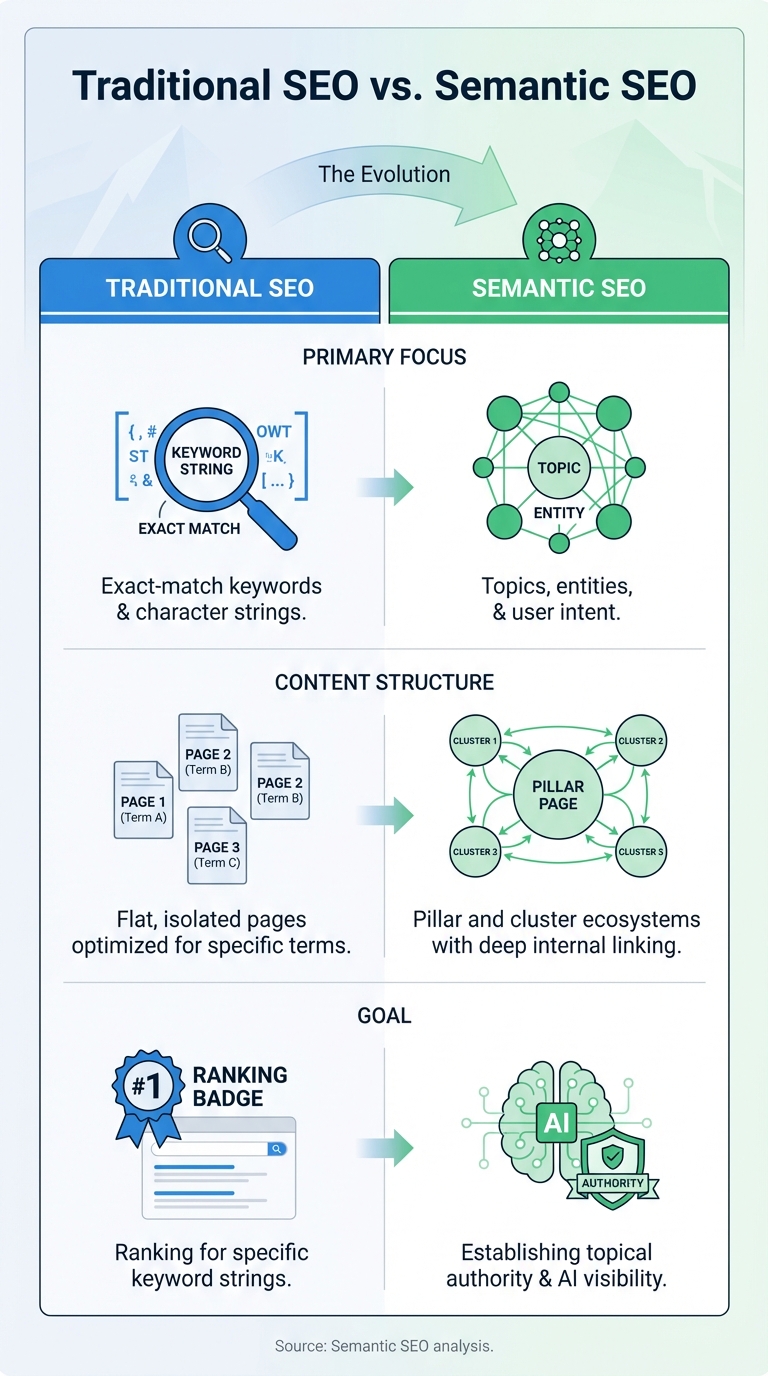
Traditional SEO vs Semantic SEO: Key Differences and Approaches
Semantic SEO shifts the focus from isolated keywords to a broader understanding of meaning. Instead of zeroing in on exact-match phrases, it aims to help search engines grasp the relationships between ideas, the context of a query, and the needs of users. Building on the earlier discussion of context, these principles show how semantic SEO aligns user intent with content structure.
At its core, semantic SEO revolves around three key ideas: understanding what users are searching for, covering topics in-depth to showcase expertise, and connecting related concepts so search engines can see how everything fits together.
Content needs to address the reason behind a query, not just sprinkle in target keywords. For instance, when someone searches for "best project management tools", they’re likely researching options before making a purchase. If your page simply defines project management, it’s missing the point.
Search engines typically categorize queries into four types: informational, navigational, commercial, and transactional. Analyzing the top-ranking pages for your target query can help you determine the intent. For example, if the leading results include how-to guides, your content should likely be informational rather than a direct sales pitch.
Real-world examples show that aligning content with user intent can lead to noticeable boosts in traffic and conversions. Start with BLUF (Bottom Line Up Front) - give users the answer right away - then dive into the supporting details.
Covering a topic thoroughly is more effective than relying on repetitive keywords. Search engines assess the semantic depth of your content - how well you explore a subject and its related subtopics. Research indicates that 82.5% of citations in Google's AI Overview point to in-depth pages that are at least two clicks away from the homepage, rather than surface-level summaries.
Take GeoSLAM, a technology company, as an example. By targeting long-tail technical queries, they created a highly detailed article that generated 18,300 impressions and 816 clicks in just four months. Building depth means anticipating follow-up questions and addressing them naturally. Tools like "People Also Ask" can help uncover what users are curious about next, guiding you toward comprehensive coverage.
Once search intent and topic depth are clear, the next step is to establish strong entity relationships that help search engines understand your content. Entities - such as people, places, products, and concepts - are the building blocks of this understanding. Search engines map how these entities connect to one another. For example, if you’re writing about email marketing, related entities might include automation platforms, open rates, A/B testing, and segmentation. By weaving these related concepts into your content, you provide the context search engines need to categorize and rank your page.
This approach aligns with the Entity-Attribute-Value model: Entity (Email Marketing), Attribute (Metric), Value (Open Rate).
Veruska Anconitano, Multilingual SEO Consultant, puts it simply: "It's the difference between being found by query and being remembered by context".
Clear entity relationships not only improve your chances of appearing in AI-powered search results but also drive more meaningful engagement. Visitors from these AI-driven results convert at more than four times the rate of those from traditional organic searches.
| Feature | Traditional SEO | Semantic SEO |
|---|---|---|
| Primary Focus | Exact-match keywords and character strings | Topics, entities, and user intent |
| Content Structure | Flat, isolated pages optimized for specific terms | Pillar and cluster ecosystems with deep internal linking |
| Goal | Ranking for specific keyword strings | Establishing topical authority and AI visibility |
To put this into action, use internal linking with descriptive anchor text to connect related ideas, implement structured data like JSON-LD schema to define entities and their relationships, and write naturally to convey expertise and clarity.
Now that you’ve got the basics down, let’s dive into how to actually apply semantic SEO. These methods bridge the gap between user intent and search engine algorithms, making your content work harder for both readers and rankings. Whether you’re part of a marketing team planning content or a developer fine-tuning technical details, these strategies can make a big difference.
Semantic SEO isn’t just about keywords; it’s about using terms that help search engines understand context. Search engines rely on embedding vectors to assess the similarity between terms. By including synonyms and related phrases, you guide Google to interpret your content correctly. For instance, it helps differentiate "Apple" the tech giant from "apple" the fruit.
If you’re writing about "PPC", don’t overdo the term. Mix in alternatives like "paid search" or "search advertising." This not only keeps the content reader-friendly but also signals context to search engines. Think of it through the Entity-Attribute-Value framework: treat the subject as an Entity (Apple), its traits as Attributes (Color), and specifics as Values (Red).
"Search engines don't speak English. They speak code. Semantic SEO is about translating your meaning into their language." - Amanda King, Marketing & SEO Consultant at FLOQ
Topic clusters are all about organizing content into tightly connected groups. Start with a pillar page that covers a broad topic comprehensively, and link it to spoke pages that dive into related subtopics. This approach aligns your content with user needs and search engine expectations.
For example, a pillar page on "Retirement Plans" could link to sub-pillars like "401(k) Plans" and "Roth IRA." These sub-pillars could then connect to spoke pages on topics like "Contribution Limits" or "Tax Benefits." Use descriptive anchor text - 3 to 8 words that clearly explain the destination topic. Skip vague phrases like "click here". A hub-and-spoke structure ensures your content is interlinked, making it easier for search engines to crawl and for users to navigate.
Here’s a real-world example: Appliance City grouped its help and advice articles around a central washing machine category page. This strategy contributed nearly 2% of their total revenue through assisted and last-click conversions over a year. Similarly, a project management platform saw a 47% boost in organic traffic by organizing its content into pillar pages and topic clusters.
Research shows that 82.5% of AI Overview citations point to deeper pages - those two or more clicks away from the homepage. This highlights why well-structured topic clusters are critical for visibility, especially in AI-driven search results.
Next, take it a step further by defining relationships between entities through structured data.
Schema markup is like giving search engines a map to your content. It helps them understand how different elements on your page connect. Don’t rely on generic plugins that only cover basics like author or date. Instead, opt for specific properties like about or mentions to clearly define entities and topics.
Use the @id tag to assign unique identifiers (URIs) to entities, allowing you to reference them consistently across pages. This creates an internal knowledge graph that search engines can easily follow. The sameAs property links your entities to authoritative sources like Wikidata or Wikipedia, helping disambiguate terms for search engines.
Rich result schemas - like FAQ, Review, or Product - can make your content stand out in search results. For instance, a technical article created for GeoSLAM using long-tail queries and semantic relationships generated 18,300 impressions and 816 clicks between June and October 2022. Adding structured data played a key role in establishing the content’s authority within a niche market.
"Adding descriptive schema markup to a website's web pages provides the missing piece for machines: context. That is, how one entity is related to another." - Daniel Cheung, Enterprise SEO Strategist
For implementation, developers should use JSON-LD and validate it with Google’s Rich Results Test. Meanwhile, marketing teams can map key pages to authoritative identifiers to boost credibility.
To effectively implement semantic SEO, you need tools that help identify entities, assess topic coverage, and uncover content gaps before they hurt your rankings. Here’s a closer look at some of the best options available.
The Google Natural Language API gives you a glimpse into how search engines interpret your content. It analyzes text to identify entities like people, places, organizations, and concepts, assigning each a salience score to indicate its importance to your page. What sets this tool apart is its ability to contextualize mentions. For instance, it can differentiate whether "Apple" refers to the tech company or the fruit.
Beyond entity recognition, the API offers sentiment analysis, providing scores between -1.0 (negative) and 1.0 (positive), along with a magnitude metric to measure the intensity of emotions. It also uses dependency trees to map out word relationships within sentences. If you're new to Google Cloud, you can take advantage of $300 in free credits to test the API. Running your top-performing URLs through this tool can reveal which entities are associated with each page. If there’s a mismatch with your intended focus, it might indicate semantic drift.
Advanced AI tools go beyond basic entity detection, offering actionable insights to refine your content. Tools like Diffbot and spaCy extract entities from your content, showing which concepts are emphasized and highlighting areas where your content might fall short.
Surfer SEO uses NLP scoring within a real-time content editor to suggest semantically related terms that align with authoritative content expectations. Similarly, Clearscope evaluates your content and grades it based on how well it addresses a topic's semantic requirements.
For larger teams, MarketMuse provides AI-driven topic modeling and gap analysis to help establish topical authority. It identifies missing entities and subtopics that could strengthen your content. Tools like Rankability integrate IBM Watson and Google Natural Language Understanding to deliver entity-rich keyword recommendations. Meanwhile, AirOps allows agencies to create custom AI workflows using models like GPT-4 and Claude, helping to spot content gaps and optimize for better search visibility.
"LLMs like ChatGPT provide generic advice that doesn't consider what's already on the page. But Chatsonic identified real areas for improvement and concrete suggestions - it felt like collaborating with another SEO expert on the team!" - Evelina Milenova, SEO and Growth Manager, Opinion Stage
This section dives into how semantic principles can be applied to marketing websites. For these sites, it's essential to clarify the meaning of each page so that search engines and AI systems can accurately interpret their focus. With the rise of entity-first optimization, every landing page should center on a single, well-defined concept. Your H1, meta title, and schema mainEntityOfPage should all align with that specific entity.
Each page should map to a unique entity. For instance, a page about running shoes should reference a public identifier like a Wikidata Q-ID, rather than overloading the content with generic terms. Structuring content using the Entity-Attribute-Value (EAV) model can help. For example, if the entity is "Product", attributes like "Price" or "Material" can be paired with specific values.
A practical example of this approach is Express Doors Direct. By implementing entity-rich content across more than 200 pages, they achieved nearly 500% more organic sessions and over 365% growth in transactions and revenue.
Building topical authority is another critical step. Start by creating pillar pages that cover broad topics and support them with cluster pages targeting subtopics. Use descriptive anchor text to highlight entity relationships. Adding an FAQ section with schema markup can help your content appear in "People Also Ask" boxes. For clearer content relationships, use JSON-LD schema. Define links between entities like Product → Brand → Organization, and include @id and sameAs attributes to connect with authoritative sources.
Finally, aligning your content with user intent is key to making your landing pages more effective.
Your content should match what users are looking for. For example, someone searching for "best project management software" (commercial intent) expects comparison tables and reviews, not a sales pitch. On the other hand, a query like "buy Asana subscription" (transactional intent) calls for pricing details and a checkout button - not a lengthy guide.
| Query Type | User Goal | Content Strategy |
|---|---|---|
| Informational | Seeking knowledge/answers | "What is..." guides, FAQs, definitions |
| Navigational | Finding a specific page | Clear brand/product names, login pages |
| Commercial | Researching options | Comparison tables, "Best of" lists, reviews |
| Transactional | Taking action/buying | Product pages, calculators, "Buy now" buttons |
Apply the BLUF principle (Bottom Line Up Front) to ensure users and AI crawlers quickly find value. Place the most critical information directly after subheadings.
Lee Wallis, Head of Digital at Excite Media, advises: "If it only takes 500 words to thoroughly answer the user's search query, don't write a 5,000-word article. That will give the user a poor experience".
Interestingly, visitors arriving from AI-driven search results convert four times more often than those from traditional organic traffic. This makes aligning your content with intent even more important. By early 2025, 18.76% of keywords in U.S. search results will trigger AI Overviews, and 82.5% of Google AI Overview citations will link to deep pages two or more clicks away from the homepage.
Once your pages align with user intent, tracking performance becomes the next step.
Use Google Search Console to track unique queries for each page. Filter by URL to identify distinct queries driving impressions. If a page sees a 25–100% increase in unique queries after an update, it's likely filling entity gaps effectively. Monitor how often your brand appears in AI Overviews, Knowledge Panels, Featured Snippets, and "People Also Ask" boxes. This entity-level visibility is a strong indicator that search engines view your content as credible.
Evaluate internal link density to measure the strength of your content clusters. Each cluster page should have at least two internal links and two sibling cross-links. Tools like Screaming Frog or Sitebulb can help you map these relationships and identify weak spots in your semantic structure.
Regularly check for semantic drift by comparing your content's vector embeddings with top-ranking competitors. This ensures your page stays relevant as online trends evolve. Use Google's Rich Results Test to confirm that your @id, sameAs, and mainEntityOfPage attributes correctly link to recognized Knowledge Graph identifiers.
Finally, track metrics like average engagement time and scroll depth to gauge how well your content meets user intent. For example, one B2B e-commerce brand reported a 47.92% increase in unique ranking keywords and a 627.58% rise in first-place rankings after adopting a semantic content clustering strategy.
Semantic SEO is all about making your content crystal clear for search engines and AI systems. It’s not about cramming in keywords anymore - it’s about creating meaningful connections between ideas, addressing user intent, and organizing your site into topic clusters that showcase genuine expertise.
To get started, assign a specific entity to each page. A simple way to do this is by creating a spreadsheet that links each URL to a distinct concept, using public identifiers like Wikidata Q-IDs. Make sure your entity mapping aligns with your topic clusters to strengthen your site’s thematic focus. After that, implement JSON-LD schema markup to define relationships between entities - for example, linking products to their brands or brands to their parent organizations. This structured data helps search engines understand your content’s context and fit it into the right semantic framework. This method provides a solid foundation for ongoing optimization and refinement.
With AI-powered search results driving higher conversion rates and AI Overviews now appearing frequently in U.S. search results, optimizing for semantic clarity isn’t optional - it’s crucial. As search evolves toward meaning-based discovery, staying ahead means ensuring your content is easy for these systems to interpret.
After three months, check your progress. Use Google Search Console to track unique queries, monitor Knowledge Panels and AI Overviews, and review your internal linking to strengthen those topic clusters. The focus here isn’t on quick wins but on building lasting topical authority. By making continuous improvements, you’re setting your content up for long-term success in search visibility.
Semantic SEO is all about grasping what users truly want and crafting content that dives into the meaning behind their search queries. Instead of focusing solely on exact-match keywords, this approach prioritizes addressing broader topics, weaving in related terms, and using entities to add depth and context. The goal? To create content that's not just relevant but also genuinely helpful.
On the other hand, traditional SEO often revolves around picking a handful of target keywords and sprinkling them throughout the content. Semantic SEO goes beyond this by matching the way search engines now understand language and connections. This makes your content feel more natural and, ultimately, more valuable to readers.
Entities refer to specific concepts like people, places, products, or ideas that search engines can identify and link through their Knowledge Graph. Instead of just focusing on keywords, search engines use entities to grasp the context and meaning behind content, as well as how it connects to other topics. This approach helps deliver more precise and relevant results, even when queries are vague or phrased differently.
When you include entities in your content - by naming them clearly, offering relevant information, and linking them to related ideas - you make it easier for search engines to understand your page’s intent. This can enhance your rankings, establish your topical authority, and boost visibility in both traditional search results and AI-powered features like answer panels.
Structured data is a type of code you add to your website to help search engines grasp the meaning behind your content. It uses standardized formats like Schema.org to tag important details - think products, events, or reviews - in a way that's straightforward for search engines to interpret.
When you use structured data, search engines can create enhanced search results, such as rich snippets, showing things like ratings, prices, or event specifics right in the search listings. These eye-catching features not only make your page stand out but also increase click-through rates and help search engines align your content with what users are looking for. It's a smart way to strengthen your semantic SEO efforts.