





Insights
Webflow
Copy Link




Compare costs, launch times, and scalability of Webflow retainers vs in-house developers to see which option is faster, cheaper, and more flexible for marketing sites.
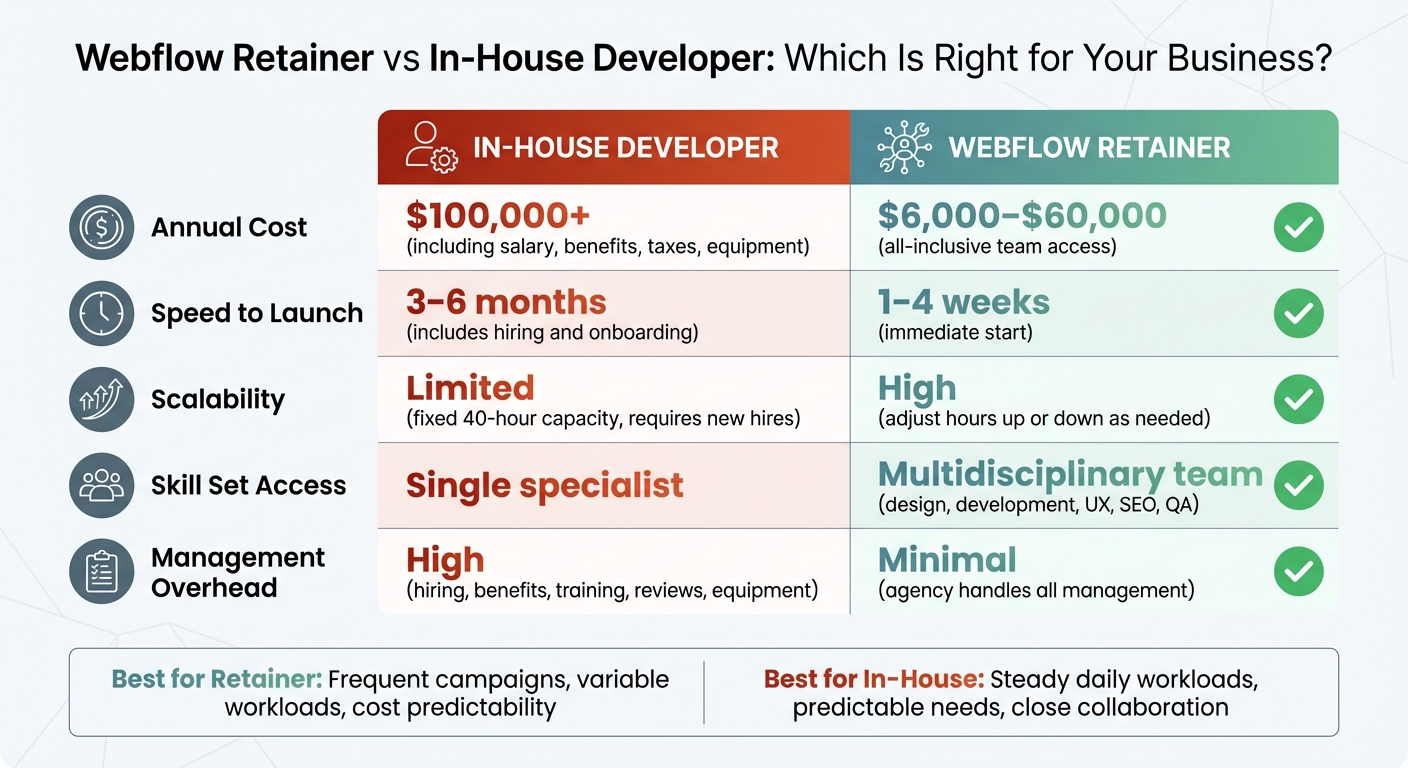
When it comes to maintaining your marketing website, you have two main options: hiring an in-house Webflow developer or using a Webflow retainer service. Here’s the key takeaway: retainer services often save you money, deliver faster results, and offer more flexibility compared to hiring full-time staff.
| Factor | In-House Developer | Webflow Retainer |
|---|---|---|
| Annual Cost | $100,000+ | $6,000–$60,000 |
| Speed | 3–6 months to launch | 1–4 weeks to launch |
| Scalability | Limited (fixed capacity) | High (adjustable hours) |
| Skill Set | Single specialist | Multidisciplinary team |
| Management Overhead | High (hiring, benefits) | Minimal (handled by agency) |
If your business needs Webflow design and development for quick updates, frequent landing page campaigns, or cost predictability, a Webflow retainer is likely the better choice. But for companies with steady, predictable workloads requiring daily collaboration, an in-house hire might make sense.
Webflow Retainer vs In-House Developer: Cost, Speed, and Flexibility Comparison
Bringing an in-house Webflow developer on board comes with a hefty price tag even before they start working. Recruitment fees, onboarding processes, and purchasing necessary equipment like laptops and software licenses can quickly add up to thousands of dollars - and that’s before a single webpage is live.
Opting for a retainer service flips the script. There are no recruitment fees, no onboarding delays, and no equipment costs. The team is ready to work immediately, and you pay a consistent monthly fee that covers everything - design, development, technical support, and software - rolled into one predictable price.
In-house developers bring additional financial responsibilities beyond their salary. Health benefits, 401(k) contributions, payroll taxes, ongoing training, and separate Webflow subscription fees (Workspace plans at $19–$49 per seat/month and Site plans at $14–$212 per month) all factor into the equation. With a retainer, these software costs are typically included or managed as part of the service, saving you from juggling multiple subscriptions.
"Salaries, benefits, ongoing training, and equipment for an in-house team can quickly add up. Over time, these costs often outweigh the expenses associated with outsourced Webflow solutions." - Tuesday Solutions
These recurring and up-front costs create a clear divide in financial impact between the two options.
The yearly expenses make the differences even more apparent. A qualified in-house Webflow developer commands a $60,000 to $100,000+ annual salary. Once you factor in benefits, payroll taxes, and additional software licenses, the total cost typically exceeds $100,000 per year.
By contrast, The Hoop Studio's Webflow retainer service ranges between $500 and $5,000 per month, amounting to $6,000 to $60,000 annually. Even at the higher end, this fee grants you access to a multidisciplinary team - including strategy, UX, UI, development, and QA - at a fraction of the cost of a single in-house hire.
Here’s how these costs stack up:
| Cost Category | In-House Webflow Developer | Webflow Retainer Service |
|---|---|---|
| Up-front Costs | Recruitment, onboarding, equipment, training | $0 (No setup or hiring fees) |
| Annual Base Cost | $60,000 – $100,000+ | $6,000 – $60,000 |
| Benefits & Taxes | 20–30% on top of salary | Included in monthly fee |
| Software/Tools | $19–$49/seat/month + site plans | Bundled or managed by provider |
| Skill Set | Single specialist | Multidisciplinary team |
For businesses with variable workloads, the cost advantages of a retainer become even more compelling. You avoid paying a full-time salary during slower periods, while still having the flexibility to scale up during high-demand projects. This adaptability helps prevent wasted spending on unused capacity while ensuring you’re ready for major campaigns.
Bringing an in-house Webflow developer on board can take weeks - or even months - due to recruitment, onboarding, and training processes. Once hired, these developers often juggle competing priorities like product roadmaps, bug fixes, and meetings, which can push marketing requests to the back burner.
With a Webflow retainer, things move much faster. Retainer teams are ready to jump in and start delivering right away. Many services, such as The Hoop Studio, provide service level agreements (SLAs) that guarantee updates and changes within 24–48 hours. Whether it’s landing page tweaks, campaign adjustments, or content updates, these tasks are addressed almost immediately.
"In-house developers may juggle multiple priorities, leading to slower response times. This delay could cost your company valuable leads or conversions, especially during time-sensitive campaigns." – Tuesday Solutions
The difference becomes even more striking during high-demand periods. Retainer services can quickly scale up by adding developers or designers to tackle urgent deadlines, while in-house teams may hit capacity limits. If your sole in-house developer is unavailable, work could come to a standstill - a risk that retainer teams avoid with built-in redundancy. This flexibility directly translates to faster marketing campaign rollouts.
Fast project delivery ties directly into quicker marketing campaign launches - critical for time-sensitive initiatives. Traditional workflows can stretch launch timelines by months. In-house teams often rely on segmented processes, where design is handed off to development, and then to QA. Each step adds days or even weeks.
Webflow retainers streamline this process, cutting launch times by 30–50%. Designers work directly within the platform, eliminating the need for design-to-code transitions. This approach allows agencies to launch full marketing sites in just one to four weeks, while landing pages can go live in a matter of days instead of months.
For example, in 2024, Vancouver-based tech company VRIFY faced a tight 30-day deadline to launch a high-impact marketing site for a major investor event after securing $12.5 million in Series B funding. Using a Webflow retainer, they executed a two-phase rollout that resolved inconsistent design files and built a scalable CMS. The site launched on time, impressing stakeholders and setting the stage for future growth.
For marketing teams juggling multiple campaigns - like A/B tests, paid ad landing pages, or product launches - this speed advantage becomes even more valuable. Retainer services ensure project kick-offs within 48 hours and provide priority scheduling. This rapid delivery model keeps your marketing efforts agile and responsive to shifting market demands.
In-house teams come with a fixed capacity. When you hire an in-house Webflow developer, you're essentially locking in one person's availability - usually 40 hours a week. This setup can become a roadblock during busy periods like product launches or seasonal campaigns. If demand spikes, your only option is to hire another developer, a process that typically takes anywhere from 4 to 12 weeks.
Webflow retainers offer a more adaptable solution. Services like The Hoop Studio provide the ability to scale resources up or down as needed. When workloads increase, additional team members can be deployed quickly. When things slow down, you can reduce your monthly hours or even pause the retainer altogether - no layoffs, no awkward conversations, no wasted capacity.
"Agencies can quickly deploy additional resources, ensuring you stay ahead of your growth curve. In contrast, in-house teams may hit bottlenecks during high-demand periods." – Tuesday Solutions
This flexibility is particularly appealing for early-stage SaaS companies or startups, where growth is often unpredictable. Instead of shouldering the cost of a full-time employee during quieter months, you only pay for the work you actually need. Plus, the real cost of an in-house hire is 1.4x to 1.7x their base salary when you include benefits, taxes, and overhead. By reallocating resources dynamically, you not only speed up project timelines but also save money - further reinforcing the financial advantages.
But scaling isn't the only challenge. Managing the day-to-day ups and downs of workload is just as crucial.
Web development needs rarely follow a steady rhythm. One week, you might need two landing pages; the next, a homepage overhaul; and after that, just minor updates. In-house developers often struggle with this unpredictability because their schedules and capacity are fixed. When workloads increase, they juggle competing priorities. When workloads drop, you're still paying for their full-time salary, even if they're underutilized.
Retainer services are built to handle these fluctuations seamlessly. They use parallel task management and priority scheduling to keep everything moving smoothly. For instance, The Hoop Studio can allocate different team members to different tasks simultaneously. If you need A/B test variations for a paid campaign while preparing a product launch page, both can move forward at the same time - something a single in-house developer simply can't do. This speed is vital when implementing Webflow SEO tips for lead generation that require rapid structural adjustments.
Continuity is another key advantage. If your in-house developer takes sick leave, goes on vacation, or resigns, your web projects can grind to a halt. Retainer teams, however, have backup resources ready to step in immediately. This reliability is why about 35% of businesses opt for developers on retainer to ensure consistent support and maintenance.
And when priorities shift, agencies can quickly reassign team members to align with your new goals - no need for the internal reshuffling that slows down in-house teams.
A Webflow retainer can be a smart choice when your business requires senior-level expertise across multiple areas - such as design, development, SEO, and UX - but you want to avoid the high overhead of a full-time hire. Employing an in-house developer comes with extra costs, including taxes and benefits, which can increase base salaries by 25–35%. That means you're looking at a total monthly cost of $7,300 to $13,500. For many small-to-mid-sized teams, this isn't feasible, especially when website needs tend to ebb and flow.
The Hoop Studio has structured its retainer tiers to fit different workload needs. For example, the Essentials Partner plan (starting at £2,500/month) is perfect for teams that need ongoing maintenance, SEO monitoring, and quick CMS updates —essential for managing dynamic content— - the kind of tasks that keep a site functioning smoothly without requiring constant attention. The Professional Partner plan (£4,500/month) includes added design support and guarantees a 48-hour project kick-off, making it ideal for teams juggling multiple campaigns at once. At the top tier, the Enterprise Partner plan (£8,500/month) provides a full team - including two developers, a senior designer, and a project lead - capable of handling parallel tasks without the hassle of hiring in-house.
"The monthly retainer fee is often significantly less than the fully loaded monthly cost of even a relatively junior full-time hire, especially when you factor in the strategic value and breadth of expertise." – Jason Skipper, Web Developer and Digital Marketing Professional
Unlike working with freelancers, a retainer ensures long-term brand consistency and a setup designed to avoid technical debt. Plus, there's no downtime - if one team member is unavailable, another steps in immediately, something a lone in-house developer simply can't provide. These retainer plans are tailored to give you exactly the level of support you need, no matter how your demands change.
These structured pricing models shine in specific situations. For instance, if you're a small team needing fast execution on marketing campaigns but can't justify the cost of a six-figure salary for a single specialist, a retainer gives you access to an entire team without the financial burden.
If you're managing multiple campaigns and need landing pages, A/B tests, or updates delivered in days instead of weeks, a retainer is designed to meet that speed. Take Avarra AI, an enterprise AI platform, as an example. In July 2025, they used a Webflow retainer service to rebuild their website. Within six weeks of launching the new site, they saw a 100% increase in traffic and a 120% boost in conversions, directly enhancing their enterprise sales efforts.
"Within six weeks of launching our new site... our traffic and conversions more than doubled. Their work had a significant impact on our growth." – Brandon Redlinger, CMO of Avarra AI
Another key advantage is cost predictability. Instead of dealing with fluctuating expenses like plugin licenses, security updates, or emergency fixes, a retainer offers a fixed monthly price. Some organizations have even saved over $850,000 by switching from legacy CMS platforms and full-stack developers to a Webflow-based solution. And if your workload changes seasonally, you can easily scale your retainer up during busy periods and down during slower ones. This flexibility means no layoffs, no wasted resources, and no difficult conversations. It’s a scalable, predictable solution that aligns perfectly with businesses running fast-paced marketing campaigns or dealing with fluctuating demands.
Let’s break down the key differences in cost, speed, and flexibility between an in-house Webflow developer and a Webflow retainer. Hiring an in-house developer comes with a hefty price tag of over $100,000 annually - this includes salary, benefits, taxes, and equipment costs. In contrast, Webflow retainers range from $24,000 to $90,000 per year. The value becomes even clearer when you realize that a retainer grants you access to a whole team of specialists - designers, developers, and SEO experts who specialize in Webflow SEO for lead generation - compared to the more limited skill set of a single hire.
When it comes to speed, retainers shine. Agencies can launch marketing websites in just 1–4 weeks, while in-house teams often take 3–6 months. If your website is a key revenue driver, faster launches mean quicker returns on investment. Retainers also offer unmatched flexibility. You can scale resources up during busy periods, like product launches, and scale back down afterward - no need to worry about layoffs or idle staff.
| Factor | In-House Developer | Webflow Retainer |
|---|---|---|
| Annual Cost | $100,000+ (fully loaded) | $24,000–$90,000 |
| Speed to Launch | 3–6 months | 1–4 weeks |
| Scalability | Limited; requires new hires | High; can adjust hours as needed |
| Skill Access | Expertise of a single hire | Multidisciplinary team access |
| Management Overhead | High (hiring, benefits, reviews) | Minimal; agency handles management |
These comparisons underline how each option aligns with different priorities, whether it’s cost-efficiency, speed, or scalability.
If your business relies on frequent marketing campaigns or operates under tight deadlines, a Webflow retainer is the smarter choice. It eliminates the long-term financial commitment and administrative burden of a full-time hire while offering the agility to adapt to time-sensitive opportunities. For example, if you’re preparing for a product launch or investor event, a retainer can quickly mobilize the resources you need without the delays of hiring and onboarding.
However, an in-house solution might make sense for mature companies with a steady stream of web work that demands close, daily collaboration with internal teams. Keep in mind the potential downside of underutilized resources - if your high-impact web tasks don’t consistently fill 40 hours a week, a retainer could be the more cost-effective route. Ultimately, the best choice depends on your business strategy and workload. Teams focused on growth often lean toward retainers for their ability to control costs, deliver quickly, and scale without the overhead of full-time staff.
This model is why many fast-moving marketers are shifting toward specialized studios to maintain agility.
A Webflow retainer is ideal for handling ongoing tasks like regular website updates, maintenance, and gradual improvements. This setup provides the flexibility to manage continuous content updates, make design adjustments, and address troubleshooting needs without the hassle of renegotiating terms each time. On the other hand, if you're tackling a one-time project, such as building or redesigning a website from scratch, a project-based model is a better fit. Retainers are designed to offer steady support and adapt to the changing demands of your business.
Retainer SLAs for urgent updates usually guarantee responses within 12–24 hours, even on weekends. Regular support is available Monday through Friday, centered on the predefined scope of work. These agreements often include proactive monitoring and preventative maintenance, aiming to catch and resolve potential problems early to reduce interruptions.
Hiring in-house works best when your business demands steady development support, tighter control over projects, and the ability to respond swiftly to changes. It's a great fit if your team is equipped to handle web development internally and align it with your broader, long-term objectives. This option is particularly useful for projects that need regular updates, custom integrations, or specialized skills that are deeply tied to your company's way of working.