






Insights
SEO & GEO
Copy Link




How SEO and GEO differ, when to use each, and how to optimize pages for traffic, direct answers, snippets, and voice search.
Yes - most sites need both. I’d use SEO to help pages rank and bring visits, and GEO to help answer blocks get picked by AI tools, voice search, featured snippets, and People Also Ask.
Here’s the short version:
This matters more now because more searches end without a click. In one 2024 study, nearly 60% of Google searches in the U.S. were zero-click. At the same time, AI answer features are taking up more space in search results. That means being the page that ranks is not always the same as being the answer people see first.
If I had to make the call fast, I’d sort pages into 3 buckets:
A simple rule: if a page needs to bring people to your site, lead with SEO. If a page needs to answer a question fast, lead with GEO. If it must do both, build for both from the start.
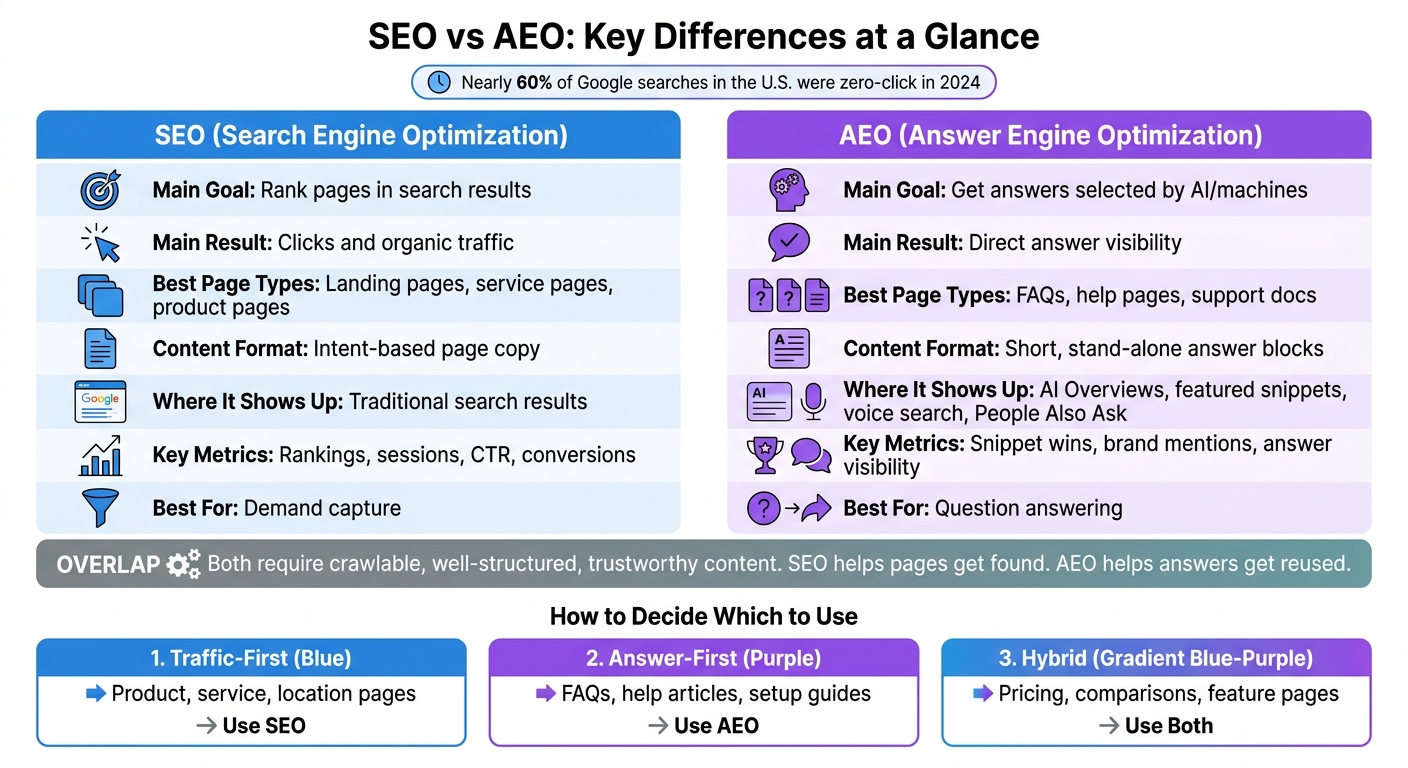
SEO vs GEO: Key Differences at a Glance
| Criteria | SEO | GEO |
|---|---|---|
| Main goal | Rank pages | Get answers selected |
| Main result | Clicks and traffic | Direct answer visibility |
| Best page types | Landing pages, service pages, product pages | FAQs, help pages, support docs |
| Main format | Intent-based page copy | Short, stand-alone answer blocks |
| Where it shows up | Search results | AI answers, snippets, voice, PAA |
| Main metrics | Rankings, sessions, CTR, conversions | Snippet wins, mentions, answer visibility |
| Best for | Demand capture | Question answering |
Bottom line: SEO helps people find your page. GEO helps machines use your answer. Once I know the job of each page, the right mix is usually clear.
SEO tunes individual pages so search engines can crawl them, understand them, and rank them for the right searches. When that happens, the right visitors click through to your site.
SEO turns search demand into visits, leads, and sales by matching individual pages to specific search intents and making those pages easier to rank.
First, the page needs to be crawlable, indexable, and technically sound. Then the focus moves to intent alignment. Each page should go after one clear intent - informational, commercial, transactional, or navigational - so the content lines up with what the searcher wants to do.
A page targeting "enterprise SEO platform" should speak to a buyer. A guide on "how SEO works" fits someone who is still in the research phase.
Relevant backlinks, steady topical coverage, and authority signals also help build trust with search engines.
Here’s what that can look like on a landing page built for search traffic.
Consider a landing page targeting the keyword "SEO consulting services" for U.S. businesses:
/seo-consulting-services paired with a title tag that names the service and its value: "SEO Consulting Services for U.S. Businesses | Drive Qualified Organic Traffic."
SEO is built to win clicks. GEO is built to win selection as the answer. That ranking-first approach makes sense when traffic matters most; the next section shows how GEO works when answer selection matters more.
Where SEO sets up a page to rank, GEO sets up answer blocks so machines can pull them out. The idea is simple: arrange content in a way that answer engines can read, understand, and quote with little friction.
GEO is built for places where people want an instant reply: AI assistants, voice search, featured snippets, and People Also Ask panels.
To get picked, content has to be easy for machines to parse. That usually means question-style headings, short answer blocks that stand on their own, clear names for products, people, and topics, and schema markup that spells out what kind of content is on the page.
Take a FAQ page built for answer selection. Each section starts with an H2 that matches a real user question - "Can I change my billing date?" or "What happens if my payment fails?" - instead of a broad heading like "Billing Information."
Then the first one to three sentences under that heading give a complete answer on their own. For example: "Yes, you can change your billing date. Go to Settings → Billing → Billing Date and select a new date. The change takes effect on your next invoice." An AI tool can quote that block word for word without needing extra context.
After that, you can add supporting detail like edge cases, screenshots, and related links. The page also uses FAQPage schema in JSON-LD, which maps each question to its matching answer text. And each answer names the product directly instead of leaning on fuzzy words like "it" or "the platform." That helps AI systems connect the answer to the right brand.
That difference becomes clearer when you compare workflows, outputs, and success metrics.
SEO and GEO both shape visibility. But they don’t win in the same places, and they’re not judged by the same scorecard. You can see the gap fast when you put a landing page next to a help page.
Here’s the practical split by goal, format, and measurement.
| Dimension | SEO | GEO |
|---|---|---|
| Primary goal | Rank for clicks | Win direct answers |
| Where content appears | Traditional search results | AI Overviews, featured snippets, People Also Ask, voice assistants |
| Content style | Intent-led page copy | Short answer blocks |
| Page structure | Landing pages, pillar pages, topic clusters | FAQs, help pages, modular answer blocks |
| Technical requirements | Crawlable, fast, structured site | Same, plus schema and clear formatting |
| Measurement focus | Rankings, organic sessions, CTR, conversions | Answer visibility, snippet capture, brand mentions |
| Best-fit use case | Pages meant to attract traffic and convert visitors | Content meant to answer questions instantly in AI-driven experiences |
GEO builds on SEO. Both depend on crawlable, well-structured, trustworthy content. SEO helps a page get found. GEO helps the answer get reused.
That’s the key point: SEO still matters even if your main aim is GEO. If search engines can’t find, read, and make sense of the page, it’s hard for AI-driven surfaces to pull from it.
This is where things split.
SEO looks at rankings, organic sessions, click-through rates, and conversions. GEO looks at answer visibility, featured snippets, FAQ rich results, People Also Ask, and brand mentions in AI tools.
Put simply, SEO asks, “Did the page bring in traffic?” GEO asks, “Did the answer show up?” That difference helps you decide whether a page should lean toward SEO, GEO, or both.
Once you've compared goals, formats, and metrics, the next move is figuring out the right mix for each page. In most cases, growth-focused teams need both. The split comes down to what the page is supposed to do: rank, answer, or both.
Start with SEO for service pages, product pages, and location landing pages. These pages are there to capture demand from people already searching for what you sell.
Track performance with:
A B2B SaaS company going after "CRM for real estate agents" needs a landing page with solid structure, a clear value proposition, and a strong call to action. If the page needs to pull in traffic, SEO should lead.
GEO makes sense when the page is built to explain, guide, or clear something up. That includes documentation, onboarding guides, comparison explainers, and FAQs.
These pages are made for direct retrieval by AI tools and voice assistants. And when your content gets picked as a direct answer, your brand can show up before a prospect even lands on your site.
Most growth-focused websites need both. SEO handles discovery and acquisition. GEO handles the answer-selection layer, making sure your content is clear enough for AI systems to extract, cite, and reuse at the page level.
Put simply, they work better together.
Once you know a page's job, the choice gets pretty simple. Map pages as traffic-first, answer-first, or hybrid. A pricing page that needs to rank and answer "how does your pricing work?" in AI tools is a hybrid. A launch page for a new feature is traffic-first. A help article that explains error codes is answer-first. Once intent is mapped, the optimization strategy usually falls into place.
A page is SEO-first when it’s built to rank in standard search results. The focus is on keywords, internal links, metadata, site speed, and a clean structure that helps the page earn clicks.
A page is GEO-first when it’s built to give direct answers in AI tools and voice search. That usually means question-based headings, short 40- to 60-word answers, a clear layout, and schema markup.
Yes. GEO can help even if your page doesn’t rank well in standard search results.
While SEO is mostly about ranking pages, GEO is about making your content easy for AI tools to pull, understand, and cite in direct answers. That means your page can still show up in AI-driven responses even while your site’s search authority is still growing.
A few tactics can help:
Think of it this way: SEO helps people find your page in a list of results. GEO helps AI systems grab the right part of your page and use it in the answer itself.
You don’t have to pick one and ignore the other. They do different jobs.
SEO builds the technical base of your site. That includes site structure, indexing, and metadata so search engines can find, crawl, and understand your content.
Once that base is in place, add GEO tactics. Use schema markup, concise answer formats, and clear entity signals to help AI tools interpret your content and cite your brand in direct answers.