





Insights
Webflow
Copy Link




Use white-label Webflow to scale your agency, cut developer costs, fill skill gaps, and protect margins—plus partner vetting tips.
Yes, white-label Webflow development can be worth it for agencies - especially those looking to scale efficiently, fill skill gaps, or manage tight deadlines. Here’s why:
However, success depends on selecting a reliable partner, managing internal project oversight effectively, and ensuring quality control. If Webflow projects are a regular part of your business, a white-label approach could help you scale while maintaining quality and profitability.
Agencies often find it challenging to scale effectively as client demands increase. White-label Webflow development offers solutions to several key hurdles that arise during growth.
Bringing in in-house Webflow developers can be costly and time-consuming. Recruitment delays, fixed salaries, and under-utilized staff during slower periods can strain resources. White-label partnerships eliminate these issues.
"A reliable white label Webflow development company can help you access a trained team without fixed costs, onboarding delays, or bench costs during slow months." - Prince Kapoor, Digital Marketing Expert
For example, in March 2026, E2M Solutions was working with over 1,100 agencies and had delivered more than 300 Webflow websites, all while maintaining a 98% client retention rate. This approach allows agencies to take on more projects without increasing staff, helping maintain profitability.
In addition to managing higher work volumes, white-label partners bring specialized expertise that internal teams may not possess.
Not every agency has the technical know-how for Webflow’s advanced features, such as custom interactions, modular CMS setups, and Webflow SEO strategies. Lacking these skills can lead to missed opportunities or subpar project outcomes. By collaborating with a specialized partner, agencies can bridge these gaps effectively.
A great example is Fluid, a white-label Webflow agency. They built a bilingual website for Charmer Studio with flawless precision and a CMS structure that allowed the client to manage their content independently.
"Webflow is becoming a core competency rather than a niche add-on for agencies." - Prince Kapoor, Digital Marketing Expert
This level of technical expertise enables agencies to confidently expand their service offerings without compromising quality.
Adding Webflow development, ongoing support, and CMS training to your services can create operational complexity if managed internally. White-label partnerships simplify this process, allowing agencies to grow their offerings without increasing overhead.
White-label Webflow services often cost 40–60% less than building in-house capabilities, as they eliminate expenses related to recruitment, benefits, and training. Monthly retainers typically range from $799 to $3,999, providing predictable costs that are easy to incorporate into project pricing.
Not every agency needs a white-label partner, but for many, the right moment becomes clear once you recognize the signs. Here are three scenarios where it makes perfect sense.
White-label Webflow services shine when Webflow work is a regular part of your workload, not just an occasional request. If Webflow projects account for 40% or more of your incoming work, outsourcing often becomes more efficient than trying to manage everything in-house. A steady stream of projects makes it easier to justify outsourcing, helping your agency scale effectively while maintaining high-quality results.
It’s also a lifesaver when your team is stretched thin and deadlines loom.
Client timelines can be unforgiving, and internal capacity doesn’t always align with demand. If a project requires a quick two-week turnaround but your team is already maxed out, bringing in a white-label partner ensures you can deliver without cutting corners.
"A white label website developer gives you extra help right away – no need for hiring, training, or long-term commitments." - Digital Octane
The trick is to establish this partnership before you’re in a time crunch. Scrambling to vet a partner when you’re already overwhelmed can lead to rushed decisions and added stress. Having a reliable partner in place ahead of time keeps your workflow smooth and your clients happy.
Profitability is always top of mind for agencies, and white-label services can be a smart way to keep costs in check. Hiring a full-time Webflow developer can run over $185,000 per year when you include salary, benefits, and overhead. With white-label services, you only pay for what you need, when you need it.
Agencies often mark up white-label project costs by 50% to 150%, allowing them to stay competitive while maintaining healthy margins.
"White label creates leverage when it helps you do three things consistently: package services clearly, produce deliverables predictably, and prove value through outcomes." - Geeks for Growth
If high developer costs are squeezing your profits, white-label development offers a flexible, cost-effective alternative. By scaling expenses with your workload, you can take on more projects, address skill gaps, and keep your agency profitable - all without the burden of fixed payroll costs.
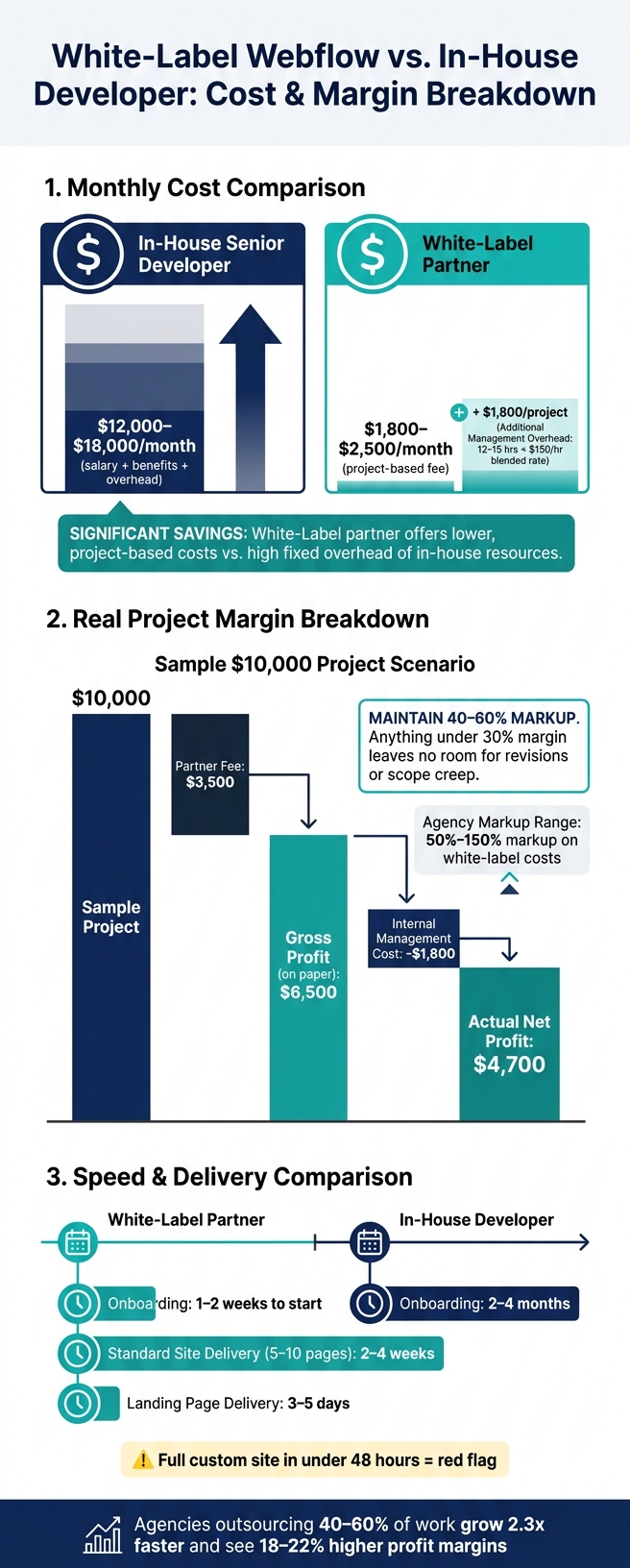
White-Label Webflow vs. In-House Developer: Cost & Margin Breakdown
Let’s break down the financial side of using white-label services, focusing on how these costs impact your margins. The numbers reveal why white-label Webflow services can be a game-changer for agencies looking to scale, though the details require careful consideration.
Bringing a senior in-house developer on board can cost $12,000 to $18,000 per month when you factor in salary, benefits, and overhead. In contrast, a white-label partner typically charges $1,800 to $2,500 per month for similar output. However, project management tasks - like briefings, staging reviews, and feedback - add another layer of expense. These tasks often require 12–15 hours per project, and at a blended rate of $150 per hour, that’s an additional $1,800 you’ll need to account for.
For instance, on a $10,000 project where the partner fee is $3,500, your gross profit might seem to be $6,500. But once you factor in internal management costs, the actual profit is closer to $4,700.
"The margin is real on paper. Whether it survives contact with reality depends on how efficiently you run the process." - Stan Suboticki, Founder, North Pole Digital
To maintain a 40–60% markup, it’s crucial to include internal management hours as part of your upfront cost calculations. Anything under a 30% margin leaves little room to handle revisions, scope creep, or unexpected quality assurance needs.
One of the biggest advantages of white-label partners is their speed. They can typically begin projects within 1–2 weeks, compared to the 2–4 months it usually takes to onboard an in-house developer. For standard Webflow sites (5–10 pages), delivery timelines are often 2–4 weeks.
However, prioritizing speed over quality can backfire. Promises of a fully custom site in just 48 hours are often a warning sign. Such claims may indicate rushed testing or overlooked technical details. Beyond aesthetics, attention must be given to the site’s CSS structure, Webflow CMS architecture, and Core Web Vitals performance.
"The cheapest quote is almost never the best value. A $2,000 build requiring $1,500 in fixes costs more than a $3,000 build that ships clean." - Prince Kapoor, Digital Marketer and Web Development Expert
A smart move is to request a prospective partner’s QA checklist before signing on. If they don’t have a documented process for cross-browser and responsive testing, your team might end up doing that work - on your client’s time and budget.
Here’s a quick look at the key benefits and risks to help you weigh your options:
| Category | Benefits | Risks |
|---|---|---|
| Scalability | Quickly increase capacity without committing to fixed payroll costs | Limited partner availability could restrict your growth potential |
| Cost Control | Turns fixed salary expenses into flexible project-based fees | Hidden project management hours can erode your actual margins |
| Quality | Access to Webflow specialists with advanced technical skills | Poor communication during briefing can result in subpar technical foundations |
| Reputation | Expand your services to include full web builds | Your agency bears all the brand risk, as the partner has no direct relationship with the client |
| Delivery Speed | Faster turnaround for standard projects (2–4 weeks) | Partners promising unrealistic timelines may compromise on quality assurance |
A portfolio only holds value if it demonstrates genuine expertise. Always request live links to previous Webflow projects, and take the time to conduct a Lighthouse audit using Chrome DevTools. Look for scores above 80, proper heading hierarchies, and clean metadata. If a partner’s past projects fail to meet Core Web Vitals standards, it could lead to performance issues for your clients.
Pay close attention to technical elements like CSS structure and CMS implementation. Ask how they organize their CSS to avoid unnecessary bloat and whether they create custom CMS collections with reference and multi-reference fields. If they hesitate or can’t provide clear answers, it might be a warning sign. Reliable partners use structured class naming systems - like the Client-First style system - and follow component-based design methods, ensuring future updates are straightforward and predictable.
"The wrong choice doesn't just cost money. It costs client trust, which is significantly harder to rebuild." - Prince Kapoor, Digital Marketer and Web Development Expert
Once technical skills are confirmed, focus on their communication style and project management practices.
Even the most technically skilled partner can cause setbacks if they disappear mid-project or fail to communicate effectively. Look for partners who integrate seamlessly into your workflow using tools like Slack, ClickUp, or Asana. A dedicated project manager is a must. If they provide vague response times or lack a clear point of contact, consider it a red flag. Reliable communication ensures projects stay on track and deadlines are met.
Before committing, ask them to explain their process in detail. Learn how they handle content handoffs, feedback cycles, and scope changes. Professional partners will have structured workflows with defined approval stages at every phase. They should also be able to share examples like sample status reports or project dashboards. If they can’t articulate their process, your team may end up micromanaging them - leading to increased costs and frustration.
"Distance is not the driver. How they work is." - Armando Ascione, Solvera Studio
To minimize risk, consider running a paid test project. Assign them a small task like creating a landing page or blog template. This trial will give you valuable insight into their communication style, ability to meet deadlines, and the quality of their Webflow Designer work.
This table can help you quickly evaluate potential partners:
| Criteria | What to Check | Red Flags |
|---|---|---|
| Webflow Expertise | Client-First class naming, use of style manager, component-based patterns | Only screenshots available; no live links |
| Service Scope | Full lifecycle services: UI/UX, development, QA, SEO, and post-launch support | Dev-only focus without QA or SEO |
| Communication | Dedicated project manager; integration with tools like Slack | No dedicated contact; vague or undefined response times |
| Turnaround Time | 3–5 days for landing pages; 2–4 weeks for standard sites | Promising a full custom site in under 48 hours |
| QA Process | Documented checklists for cross-browser testing and real-device responsiveness | Reliance solely on Webflow's built-in preview mode |
| Confidentiality | Standard NDAs; no partner branding in code or on staging links | No NDA offered; partner branding is visible |
| Ownership | Build occurs in your workspace with clear transfer of intellectual property upon delivery | Ambiguous handoff terms; no formal written ownership clause |
White-label Webflow development isn’t a one-size-fits-all solution - it’s a strategic move that thrives under specific circumstances. Before jumping in, take a close look at your agency’s workload patterns, skill gaps, and profit margins.
For instance, if Webflow projects make up less than 40% of your workload, hiring in-house talent might not be the most cost-effective route. White-label retainers are typically far less expensive than full-time salaries, but the true savings depend on how efficiently you manage the partnership. Your margins will hinge on how streamlined your oversight process is. These factors are key in determining whether this approach makes sense for your agency.
Another critical consideration is the reliability of your white-label partner. It’s easy to underestimate how vital this is. As Prince Kapoor, a Digital Marketer, aptly said:
"The best white label solutions are the ones where even your internal team forgets there's an external partner involved."
Achieving that level of integration takes a partner who checks every box - clean Webflow builds, thorough quality assurance documentation, signed NDAs, and clear ownership of intellectual property.
Research shows that agencies outsourcing 40%–60% of their work grow 2.3 times faster and see margins increase by 18%–22%. With talent becoming harder to find, white-label partnerships are shifting from being a temporary fix to a long-term strategy.
If your agency has a consistent project pipeline, struggles with complex CMS builds or custom interactions, and is ready to invest time in vetting the right partner, white-label Webflow development could be a game-changer. Start small with a paid test project, and let the results guide your next steps.
Your agency might be ready for white-label Webflow development if you're finding it tough to keep up with client demand. When your team is stretched thin, opportunities can slip through the cracks, or your staff could end up overwhelmed. To make this transition work, your internal processes need to be rock solid. This means having clear workflows in place - like detailed project briefs and QA checklists.
You'll also want to ensure you have build-ready Figma files ready to go, maintain control over client communication, and establish criteria for picking the right partners. These criteria should focus on their technical expertise, ability to maintain confidentiality, and commitment to aligning with your brand standards.
When assessing quality, it's essential to dig into specifics. Start by asking about their developer screening process - how do they ensure their team is skilled? Look into their independent quality assurance measures and expertise in Webflow-specific areas like CMS structure, responsive design, and SEO optimization (including Core Web Vitals).
Also, review their project management workflows. How do they handle briefs? What systems are in place for managing revisions or resolving blockers? It's equally important to confirm they conduct staging environment reviews and offer post-launch support.
Lastly, protect your agency's interests. Make sure they have an NDA that includes non-solicitation clauses and guarantees full intellectual property ownership. These details can save you from headaches down the line.
To keep your profit margins intact, consider using fixed-scope pricing instead of charging by the hour. This approach gives you more predictable costs and helps avoid surprises. Shifting to a variable cost model can also cut down on overhead expenses like salaries and downtime during slower business periods.
Partnering with a dependable white-label provider is key. Make sure to define clear project scopes, set rules for revisions, and establish quality control measures. This ensures consistent results, allowing you to price your services with confidence while maintaining strong profit margins.