






Insights
SEO & GEO
Copy Link




Make pages easy for AI to quote: answer first, use question headings, quote-ready lines, dated sources, clean HTML, and original data.
If I want AI tools to cite my page, I need to make it easy to pull, easy to check, and easy to read in raw HTML. That means I answer the question in the first line, use headings that match what people ask, and support claims with dated facts and named sources.
Here’s the short version:
A few numbers show why this matters: 51% of software buyers now start research in an AI chatbot instead of a search engine, and Google AI Overviews reached 2 billion monthly users by late 2025. Also, 88% of text fragments in Google AI Overviews come from HTML body content. So if my page says the right thing, in the right format, AI tools have a much better shot at quoting it.
This article explains how I’d do that across writing, page layout, and site upkeep.
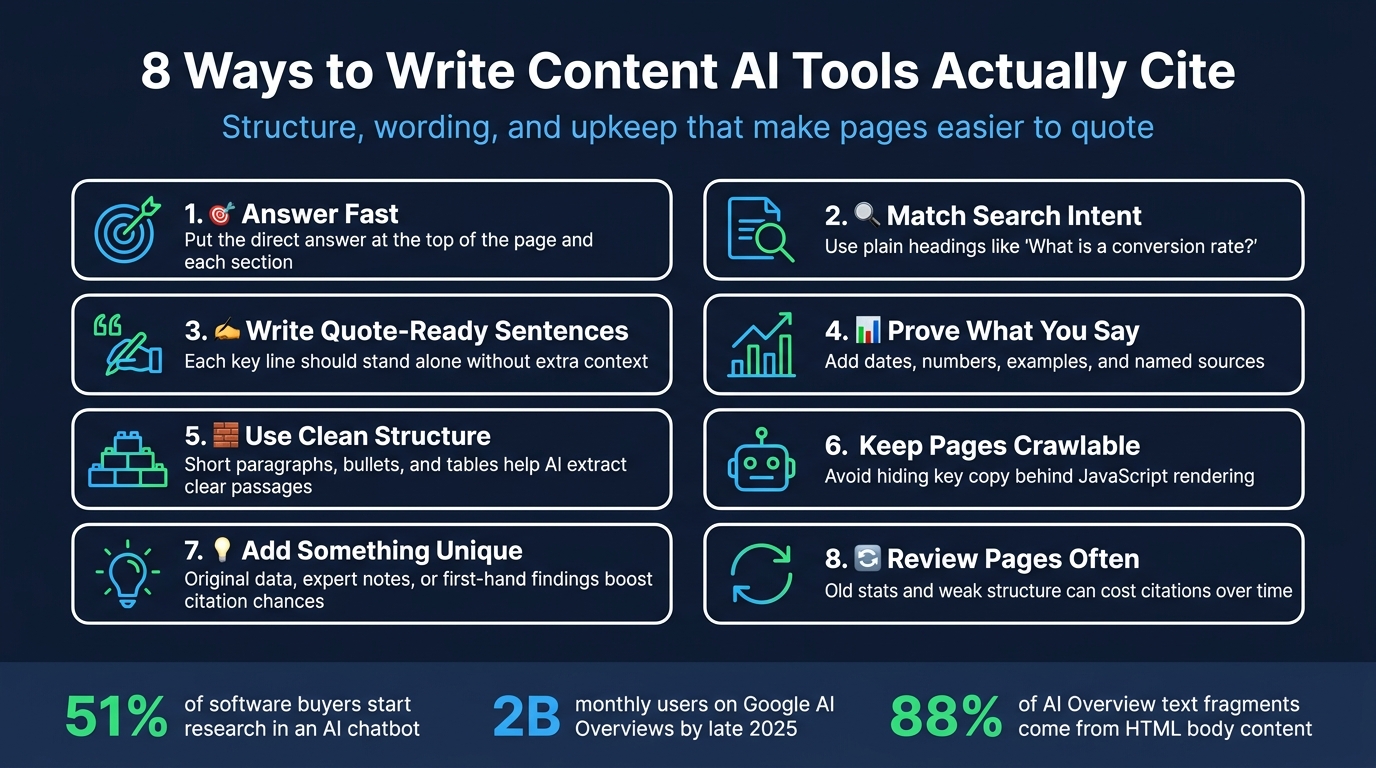
8 Ways to Write Content AI Tools Actually Cite
How you organize a page matters just as much as what you say on it. Research shows that 88% of text fragments featured in Google AI Overviews come straight from a page's HTML body content. That means your structure should make each answer easy to pull on its own.
When a page is easy to scan, each section can work as a stand-alone answer. In practice, each section should function like its own citation block.
Your H2 and H3 headings should act like signposts. Use headings that mirror the exact question each section answers. Clear labels help connect each section to a specific query.
A heading like "What is a conversion rate?" is much easier for an AI tool to match to that exact question than something vague like "Understanding Metrics."
As Jacquelyn Pica, Senior SEO Manager at Grit, puts it:
"Organize your content in a clear question-and-answer format. Provide answers in complete sentences, restating the question."
Write headings the way people type questions into search: direct, specific, and plain. Once the heading sets up the query, the first sentence should answer it right away.
Start with the answer. Put the direct response in the first sentence, then add context after that. Restate the question in that opening sentence so the meaning stays clear even if the text gets pulled out of context.
AI tools look for the most precise, self-contained answer they can quote. Complete sentences make that much easier. If the answer is clear up front, lists and tables can carry the supporting details. This approach is also effective when you boost website conversion rates by simplifying complex information for users.
Long paragraphs tend to hide the answer. Short sections that cover one idea at a time give AI tools a clean chunk to work with. If you're walking through steps or comparing options, a list or table often says it better than a wall of text.
| Format | Best Use Case | Easy to Cite |
|---|---|---|
| Short paragraphs | Definitions and self-contained claims | High - easy to quote word-for-word |
| Bullet lists | Multi-step instructions or "reasons why" | Very high - AI frequently extracts these as structured answers |
| Markdown tables | Comparisons, specs, feature breakdowns | High - especially for commercial and comparison queries |
| FAQ blocks | Top-funnel "What", "How", and "Why" questions | Very high - maps directly to how AI retrieves answers |
Still, don't cram every section into a list. Use lists for steps and side-by-side comparisons. Use direct sentences for definitions and points that need a bit more nuance.
Structure helps AI tools find the right part of a page. But your wording decides what happens next: do they quote your sentence, or move on?
Say exactly what the subject is, and say it in a full sentence. For example, "A citation-worthy page is one that answers the question in one sentence" is easy to pull and reuse. But a sentence that starts with "It refers to..." or "This means..." falls apart once it's taken out of context.
A good rule of thumb is to write each definition like a glossary entry. Keep it to one sentence. Name the full subject. Use plain English. And skip pronouns that only make sense if someone has read the line before it.
Vague statements tend to get passed over. Specific statements are much easier to check and cite. Saying "Google AI Overviews reached a milestone of 2 billion users every month by late 2025" gives an AI tool something concrete to surface.
When you use a stat, pair it with a date and a source. That makes the claim easier to verify and easier to reuse. Stick with standard U.S. formatting so the number is clear at a glance:
Name the source directly too. If a number comes from a study, publication, or organization, say so. That simple step tells both readers and AI systems that the claim can be checked.
If the point you're making is already common knowledge, add a benchmark, example, or first-hand note that gives people a reason to cite your page instead of someone else's.
Once a claim is clear and supported, the next thing that makes it worth citing is originality. That can come from proprietary benchmarks, team notes, or client patterns that other sites can't copy word for word.
A proprietary benchmark - like average engagement by content format - gives AI tools a source they won't find elsewhere. First-hand observations also help. They show direct knowledge, strengthen trust signals, and give your page a better shot at staying useful as AI tools keep favoring sources with clear proof and first-hand input.
| Content Type | Ease of Citation | Trust Value | Ideal Use |
|---|---|---|---|
| Self-Contained Definitions | High | High | Glossary sections and introductory paragraphs |
| Stats Blocks (Dated & Sourced) | High | Very High | Backing up claims with proof points |
| Original Data Studies | High | Very High | Establishing brand authority with unique findings |
Quotable copy doesn't stand on its own. The page has to do its part too. Layout, CMS setup, and page type all affect whether a page is easy to cite. At the page level, the rule is simple: give a fast answer, back it up, and make sure the content lives in crawlable HTML.
Start each page with a one- or two-sentence answer. Then show proof. Then get into the full detail.
That order matters. On a service page, the proof could be a key result or a specific capability. On a blog post, it might be a sourced stat or a direct claim with a clear date. When the top of the page works this way, AI tools have a clean passage they can pull and quote.
Topical authority matters more than sheer volume. A group of tightly focused pages on one topic, with each page covering a different angle, sends a stronger signal to AI systems than one long page that tries to do everything at once.
The same idea should shape your CMS categories. When content is organized around narrow, well-defined subjects, AI tools can more easily read the site as a trusted source for those exact topics. Internal links between related pages strengthen those ties and help AI systems see which pages belong to the same knowledge cluster. That makes each page simpler to classify, cite, and connect with related content.
Different page types serve different kinds of intent, and AI tools use them in different ways. A glossary entry may get cited for a definition. A comparison page may show up when someone is weighing options. A research-backed post may be used as evidence. A landing page may support high-intent action.
So each page type needs its own citation-ready parts. The table below maps common page formats to the intent they serve and the elements that make them easy to cite.
| Page Type | Intent Served | Citation-Ready Elements | Likely AI Use |
|---|---|---|---|
| Glossary/Definition | Informational (What is?) | Self-contained definitions, schema markup | Direct answer snippets |
| Comparison Page | Decision (Which is best?) | Markdown tables, pros/cons lists | Multi-faceted summaries |
| Research/Data Post | Evidence (Why?) | Original stats, sourced claims, "Last Updated" field | Fact-checking and verification |
| Service/Landing Page | Action (How to hire?) | Summary above the fold, proof points, crawlable pricing, FAQ section | Brand recommendations/referrals |
Make service and pricing pages crawlable in raw HTML so AI tools can read them without JavaScript.
Once a page is well structured, upkeep helps keep it ready for citation. Pages that earn citations don’t stay that way on their own. Stats get old, page structure slips, and newer sources can take your place. A simple review routine helps your best pages stay in the mix.
Start with your highest-value pages first. Focus on pages with direct answers, intent-matched headings, and dated, sourced claims.
Then check a detail many teams overlook: technical rendering. Run a curl test on your most important pages. If the output is just an empty shell, AI tools may not be able to read the page content. Add transcripts for video, alt text for images, and structured metadata when it fits.
Work with your dev team to set up server-side rendering on key pages.
Next, fix what the audit turns up: old facts, thin proof, and structure that no longer works.
Replace stale stats, sharpen weak definitions, and add new proof or commentary that makes the page more cite-worthy. If a long paragraph would work better as a table, turn it into one. Also check whether each heading still matches the intent behind the search. Topics change, and a heading that worked two years ago may not line up with how people search now.
The goal is simple: keep pages easy to quote, easy to verify, and easy to trust.
The ideas behind citation-worthy content stay the same across page types and AI tools. Answer real intent directly. Put the answer first in each section. Write sentences that can stand on their own as clear, verifiable claims. Support key claims with dates, numbers, and facts people can check. Then add something other pages don’t have - original data, a named expert's perspective, or case study data that’s yours.
Audit for clarity, rendering, specificity, originality, structure, and freshness. Pages that answer cleanly, render in HTML, and include proof are easier for AI tools to cite.
There’s no fixed timeline. AI tools usually won’t start citing a page overnight, and visibility tends to build little by little as citation patterns start to take shape.
You can improve your odds by keeping content up to date, especially pages refreshed within the last six months. It also helps to use an answer-first structure so the information is easier for AI systems to crawl, parse, and cite.
Yes. Schema markup can help AI tools cite your content more often because it gives clear, machine-readable signals about your page type, business entity, and factual relationships.
For the best shot at this, make sure the markup is validated, shows up in the initial HTML, and matches the headings and body copy people see on the page.
Prioritize pages that already perform well in search or work as direct, answer-first resources. Start with:
On each page, add a short 40- to 100-word answer near the top. Use question-led headings, and make sure the content is crawlable, schema-rich, and not dependent on JavaScript-only rendering.