





Insights
Conversion
Copy Link




Decide whether a focused landing page or a full website fits your campaign by weighing goal, traffic, buyer effort, proof, and build time.
If you want one action, send people to a landing page. If people need to research, send them to a website. That’s the short answer.
I’d make the choice based on five things:
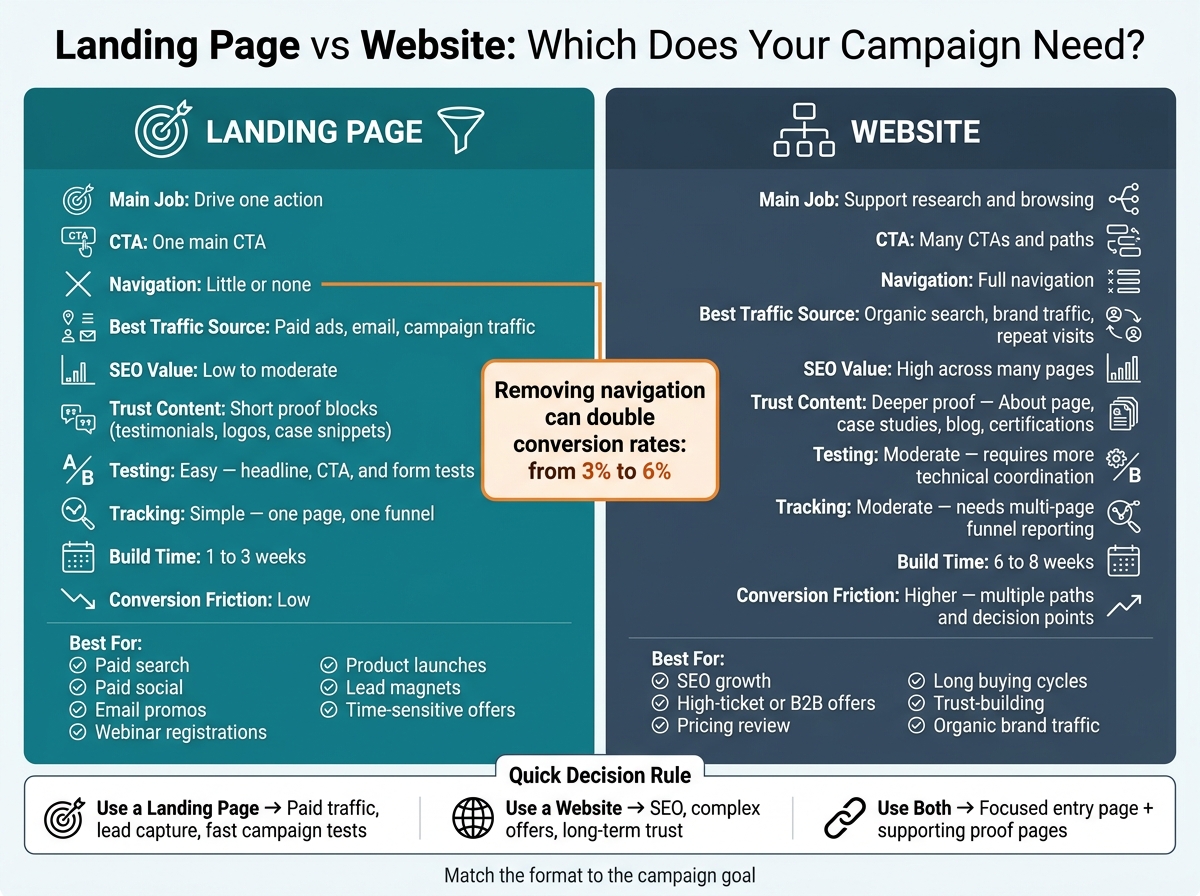
A landing page is built for focus. A website is built for browsing. That one difference affects conversion rates, tracking, SEO, testing, and build time. In one test cited in the article, removing navigation moved conversion from 3% to 6%. That’s why paid campaigns often do better with a page that has one offer and one CTA.
If I were choosing fast, I’d use this rule:
Quick Comparison
| Criteria | Landing Page | Website |
|---|---|---|
| Main job | Drive one action | Support research and browsing |
| CTA | One main CTA | Many CTAs and paths |
| Navigation | Little or none | Full navigation |
| Best traffic source | Paid ads, email, campaign traffic | Organic search, brand traffic, repeat visits |
| SEO value | Low to moderate | High across many pages |
| Trust content | Short proof blocks | Deeper proof across many pages |
| Testing | Easy headline, CTA, and form tests | More setup across page paths |
| Tracking | Simple: one page, one funnel | More setup for multi-page paths |
| Build time | 1 to 3 weeks | 6 to 8 weeks |
So if your campaign needs focus, pick a landing page. If it needs depth, pick a website. If it needs both, I’d send traffic to the landing page first and link to supporting site pages as needed.
Landing Page vs Website: Side-by-Side Comparison for Campaigns
The difference here is about structure, not looks.
A landing page is one page built for one audience, one offer, and one call to action (CTA). A website gives people more than one path, with menus, links, and extra content to click through. That setup shapes how each one performs.
A landing page is made to convert one type of visitor on one offer through one action, such as "Request a demo." It usually removes the main navigation, cuts down outbound links, and lines up the headline, subhead, and proof around that single goal.
That tight setup creates message alignment. In plain English, the page feels like a natural next step from the ad or email that brought the visitor there. If someone clicks because they want one thing, the page gives them that thing without sending them down five side roads.
The proof on a landing page stays narrow. You might include a few testimonials, client logos, or a short case snippet. That's enough to support the offer without trying to tell the whole brand story.
This format tends to work best for:
In one documented A/B test, removing navigation doubled conversion from 3% to 6%.
A website supports longer buying cycles.
Its multi-page setup lets visitors dig into product details, pricing, FAQs, case studies, blog content, and company background before they act. That extra depth matters for higher-consideration purchases like enterprise software or professional services, where people often need more than one visit before making a decision.
Websites also help with SEO. When you have many pages aimed at different keywords, plus deeper content and internal links, a website can build organic authority over time in a way a single landing page can't match. If organic search is a major channel, a website is often the better fit.
| Factor | Landing Page | Website |
|---|---|---|
| Conversion focus | Single goal, single CTA; built around one main action | Multiple goals and outcomes; conversion is one of several aims |
| Navigation | Minimal or none; few outbound links to cut distraction | Full site-wide navigation, footer links, and search to support browsing |
| Messaging control | Tight message alignment to one ad or email; all content tied to one offer | Broader messaging for many products and personas |
| Trust-building | Focused proof: testimonials, logos, and case snippets | Deeper trust assets: About page, case studies, blog, and certifications |
| SEO value | Limited keyword scope; usually tuned for paid performance | Broader SEO footprint with many pages, deep content, and internal links |
Those differences shape the next call: how much focus, proof, and flexibility the campaign needs.
The question is simple: what does this destination need to do for the campaign? That’s the whole game. The right choice depends on the goal, where the traffic comes from, and how much thinking a buyer needs to do before taking action.
A landing page makes sense when you’re running a focused paid campaign and need one offer, one CTA, and one clear result to track.
Why? Because a landing page cuts the clutter. You keep the message from ad to page tight, so nothing steals attention from the main CTA. If someone clicks because they want a specific offer, the page should stay locked on that offer.
Landing pages also work well when speed matters. They’re faster to build, easier to change, and simpler to test. You can swap a headline, trim a form, or tweak button copy and see what happens within days.
This setup fits best for:
A website is the better fit when the goal isn’t immediate action, but research.
If buyers need more than one visit before they decide, send them to a website. If the offer needs support from multiple pages, a website gives you room to do that. You can guide people through pricing context, case studies, and technical documentation without cramming everything into one page.
SEO is another big reason to use a website. A site with blog content, resource hubs, and linked service pages can bring in organic traffic over time in a way a single landing page can’t.
Sometimes you need both: the focus of a landing page and the depth of a website.
That’s where a hybrid path works well. Send campaign traffic to a focused landing page with one primary CTA, then give people a few secondary paths to the proof they may want. That could be a case study snapshot, a pricing summary, or a team overview.
The nice part is that different visitors can move at their own pace. Decisive visitors can convert right away. Research-oriented visitors can dig into the extra detail without leaving the path entirely.
Keep those secondary paths available, but make sure the main CTA still stands front and center. That’s the trade-off.
Every campaign choice comes down to a few plain questions: How fast do you need to move? How much control do you need over the message? How easy is it to see what’s working? Landing pages and websites sit at different ends of that spectrum.
A landing page keeps people on one track. A website gives them more places to click. That one difference has a big effect on how much attention your conversion goal gets.
With a landing page, you strip out most of the exits. Fewer links usually means fewer chances for visitors to drift away before they act. And every extra link creates another exit from the funnel. Industry data shows pages without navigation can roughly double conversion rates compared with pages that keep full site menus.
Speed matters too. The right format depends in part on how fast you need to launch, test, and make changes.
Landing pages usually go live in 1 to 3 weeks. Marketing websites usually take 6 to 8 weeks. That gap matters when you’re racing toward a deadline or trying to test a new offer while the market is still warm.
Websites ask for more work up front, but they can pay off over time. The trade-off is the day-to-day load that comes with them: content edits, structure changes, and approvals from multiple teams can slow things down. A landing page is often much easier to adjust. You can swap a headline, shorten a form, or change a CTA in hours without touching the rest of the site.
Fast launches are great. But speed alone doesn’t help much if you can’t tell what’s driving results.
The last trade-off is data: how easy it is to track performance and improve it.
Landing pages have a clear edge here. You usually have one URL, one main conversion event, and one funnel to watch. UTM parameters line up cleanly with each channel and ad group, so it’s easier to see which campaign drove which result.
Websites can give you the same picture, but getting there takes more setup. Multi-page journeys, assisted conversions, and cross-session behavior need event-based tracking, funnel reports, and careful tagging. The trade-off isn’t whether websites matter. It’s the extra setup needed to read the data with confidence.
Here’s a side-by-side look at the factors that matter most:
| Factor | Landing Page | Website |
|---|---|---|
| Conversion friction | Low - single goal, no navigation | Higher - multiple paths and decision points |
| Content depth | Lean - campaign-specific | Deep - CMS, multiple pages, resource hubs |
| Build effort | Low - 1 to 3 weeks | High - 6 to 8 weeks typical |
| Update speed | Fast - hours to days | Slower - structural changes take longer |
| Testing flexibility | High - easy A/B tests on headlines, CTAs, and forms | Moderate - requires more technical coordination |
| Analytics clarity | High - one funnel, one event | Moderate - needs multi-page funnel reporting |
You can make this choice pretty fast if you focus on the trade-offs. Before you build anything, answer these five questions:
If your answers pull in different directions, go with a landing page for the main CTA, then link out to proof pages that support the decision. That setup gives you focus up front without leaving people stranded when they want more detail.
If the goal needs both focus and proof, use a landing page as the starting point and send people to supporting pages for more depth.
When most of your answers point to one offer, one audience, and one action, start with a landing page. If they point to research, SEO, and depth, build the website.
Choose landing pages for focused campaigns. Use websites for research-heavy, long-term campaigns. If you need both, make the landing page the main entry point and connect it to site pages that fill in the missing detail.
Yes. A landing page can rank in search results.
Its visibility depends on page speed, site architecture, relevant content, and technical optimization. Faster load times help both user experience and search performance.
No. Your homepage introduces your business. A landing page is built to turn a visitor into a lead.
That difference matters.
A dedicated landing page keeps the headline, copy, and images in sync with the ad. It also cuts out extra distractions. And when the page matches what people clicked on, your campaign is more likely to convert.
Use your website to introduce your business. Then use separate landing pages to turn paid traffic into leads or sales.
That split matters. Your main site should help people learn who you are, what you do, and why they should care. A landing page has a narrower job: guide one visitor toward one action.
When you keep landing pages out of your main site navigation, people are less likely to drift off course. They stay focused on a single conversion goal instead of bouncing between menus, links, and extra pages. It also removes the drag that comes from asking one page to do two different jobs.
A good rule here is a clear 1:1 ratio between your conversion goal and page links. In plain English, the page should support one main action, and the message on that page should line up with the ad that brought the visitor there.