






Insights
SEO & AEO
Copy Link




A polished website isn't enough—match search intent, fix technical SEO, and build consistent local and AI-friendly signals to get found.
A good-looking website does not get you found by itself. If your pages do not match what people search for, if Google and AI tools cannot read your content, or if your business details do not match across the web, you can stay buried.
Here’s the short version:
A few numbers make the shift clear:
If I had to boil the article down to one point, it would be this: your website is now one signal in a much bigger system. To get found, I need my site, content, local listings, reviews, and page structure all saying the same clear thing.
That means less vague brand copy, more direct service pages, better site structure, faster pages, and content that both people and machines can understand fast.
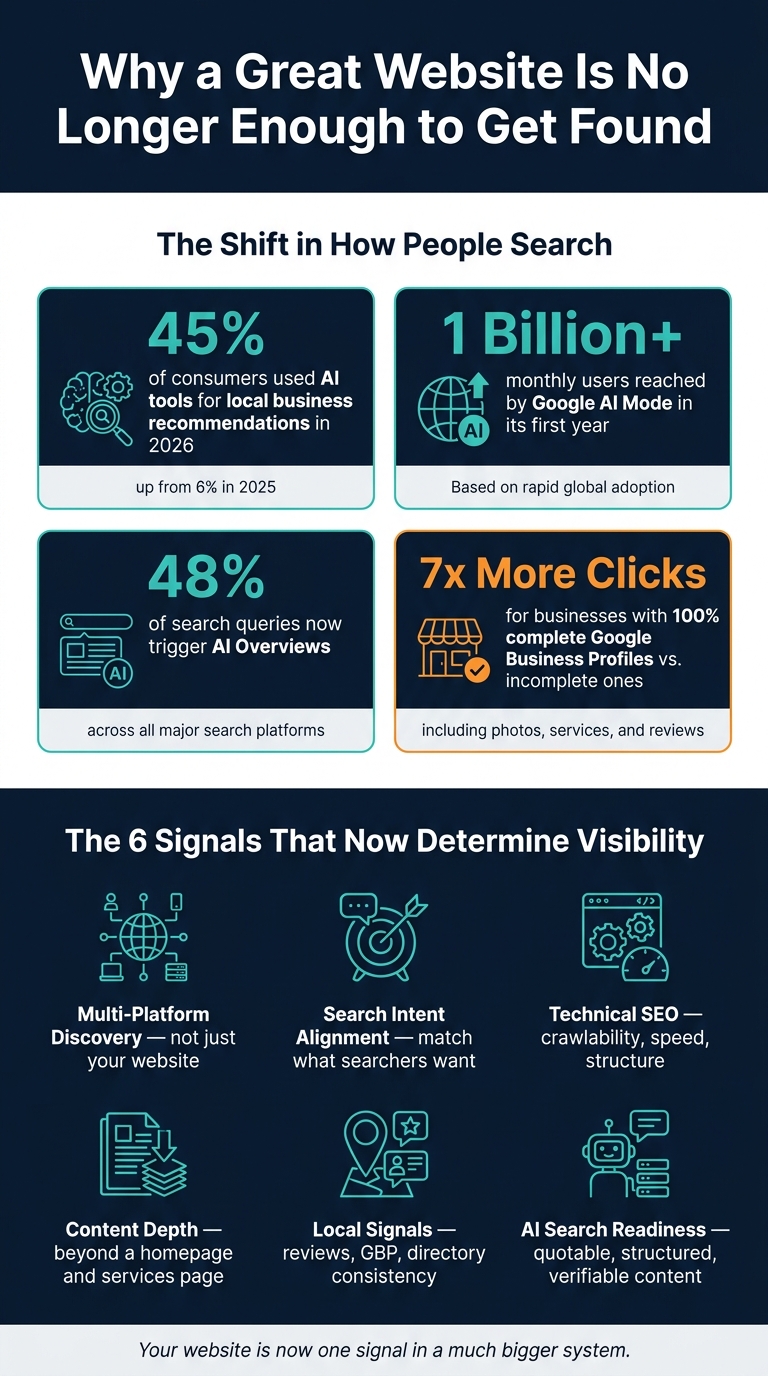
Why a Great Website Is No Longer Enough: Key Stats & Signals
A site can load fast, look sharp on every screen, and still rank poorly. That happens because search engines and AI tools don’t read a website the way people do. They look at signals like text, structure, consistency, and context to figure out what a page is about and whether it should show up at all.
So a polished design, by itself, isn’t enough. If those signals are weak, thin, or missing, the site can stay hard to find. Discovery now depends on how machines read the page, not just how people see it.
This problem often starts with the words on the page. A lot of sites open with brand-first copy like "Quality Work You Can Count On" instead of plain language like "Kitchen Remodels in Denver." For a crawler or AI search tool, that vague tagline says almost nothing about what the business does.
If a visitor can’t tell what you do within seconds, search systems usually can’t either.
Design choices can make things worse. JavaScript-heavy or image-first layouts often hide core content from crawlers. If service copy appears only after scripts run, crawlers may never see it. The same goes for key services tucked inside generic dropdown menus instead of sitting on their own crawlable pages. The page may exist, but that doesn’t mean crawlers can use it well enough to rank it.
Search engines and AI tools now judge signals that live outside the website too. If a business name, address, phone number, or other details don’t match across platforms, that can signal unreliability. And when that happens, a business may get skipped.
One stat makes the point fast: businesses with 100% complete Google Business Profiles receive 7x more clicks than incomplete profiles.
AI tools also look for outside proof, such as:
Discoverability depends on whether search systems can piece together a clear, consistent picture of what the business offers, who it serves, and where it operates across every place they check. Those signals matter, but they still need to line up with the searcher’s intent.
Even a well-built site can miss the mark if its pages answer the wrong search intent. Once a page is easy for search engines to access, intent often decides whether it gets the click. Google looks at whether a page meets the specific goal behind a query, not just whether it includes the keyword.
When there’s a mismatch, the pattern is pretty simple: someone clicks, sees that the page isn’t what they needed, and heads straight back to the search results. That tells Google the page didn’t do the job, and rankings can slip over time. So the first step is matching each page to what the searcher wants to get done.
Search intent usually fits into four buckets: informational (learning something), navigational (finding a specific brand or site), commercial (comparing options before buying), and transactional (ready to take action). A lot of service pages fall short because they talk about the company instead of answering the buyer’s question.
Here’s a case that shows the difference. In early 2026, an Austin-based wellness coach changed her homepage headline from "Supporting You on Your Journey to Better Health" to "Health Coaching for Busy Women in Austin Who Are Done Yo-Yo Dieting." Her landing page conversion rates nearly doubled within two months. The page structure stayed the same. The big shift was that the message matched the search better.
This matters even more now that AI tools are showing up inside search. An estimated 48% of all search queries now trigger Google AI Overviews. If a page reads like a mission statement, AI systems don’t have much clear material to pull from or cite.
The fix is pretty direct: rewrite titles, headings, and opening lines around what buyers type and ask. Swap vague headers like "What We Do" for specific ones like "Emergency AC Repair for Coastal Homes." And make sure the first sentence of each section gives a straight answer. AI tools often pull standalone chunks of content, so each section needs to make sense by itself.
Use this map to line up page type with search intent:
| Page Purpose | Search Intent | Likely Visibility Outcome |
|---|---|---|
| Brand statement (taglines, mission fluff) | Navigational | Low visibility for generic service queries; skipped by AI engines |
| Educational/FAQ (direct answers to "how" or "why") | Informational | High chance of appearing in AI Overviews and "People Also Ask" |
| Service/pricing guide (cost factors, comparisons) | Commercial | Cited by AI for cost queries; higher trust and conversion for humans |
| Action-oriented (online booking, "Call Now") | Transactional | High conversion from Maps and voice search; supports booking through AI assistants |
Once a page lines up with search intent, technical SEO often decides if search engines can find it, read it, and rank it. A site can look polished and still stay buried if search systems can't crawl it, make sense of it, or trust its signals. Search engines work from HTML, links, and structured data, not design flair. If those pieces are weak or broken, even a well-designed site may never get the traction it should.
Blocked indexing, orphan pages, duplicate titles, thin metadata, and broken redirects can keep strong pages out of search altogether.
Site migrations are a big risk too. If a business relaunches its website and doesn't set up redirects from old URLs to new ones, it can lose the visibility those pages had built over time. That equity doesn't move on its own.
Heading structure matters more than many teams think. H1, H2, and H3 tags help search systems figure out what a page covers and which parts may answer a query. A page that hides its main service under a vague heading like "Our Approach" gives search engines almost nothing useful. If a system can't tell what a business does, where it works, and why people should trust it in one pass, the odds of showing up in results can fall fast.
A good audit should look for orphan pages, broken redirects, and duplicate metadata. Each service page and location page should be reachable through at least one crawlable internal link. And each page needs its own title tag and meta description built around a specific search term.
Even if a page can be indexed, slow load times can still hold it back in search and hurt clicks.
Speed affects visibility and conversion at the same time. Google's Core Web Vitals give a clear target: Largest Contentful Paint (LCP) should load in under 2.5 seconds. Miss that mark, and a page can lose ground before its content even gets a fair shot.
The usual culprits are oversized images, third-party scripts loading before the main page content, and layout shifts caused by images, ads, or embeds with no set dimensions. Cumulative Layout Shift (CLS) is especially rough on mobile. When buttons and text jump around while the page loads, people leave. Conversions usually fall with them.
Performance isn't just a search issue. It's a user issue too.
| Performance Metric | What It Measures | Fix |
|---|---|---|
| LCP (Speed) | Main content load time | Optimize images, use a CDN, minimize JS |
| CLS (Stability) | Layout shift during load | Set explicit dimensions for media and ads |
| INP (Responsiveness) | Interaction response time | Reduce main-thread work and JS execution |
From there, content depth and site structure shape how much authority those pages can build.
Once you’ve fixed the technical problems, depth and structure start doing a lot of the heavy lifting.
A lot of polished sites still lean on the same thin setup: a homepage, a generic “Services” page, and maybe a contact form. That isn’t enough. It gives search systems too little context to map the business, understand who it serves, or connect the site to the searches it should show up for.
One services page can’t do the work of several focused pages. Each core service needs its own page. That page should clearly name the service, explain who it’s for, spell out the problem it solves, and answer the questions buyers ask before they hire someone.
That also means including details people look for when they’re close to making a choice, like:
If that kind of detail is missing, AI tools have less reason to cite the page.
Supporting content matters just as much. Blog posts and FAQ pages can answer pre-sales questions like cost factors, timelines, and what the process looks like. That gives search engines more chances to surface the business for a broader set of searches.
The point isn’t to publish more pages just to have more pages. The point is simpler than that: make sure the site can answer the questions buyers are already asking.
The way pages connect tells search engines what topics the site covers and which pages matter most. A flat list of disconnected landing pages doesn’t say much.
A better setup is a hub-and-spoke structure. One parent hub page covers a broad topic. Under that, related service pages, location pages, and support articles link into the same section. Internal links should move both ways: from the hub to the detailed pages, and from those pages back to the hub.
That setup helps crawlers see topic clusters more clearly. It also helps search systems understand the full range of what the business offers.
Navigation should follow the same logic. Group related services under clear parent categories instead of spreading them across a flat menu. URL structure should match too: descriptive, consistent, and arranged so each page’s purpose is obvious at a glance.
When the structure is clear, search systems have an easier time figuring out which page should answer which query.
Even a strong site can stay invisible if off-site trust signals are weak. Once your site structure is clear, the next gap usually sits outside your website. Search systems and AI tools check what your site says against what the rest of the web says about your business.
Start with the basics: your business name, address, and phone number. They should match across your website, Google Business Profile, Yelp, Apple Maps, and any industry directories where you're listed. Even small formatting differences can create noise. And when data conflicts, AI systems may skip a business instead of citing something that could be wrong.
Recent, location-specific reviews also send a stronger signal for local and AI visibility. A review that mentions both the service and the place, like "best HVAC repair in Austin", gives AI systems much clearer context than a generic five-star comment.
After trust signals, the next problem is simpler: can AI cleanly pull information from the page?
AI tools tend to favor pages they can quote directly. So your pages should use clear definitions, short stand-alone sections, and plain language that doesn't rely on extra context.
Schema markup in JSON-LD helps with this. Adding LocalBusiness, FAQPage, and Service schema gives AI systems a machine-readable version of your business details. That makes pages easier to read and cite, and it cuts down confusion about what you do, where you work, and who you serve. If your business needs professional licensing, like healthcare or legal services, adding license numbers directly in your structured data gives AI systems a hard verification signal they can use.
Audit consistency, schema, and extractable content. Then fix the pages that matter most for local and AI discovery. The fix isn't more design polish. It's stronger signals across the web.
A great website isn’t enough anymore. The way people find businesses has shifted past the old search-and-click pattern. Before someone ever lands on your site, they may size you up through AI-generated answers, map results, reviews, and social posts.
Your website still matters. It works as a central place where people can check who you are and decide if they trust you. But in many cases, it’s no longer the first stop.
AI search tools like ChatGPT, Perplexity, and Google AI Overviews tend to favor businesses that are clearly defined, well organized, and able to answer specific questions in a direct way.
Start with your base data before you spend time on content or rankings. Run a technical and data audit so your business details are accurate, consistent, and easy for machines to read.
First, claim and fill out your Google Business Profile. Then check your schema markup and fix technical issues like broken links and mobile usability problems.
AI tools are changing local search. Instead of showing a plain list of links, they often give direct answers and hand-picked recommendations pulled from more than one source.
That changes how businesses need to show up.
To appear in those answers, businesses need structured data that search systems can read with ease. They also need consistent name, address, and phone details across the web. On top of that, they need detailed content that answers specific questions people are asking, plus strong third-party trust signals like reviews and local mentions.