



Insights
SEO & GEO
Copy Link




Why ranking high on Google doesn't ensure AI citations — how to format pages so they're both rankable and easily quotable by AI.
Ranking on Google and getting cited by AI are not the same job. A page can rank well in search and still get skipped by ChatGPT, Gemini, or Perplexity.
Here’s the short version:
So if I want pages to win in both places, I need to do two things at once:
The article’s main point is simple: SEO helps you get found, but AI citation depends on answer format, structure, entity clarity, first-party proof, and bot access. That means direct answers near the top, clean headings, schema markup, crawlable HTML, and short sections that stand on their own.
A page that says a lot is not always a page AI can use. A page that states the answer fast, backs it up, and stays easy to crawl has a much better shot.
| System | What it looks for | What often wins |
|---|---|---|
| Relevance, backlinks, internal links, mobile performance, crawlability | Pages that match search intent and build authority | |
| AI tools | Extractable facts, structure, entity clarity, authorship, bot access | Pages with short answers, lists, tables, schema, and clear evidence |
If I had to boil the article down to one line, it would be this: Google rewards rankable pages; AI rewards quotable pages.
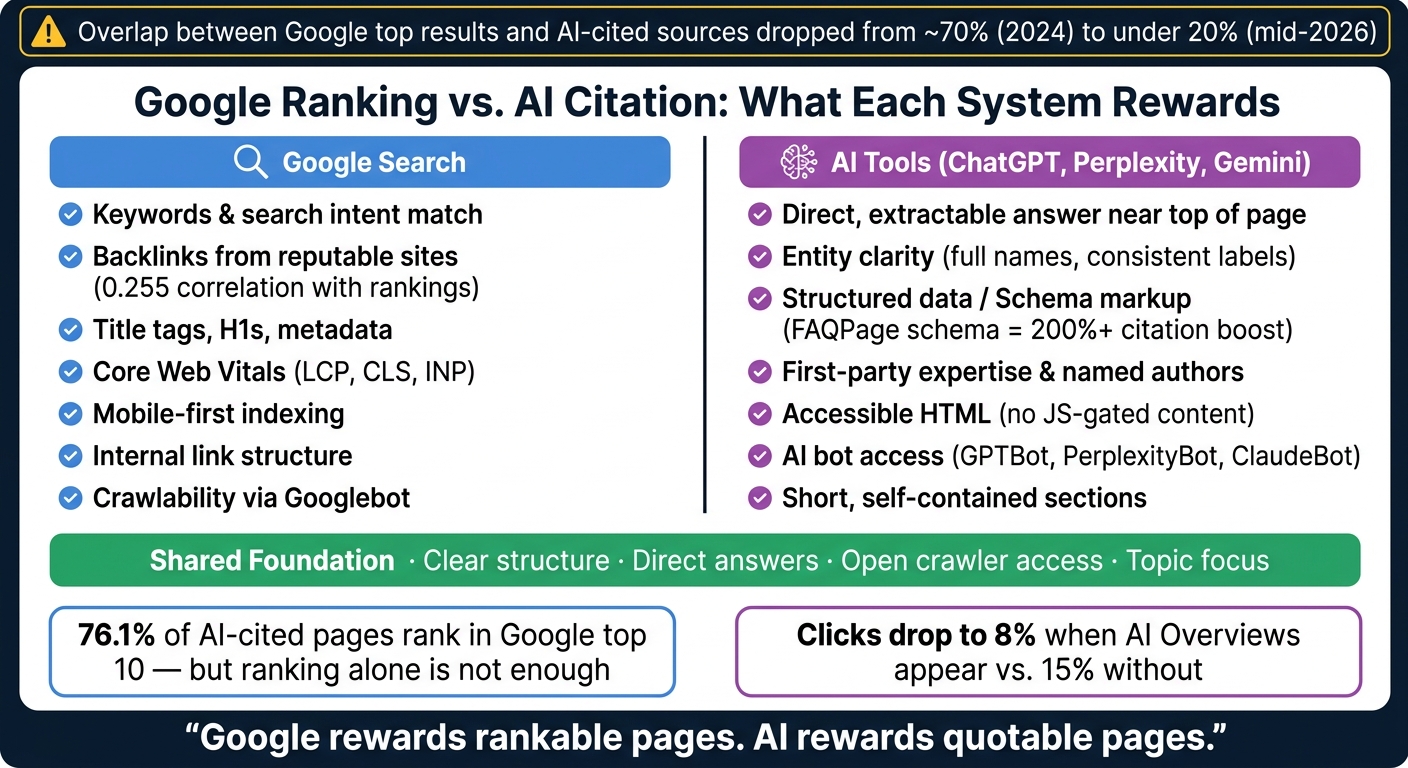
Google Ranking vs. AI Citation: Key Signals Side by Side
Google’s organic search system is built around individual URLs, not whole websites. When someone types a query, Google compares specific pages to that query using three broad signal groups: relevance, authority, and technical quality. That’s why a smaller page can beat a bigger site if it lines up better with search intent.
The clearest way Google figures out what a page covers is by reading the page itself. Target keywords show which queries a page should compete for, while related terms and entities across the page help Google understand the broader topic. For example, a page targeting “B2B lead generation” should also naturally mention terms like “MQL,” “sales pipeline,” and “demand generation.” That gives Google more context and helps confirm the page’s topic.
Title tags, H1s, and H2s should say the topic plainly. Meta descriptions can help win clicks, but they don’t directly affect rankings. Stick with one H1 and use subheads that describe what each section covers.
Content depth matters too. Google’s quality guidelines tend to favor pages that answer the query fully. That often means including definitions, steps, examples, and edge cases. Word count by itself isn’t the point. What matters is whether the page does the job. If a page only answers part of the question, it’s less likely to meet intent than a page that explains the topic in a clear, complete way.
Internal links play a big part here as well. Use descriptive anchor text, keep key pages within three to four clicks of the homepage, and make the relationship between topics easy for Google to follow.
Once Google understands the page, it still looks at outside trust signals.
Google also looks at which relevant sites link to a page. Backlinks from relevant, reputable sites work like endorsements. Ahrefs data shows that the number of referring domains linking to a page has a correlation of 0.255 with search rankings.
Then there’s the technical side. If Google can’t access a page, it can’t rank it. Crawlability means Googlebot can reach and read the page. Indexability means Google can store that page and use it in search results. Both can break because of robots.txt, noindex, or missing sitemaps. Canonical tags matter too. They tell Google which version of a page is the main one, so duplicate versions don’t split authority across multiple URLs.
Page experience also comes into play through Core Web Vitals and mobile performance. Google indexes and ranks the mobile version first, so mobile usability isn’t optional. The three metrics Google tracks are Largest Contentful Paint (LCP), Cumulative Layout Shift (CLS), and Interaction to Next Paint (INP). Slow assets, layout shifts, and heavy scripts can drag down those scores - and hurt rankings.
These signals shape how Google ranks pages, but AI systems pick sources by a different set of rules.
Unlike Google, AI systems don't just lean on ranking strength. They look for sources that directly support an answer, then cite the ones that say it most clearly.
In practice, these tools retrieve pages, re-rank them, pull out the useful parts, combine them, and then cite sources based on answerability rather than raw search position. So visibility depends on whether a page offers clear, extractable evidence.
A page can still be retrieved and never get cited. That usually happens when the useful information is buried under marketing copy, hard to pull out, or too vague to quote cleanly.
AI systems lean toward pages that are easy to read and interpret.
Topical clarity matters a lot. Each page should cover one clear subject, with headings and sections that line up with specific questions, even if that page already ranks well in Google. Descriptive headings, lists, and tables help because they make the page easier to extract.
Entity recognition matters just as much. Full names, steady labels, and short definitions help the model pin down what you're talking about. For example, writing Google Search Console (GSC) instead of only using the acronym lowers the odds of confusion.
First-party expertise often makes the difference between a source that gets cited and one that feels generic. Named authors, clear company or site details, and original data all point to direct experience.
During synthesis, the model looks for short, plain statements it can quote directly. A two-sentence definition near the top of a page has a better shot at getting cited than that same definition buried deep inside a long article.
The pattern that tends to work best is simple:
That makes structure almost as important as the information itself.
Narrative copy can still work, but only when the answer is easy to extract.
Strong Google rankings help, but they don't lock in AI citations.
Ahrefs found that 76.10% of pages cited in AI Overviews rank in Google's top 10. At the same time, 14.40% of those cited pages don't rank above position 100 at all. BrightEdge saw a similar split: only 54.5% of AI Overview citations match organic rankings.
So yes, ranking puts you in the running. But it doesn't mean AI will pick your page. If you want citations, the page can't just rank well. It also needs to be easy to quote.
A common gap shows up in long-form pages built for tough keywords. A service page or pillar page might rank for a broad term, but AI may pass it by if the answer is buried in the intro instead of stated in a short, direct definition.
AI also misses pages when the content is hard to reach, loaded after the page opens, or too broad for a tight question. Some AI crawlers use different access rules, so they may miss content behind logins, PDFs, or JavaScript-heavy widgets, even when Google still ranks the page. And while broad guides can do well in search, narrow prompts often push AI toward the page that sticks to one topic and gives one direct answer.
Schema is another dividing line. Google can rank a page from plain text alone, but AI systems have a much easier time citing pages when structure, authorship, and page type are spelled out.
You can see the gap more clearly when the signals sit next to each other.
| Signal | Google ranking | AI citation | Where they diverge |
|---|---|---|---|
| Keywords | Strong relevance signal | Helpful, but not enough alone | A page can rank on keyword alignment yet still fail to supply a liftable answer. |
| Backlinks | Major authority signal | Indirect at best | AI systems lean toward source trust and factual corroboration over raw link equity. |
| Metadata | Supports indexing and snippets | Helps classification and attribution | Schema and clear titles make a page easier for AI to interpret. |
| Crawlability | Essential | Necessary but not sufficient | A crawlable page may still be ignored if the answer isn't extractable from accessible HTML. |
| Internal links | Builds topical structure | Helpful for topic reinforcement | AI citations depend on quotable passages, not just topical grouping. |
| Entity clarity | Less direct | Very important | Clear brands, people, and topics make source attribution easier for AI. |
| Structured data | Helpful | Very helpful | Schema helps AI classify page type and content purpose. |
| First-party expertise | Supports E-E-A-T | Strong citation advantage | Original data and identifiable authors create source-worthy evidence. |
| Quotable answers | Helps snippets | Required for citation | AI systems need compact, self-contained facts they can cite directly. |
| AI bot access | Not a classic SEO factor | Critical for some systems | If AI crawlers can't reach the page, it may never be cited regardless of ranking. |
That's why a page can pull in search traffic and still get passed over for AI citations.
The gap between ranking well and getting cited often comes down to one simple thing: is the page built to be quoted? If not, it may still rank in Google, but AI tools may skip right past it. The fix is pretty practical. Build pages so they are easy to parse, quote, and crawl.
Start with a single page topic. Make that topic plain in the H1, the opening paragraph, and at least one section heading. Google uses those signals to match search intent. AI systems use them to judge whether the page gives a clear answer to one main question.
Add a direct-answer block near the top. A short 2- to 4-sentence answer near the beginning gives AI tools a clean passage to extract and cite. Think of it like putting the headline answer on the table right away instead of making the reader dig for it.
Schema markup should be part of the baseline. Add Organization, Service, Article, and FAQPage schema at the CMS collection level so it scales as new pages go live. In one analysis of ChatGPT, Perplexity, and Claude citation patterns, FAQPage schema implementation was associated with a 200%+ increase in the chance of being cited by AI compared with similar pages that lacked it. On Webflow, this works best when the schema lives at the CMS collection level.
Technical access matters for AI, not just Google. AI tools can only cite content their crawlers can reach, including GPTBot, OAI-SearchBot, PerplexityBot, Googlebot-Extended/Google-Agent, and ClaudeBot. If those bots are blocked in robots.txt, or if the main content only appears through JavaScript, the page may never get cited no matter how well it ranks.
Use descriptive anchor text to connect service pages, case studies, and educational content. That helps AI follow the topic cluster and understand how the pages relate to each other.
The difference is easier to see side by side.
| SEO-Ready Site | SEO and AI-Ready Publishing System | |
|---|---|---|
| Content architecture | Keyword-focused pages and blog posts, loosely connected | Topic hubs, structured CMS collections (services, case studies, FAQs, AI-ready pages) with clear relationships |
| Schema and entities | Basic Organization and Article schema | Organization, Service/Product, FAQPage, BreadcrumbList, with consistent entity references across all content |
| Answer-first pages | Narrative copy, main answer often buried mid-page | Direct-answer blocks near the top, clear Q&A sections, comparison tables AI can extract |
| Technical crawler access | Optimized for Googlebot and Bingbot | Managed for AI crawlers with semantic HTML and less JavaScript for core content |
| Optimization workflow | Periodic keyword updates and backlink building | Schema expansion, entity signal audits, FAQ and answer section updates aligned with how users query AI tools |
Google ranks pages. AI systems extract and cite sources. That sounds close, but the job is not the same. A page built only for one system will often lag in the other.
To do well in both, pages need clear structure, direct answers, and open crawler access. That shared base is what gives a page a better shot at both search visibility and AI citations.
Check whether each page uses an answer-first structure: a question-style heading, followed right away by a short 40- to 60-word summary.
Also make sure the page is crawlable, centered on one clear user intent, uses schema markup, and backs up key claims with visible primary evidence or authoritative sources. If the topic or proof is hard to spot without scrolling, the page likely needs clearer headings.
Use schema markup that gives machine-readable context and clearly identifies your content. Match the schema type to the page. Common options include:
It also helps to add Organization and Person schema to support identity and credentials.
One thing matters a lot here: your markup should line up with the page itself. That means the schema needs to match your copy, headings, and metadata. If those pieces don’t agree, search engines can get mixed signals.
Before publishing, validate the markup and check for errors. Make sure every field reflects what’s actually on the page.
Yes. A small site can be cited by AI even if it doesn’t rank first. That’s because AI systems focus on answer selection, not just organic position.
In plain English: a lower-ranked page can still get picked if its content is easier to pull, check, and use.
To improve your odds, make the answer easy to find and easy to trust:
That structure helps AI systems extract the key point without digging through extra copy.